

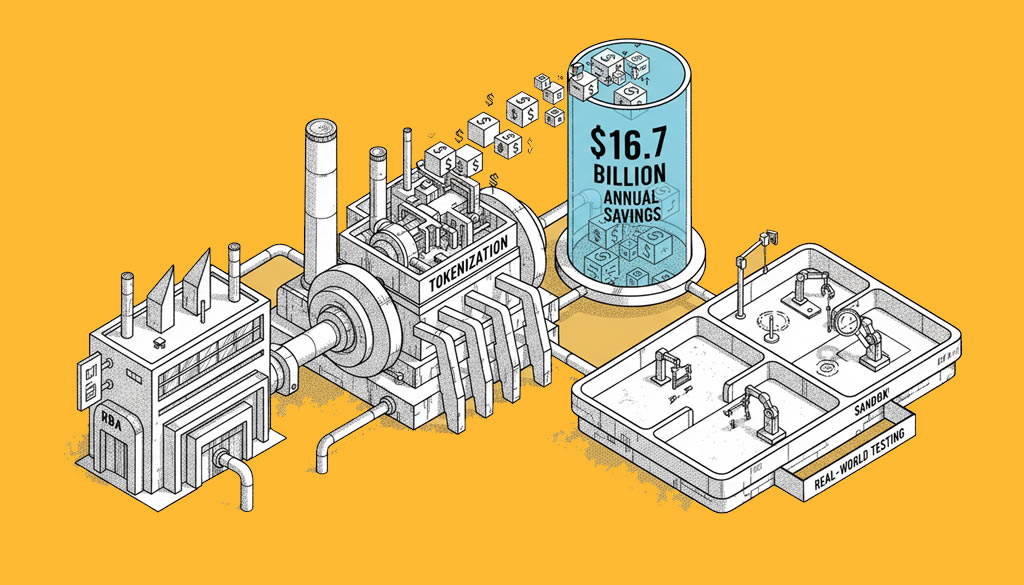
- Economic impact: Tokenization could save the Australian economy AU$24 billion ($16.7 billion) annually by eliminating manual processing, settlement delays, and capital costs in wholesale markets.
- DFMI sandbox: New long-term, stage-gated testing environment for tokenized government bonds, investment funds, and settlement using stablecoins or bank deposit tokens.
- Stablecoin role: Complementary to bank deposit tokens; suited for smaller greenfield markets while regulated deposit tokens handle larger volumes.
- Project Acacia: Examined 20 use cases across tokenized bonds, repos, funds, and private money settlement on distributed ledgers.
- Next steps: RBA to form Regulator-Industry Tokenisation Advisory Group and expand Deposit Token Working Group for interoperability.
Australia’s central bank has moved from exploratory trials to concrete implementation of tokenized finance, projecting substantial economic gains and unveiling a dedicated sandbox for live testing.
Analysis by the Digital Finance Cooperative Research Centre (DFCRC) estimates that transitioning to tokenized money and assets could generate roughly AU$24 billion ($16.7 billion) in annual efficiency savings for the Australian economy through reduced friction in wholesale markets. The figure, cited in Assistant Governor Brad Jones’ speech on March 25, could rise further with new markets and second-round effects.
The findings stem from Project Acacia, a collaborative effort between the Reserve Bank of Australia (RBA), DFCRC, and industry participants that evaluated 20 use cases involving tokenized government and corporate bonds, repos, bank term deposits, investment funds, and settlement in stablecoins, bank deposit tokens, or wholesale central bank digital currency.
In the official speech, Jones signaled a policy pivot: “We are moving from the era of ‘what if’ to the era of ‘how to.’” He noted stablecoins could serve niche roles in smaller greenfield tokenized markets, while prudentially regulated bank deposit tokens would scale more effectively in larger ones due to existing trust and liquidity facilities.
To operationalize these insights, the RBA will partner with Council of Financial Regulators agencies and industry to establish a Digital Financial Market Infrastructure (DFMI) sandbox. The long-term, stage-gated environment will allow banks and fintechs to test tokenized products under supervision, with pathways to production. Additional initiatives include a joint Regulator-Industry Tokenisation Advisory Group to tackle legal and regulatory hurdles, and an expanded Deposit Token Working Group focused on interoperability between bank-issued tokens.
The Block reported that industry participants view a wholesale CBDC as “potentially helpful, but far from essential,” pointing to U.S. tokenized repo markets already reaching significant daily volumes. The RBA also plans to review exchange settlement account access policies following pending payment service provider licensing reforms.
While challenges remain—including interoperability between legacy and distributed ledger systems, legal uncertainties around smart contracts, and liquidity fragmentation—the RBA emphasized that tokenization is no longer a question of viability but of execution and scaling.
Disclaimer: This article is for informational purposes only and does not constitute advice of any kind. Readers should conduct their own research before making any decisions.