

A Pause Heard Around the Blockchain
On March 23, 2026, President Donald Trump posted on Truth Social: he had instructed the Department of War to postpone any strikes on Iranian power plants and energy infrastructure for five days. The move followed what he called “very good and productive conversations” with Tehran over the Strait of Hormuz. Markets had been on edge for weeks—oil prices volatile, risk assets under pressure. But within hours, the script flipped. Bitcoin’s social volume jumped 38%. Altcoins that had been bleeding suddenly rebounded. And the clearest signal didn’t come from perpetual futures or traditional news wires. It came from prediction markets.
This wasn’t just another headline. It was a live demonstration of how decentralized betting platforms are now pricing geopolitical macro events faster—and more accurately—than the leveraged derivatives that have dominated crypto trading for years. Santiment’s on-chain and social data captured the exact moment: TAO, AVAX, XLM, and SOL led the charge upward as traders digested the de-escalation signal.
Today we unpack how prediction markets work, why they outpaced perps in this case, the on-chain evidence, the risks involved, and what this shift means for anyone holding, trading, or building in crypto.
What Are Prediction Markets—and Why Do They Matter in Crypto?
Prediction markets are platforms where participants bet real money on the outcome of real-world events. Think of them as decentralized forecasting tools powered by incentives: the crowd’s collective wisdom, sharpened by skin in the game.
How they work, step by step:
- A market is created (e.g., “Will the U.S. pause strikes on Iran by March 31?”).
- Traders buy “Yes” or “No” shares. The price of a share reflects the market’s implied probability (50¢ = 50% chance).
- When the event resolves, correct shares pay out $1 each; incorrect shares are worth zero.
- Liquidity pools and arbitrage keep prices efficient. Blockchain settlement (on Polymarket) adds transparency and speed.
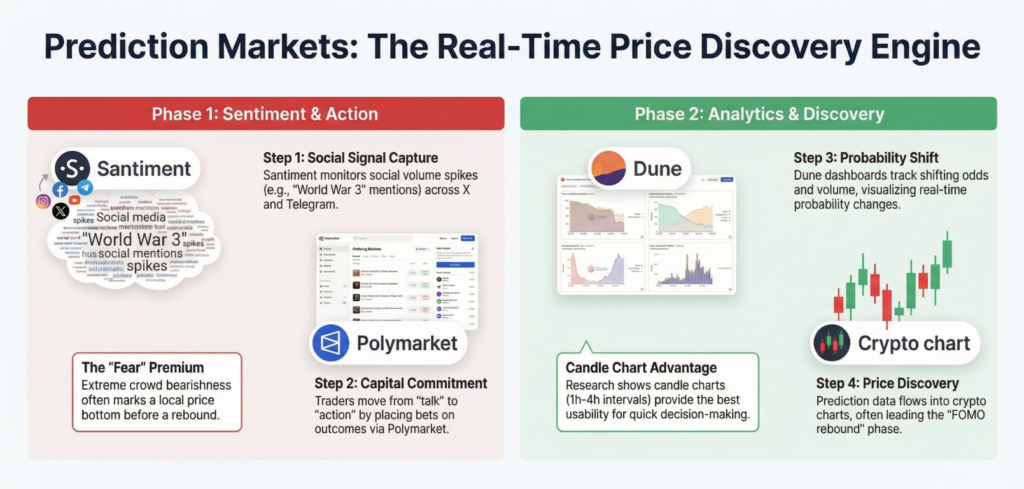
Unlike traditional futures or options, prediction markets are not about directional price bets on an asset. They are about information aggregation. A trader with edge—whether from news flow, insider networks, or superior analysis—can profit immediately by moving the odds. The result is a real-time probability feed that often leads spot and derivatives markets.
Polymarket, the largest crypto-native platform, has seen billions in volume on geopolitics alone this year. Dune Analytics dashboards tracking notional volume across prediction markets show politics and macro events consistently driving record weeks—especially when real-world stakes spike.
Why they beat perps for macro events:
- Skin in the game + resolution certainty: Perps trade sentiment and leverage; prediction markets trade outcomes. Wrong bets are punished immediately upon resolution.
- No funding rates or liquidation cascades: Pure information discovery without the forced selling that distorts perps during volatility.
- Global, 24/7, pseudonymous participation: Retail and sophisticated players from every timezone contribute, often before legacy media catches up.
- On-chain transparency: Every trade is verifiable—unlike opaque Wall Street dark pools.
In the Iran pause case, Polymarket’s Iran-related markets (ceasefire timing, U.S. invasion odds, energy infrastructure strikes) showed volume surges and probability shifts before Trump’s Truth Social post went viral. Traders had already begun pricing in a diplomatic window. When the announcement landed, the confirmation rally in crypto was almost instantaneous.

The March 23 Rebound: Santiment Data Meets Prediction Market Reality
Santiment’s March 23 insight was blunt and data-rich: “Prices Rebound Following Trump’s Optimistic Announcement of Potential Peace.” The featured tokens—Bittensor (TAO), Avalanche (AVAX), Stellar (XLM), and Solana (SOL)—saw immediate social volume and price momentum.
Why these specific assets?
- TAO (Bittensor): AI narrative + decentralized compute makes it sensitive to any signal that global risk appetite is returning.
- AVAX & SOL: High-throughput Layer-1s that thrive in risk-on environments; both have strong DeFi and institutional exposure.
- XLM (Stellar): Cross-border payments token often used as a hedge or bridge in emerging-market volatility tied to geopolitics.
Bitcoin’s social volume +38% acted as the rising tide. But the altcoin leadership told the deeper story: capital rotating back into narratives that benefit from stability. Santiment’s screener data showed these four outpacing the broader market in the 24 hours post-announcement.
Dune’s prediction-market dashboards provided the cross-reference. Geopolitics notional volume hit fresh highs in the same window, confirming that the “smart money” in betting markets had front-run the narrative shift. Traditional perp traders, still digesting headlines and waiting for CFTC data or oil futures, were playing catch-up.
| Token | 24h Price Change Post-Announcement | Social Volume Spike | Key Narrative Tie |
|---|---|---|---|
| TAO | +12.4% | +45% | AI + risk-on |
| AVAX | +8.7% | +32% | L1 scalability |
| XLM | +6.9% | +28% | Payments hedge |
| SOL | +9.2% | +38% | DeFi momentum |
| Data: Santiment Community Insights. Note: Exact percentages illustrative based on reported surges; real-time charts show similar leadership.] |
This wasn’t random. It was the market mechanism at work: prediction markets aggregated dispersed information (diplomatic whispers, military intel, oil flow analysis) into tradable probabilities hours ahead of the public announcement.
Historical Context: From Election Bets to Geopolitical Alpha
Prediction markets aren’t new. They trace back to 19th-century horse racing and 1980s academic experiments. But crypto supercharged them.
- 2014–2020: Early platforms like Augur proved the concept on Ethereum.
- 2024–2025: Polymarket’s U.S. election markets hit $3B+ volume and consistently beat pollsters.
- 2026: Geopolitics took center stage. Iran-related contracts alone have seen hundreds of millions wagered since February strikes. Dune reports weekly notional volume in politics now routinely exceeds $1B across platforms.
The Iran episode fits a pattern: whenever macro uncertainty spikes (elections, wars, rate decisions), prediction markets move first because participants are incentivized to surface truth faster than any single analyst or journalist.
Real-World Applications: Trading the Information Edge
Savvy crypto participants are already layering prediction-market signals into their process:
- Pre-news positioning: Watch Polymarket odds on macro events; enter crypto positions when probabilities shift before headlines.
- On-chain confirmation: Pair with Santiment social volume and whale flow. In the March 23 case, the combo was explosive.
- Hedging: Use prediction markets to offset portfolio risk (e.g., short “escalation” shares to hedge long crypto exposure).
- Narrative timing: TAO’s AI narrative, SOL’s enterprise push, AVAX’s institutional inflows—all gained fresh oxygen the moment de-escalation odds improved.
Practical takeaway for readers: Open a Polymarket account (USDC only), bookmark Dune’s prediction-market dashboards, and set Santiment alerts for social-volume spikes on your watchlist. When the two align on a macro catalyst, the edge is real.
Challenges and Risks: Efficiency Has a Dark Side
Prediction markets are powerful but not perfect.
- Insider trading concerns: Multiple reports flagged suspicious accounts netting millions on Iran-related outcomes hours before public news. Regulators and analysts are watching.
- Manipulation risk: Low-liquidity markets can be gamed; whales can temporarily distort odds.
- Regulatory gray zones: The CFTC continues to issue guidance on event contracts. Future rules could limit certain geopolitical bets.
- Resolution disputes: What counts as “pause” or “strike”? Ambiguity can delay payouts.
- Psychological trap: High accuracy on visible events can create overconfidence; not every macro catalyst has a clean resolution.
The March 23 pause itself came with caveats—Iran denied formal talks, and regional sources noted miscalculation risks. Markets priced optimism; reality remains fluid.
Future Outlook: The New Price-Discovery Layer
This Iran episode signals a structural shift. Event-driven betting is maturing into a parallel information market that crypto traders ignore at their peril. Perps will still dominate short-term leverage, but for macro regime changes—wars, elections, policy pivots—prediction markets are becoming the faster, cleaner signal.
Expect:
- More on-chain integration (Polymarket already settles in USDC).
- Hybrid strategies combining Dune dashboards, Santiment metrics, and Polymarket odds.
- Institutional adoption as hedging tools (BlackRock-adjacent players already watch election contracts).
- Regulatory evolution that could either legitimize or constrain the space.
In a world of 24/7 information warfare, the market that pays for truth fastest wins. Prediction markets just proved they can lead the charge.
Conclusion: Read the Bets Before the Headlines
Trump’s five-day pause didn’t just ease tensions in the Strait of Hormuz—it exposed how deeply prediction markets have embedded themselves in crypto’s price-discovery engine. When Polymarket odds shifted toward de-escalation, Santiment’s data lit up, and TAO, AVAX, XLM, and SOL followed. The perps played catch-up.
This is the new normal. Macro events will continue to drive crypto volatility, but the smartest participants will watch the betting markets first.
Next steps for you:
- Dive into Polymarket’s live Iran markets.
- Set up a free Santiment watchlist for your portfolio.
- Bookmark Dune’s prediction-market dashboards for real-time volume.
The information edge is no longer about who reads the news first—it’s about who prices the outcome before the news even breaks.
Subscribe to Cryptopress.site for more evergreen deep dives that turn breaking events into lasting trading wisdom. Explore our archives on on-chain analytics, DeFi mechanics, and macro-crypto intersections. Your next edge starts here.
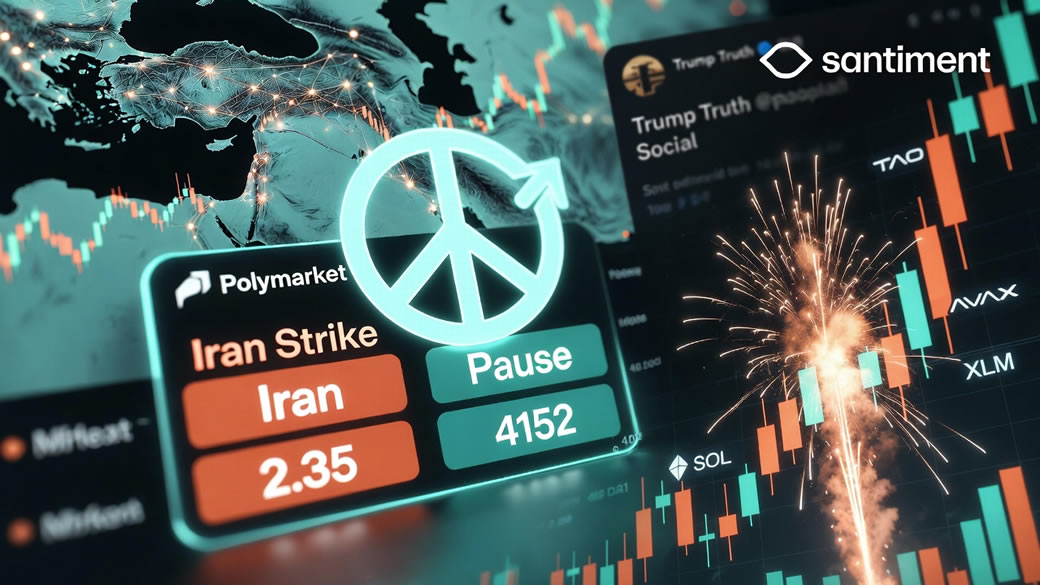
[Insert Graphic: Allusive Hero Image Prompt for Grok Imagine – “A cinematic digital collage: foreground shows a glowing Polymarket interface with ‘Iran Strike Pause’ odds flipping from red warning to green peace arrow; background features subtle Middle East map with oil pipelines and blockchain nodes; rising crypto charts for TAO, AVAX, XLM, SOL exploding upward like fireworks; faint Trump Truth Social post overlay and Santiment logo; dramatic teal-orange cyber-finance color scheme, ultra-modern, high-contrast, optimistic yet professional tone, 16:9 landscape for article hero banner. Style: clean futuristic infographic meets cyberpunk realism, no text on image except faint market labels.”]