

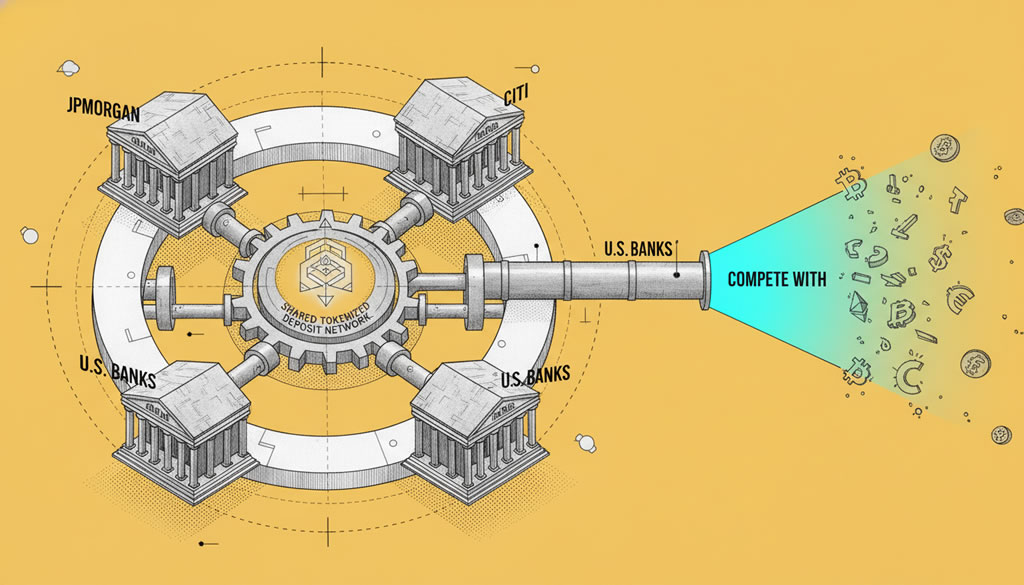
- Major U.S. banks plan a tokenized deposit network operated by The Clearing House, targeting launch in first half of 2027.
- The initiative connects traditional payment rails with blockchain infrastructure for instant, programmable settlements.
- Tokenized deposits are positioned as a regulated alternative to stablecoins, retaining bank deposit characteristics including credit risk and regulatory treatment.
- JPMorgan has already deployed JPM Coin on its private blockchain and extended a version to Coinbase’s Base network.
In a significant step toward integrating blockchain technology into traditional finance, several of the largest U.S. banks are collaborating on a shared tokenized deposit network designed to counter competition from crypto firms and stablecoins.
The network, to be operated by The Clearing House — co-owned by banks including Citigroup — will enable tokenized bank deposits to move instantly across blockchain rails with 24/7 settlement capabilities. A launch is targeted for the first half of 2027, according to a Wall Street Journal report.
Participating institutions include JPMorgan Chase, Bank of America, Citigroup, Wells Fargo and others. The project, internally referred to by some as “the bridge” or “the chain,” aims to facilitate use cases such as programmable treasury operations, real-time liquidity management, and cross-border payments, particularly appealing to large multinational corporations.
Unlike stablecoins, which function as bearer instruments, tokenized deposits represent traditional bank liabilities on a distributed ledger. This structure preserves existing regulatory safeguards, deposit insurance considerations, and accounting treatments while unlocking blockchain efficiencies like atomic settlement and programmability.
JPMorgan has been a pioneer in this space with its JPM Coin platform, which has processed substantial volumes on its private blockchain. The bank recently extended a version of JPM Coin to the public Base blockchain (affiliated with Coinbase) for institutional clients.
Clearing House CEO David Watson described the initiative as “a big move for the banks” amid a “radically different” future for on-chain payments. Citi’s Shahmir Khaliq noted that the network “cements” the role of banks in financing and capital markets. Bank of America’s Mark Monaco acknowledged growing but not yet overwhelming client interest, emphasizing proactive positioning.
The move comes as stablecoins have grown substantially and crypto legislation advances, raising concerns among banks about potential deposit outflows. Tokenized deposits allow banks to offer blockchain-based services while keeping customer funds within the regulated banking system.
Industry observers see this as part of broader Wall Street adoption of tokenization for assets like money market funds and securities. While challenges remain — including selection of an underlying blockchain vendor and achieving broad interoperability — the coordinated effort signals strong institutional commitment to bridging traditional finance with distributed ledger technology.
Disclaimer: This article is for informational purposes only and does not constitute advice of any kind. Readers should conduct their own research before making any decisions.