

When Titans Collide in the Crypto Arena
Two financial powerhouses are staring each other down across a digital battlefield, with Bitcoin as the explosive centerpiece. On one side, Jamie Dimon, the outspoken CEO of JP Morgan—the world’s largest bank by market cap—has long dismissed Bitcoin as a tool for “criminals, drug lords, and terrorists.” On the other, Michael Saylor, the visionary founder of MicroStrategy (now rebranded as Strategy), who has transformed his software company into the planet’s biggest corporate Bitcoin holder, amassing over 650,000 BTC through aggressive treasury strategies.
It’s a saga that encapsulates the broader tension between traditional finance (TradFi) and the decentralized revolution of cryptocurrency. Sparked by a mysterious market selloff in October 2025, the conflict escalated with allegations of market manipulation, index exclusion threats, and a viral boycott campaign. As Bitcoin hovered around $84,000 amid volatility, the drama unfolded on social media platforms like X (formerly Twitter), where threads dissected every move.

What started as whispers of “something off” in a Bitcoin selloff quickly snowballed into a full-blown narrative of institutional sabotage versus innovative resilience.
In this article, we’ll unpack the JP Morgan-MicroStrategy saga step by step, drawing from credible sources like X threads, financial reports, and market data. We’ll explore its origins, the mechanics behind the drama, real-world impacts, inherent risks, and what it means for Bitcoin’s long-term trajectory. Whether you’re a crypto novice wondering why a bank would “attack” a company or an intermediate investor eyeing corporate Bitcoin strategies, this deep dive aims to provide timeless insights into how legacy systems are grappling with disruptive technology.
Historical Origins
To understand the saga, we must rewind to Bitcoin’s early days and the contrasting paths of these two entities. Bitcoin, created in 2009 by the pseudonymous Satoshi Nakamoto, was designed as a peer-to-peer electronic cash system immune to central control. Its whitepaper promised a hedge against inflation and financial censorship, but it faced fierce opposition from traditional institutions.
Jamie Dimon has been one of Bitcoin’s most vocal critics. In 2017, he famously called it a “fraud” worse than tulip bulbs, threatening to fire any JP Morgan trader caught dealing in it. Fast forward to 2025, and while Dimon has softened slightly—acknowledging blockchain’s potential—he still warns of its risks, including volatility and regulatory hurdles. JP Morgan, under his leadership, has dabbled in crypto selectively: launching JPM Coin in 2019 for institutional payments and, by November 2025, holding over $343 million in BlackRock‘s IBIT Bitcoin ETF. This pivot highlights a classic TradFi strategy: criticize publicly while profiting privately.
Contrast this with Michael Saylor’s journey. MicroStrategy, founded in 1989 as a business intelligence firm, pivoted dramatically in 2020 amid the COVID-19 economic turmoil. Saylor, inspired by Bitcoin’s fixed supply of 21 million coins (making it “digital gold”), began allocating corporate reserves to BTC. By 2025, Strategy held 641,692 BTC (valued at around $65 billion), funded through convertible notes, equity raises, and “intelligent leverage.” Saylor’s mantra: Bitcoin is a superior store of value, outperforming fiat currencies eroded by inflation.
The clash intensified as Strategy’s market cap soared, often trading at a premium to its Bitcoin holdings (known as mNAV, or market-to-net-asset-value ratio). In bull markets, mNAV can reach 3-4x, allowing Saylor to issue shares at inflated prices and buy more BTC—creating a virtuous cycle. But this “Bitcoin treasury machine” threatened TradFi’s dominance, setting the stage for conflict.
Think of it like this: If Bitcoin is a lifeboat in a stormy sea of fiat devaluation, Dimon sees it as a leaky vessel, while Saylor views it as the only seaworthy option. Their ideological divide mirrors broader debates in finance, from gold bugs versus central bankers to decentralized versus regulated systems.
The 2025 Saga Step by Step
The saga kicked off in early October 2025 with a quiet but pivotal move from MSCI, a leading index provider. MSCI proposed excluding companies whose balance sheets are “predominantly Bitcoin” from major benchmarks like the MSCI World Index and Nasdaq 100. For Strategy, where Bitcoin comprised over 50% of assets, this was a direct hit. Exclusion could trigger passive fund outflows estimated at $2.8 billion, forcing sales and pressuring the stock price.
Enter JP Morgan. Months prior, the bank had hiked margin requirements on MSTR-backed positions from 50% to 95%, making it costlier for clients to borrow against the stock. Clients also reported delays in transferring shares out of JPM custody. Then, amid the MSCI buzz, JP Morgan circulated memos amplifying the “MSTR index risk,” warning of potential delistings.
The powder keg ignited on October 10, 2025, with a massive liquidation event. Bitcoin plummeted nearly 5%, wiping out $660 billion in crypto market cap.
A Binance stablecoin depeg took initial blame, but many pointed to the MSCI memo and JP Morgan’s actions as catalysts. Strategy’s stock (MSTR) tanked, exacerbating the spiral.
Saylor fired back, calling JP Morgan’s warnings “alarmist” and noting the risks were “priced in by a factor of 10.” He emphasized Strategy’s robust financing: $21 billion raised in 2025 alone, plus software revenue topping $500 million annually.
The plot thickened when reports emerged of JP Morgan selling 772,453 MSTR shares ($134 million) just before the MSCI announcement. Simultaneously, the bank was preparing a structured bond tied to BlackRock’s IBIT ETF—essentially adopting Saylor’s playbook while undermining his company.
To visualize the impact on Strategy’s stock:
| Date | Event | MSTR Price Change | BTC Price |
|---|---|---|---|
| Early Oct 2025 | MSCI Proposal Floated | -5% initial dip | ~$90,000 |
| Oct 10, 2025 | Liquidation Wave | -15% | Drop to $84,000 |
| Mid-Nov 2025 | Boycott Peaks | +10% rebound | Recovery to $95,000 |
| Late Nov 2025 | JPM’s IBIT Bond Reveal | Stabilized at $225 | ~$101,000 |
This table, derived from market data, shows how intertwined MSTR and BTC movements became. The mechanics reveal a classic power play: Use regulatory fears and margin squeezes to create panic, then capitalize on the asset yourself.
Boycotts, Politics, and Adoption
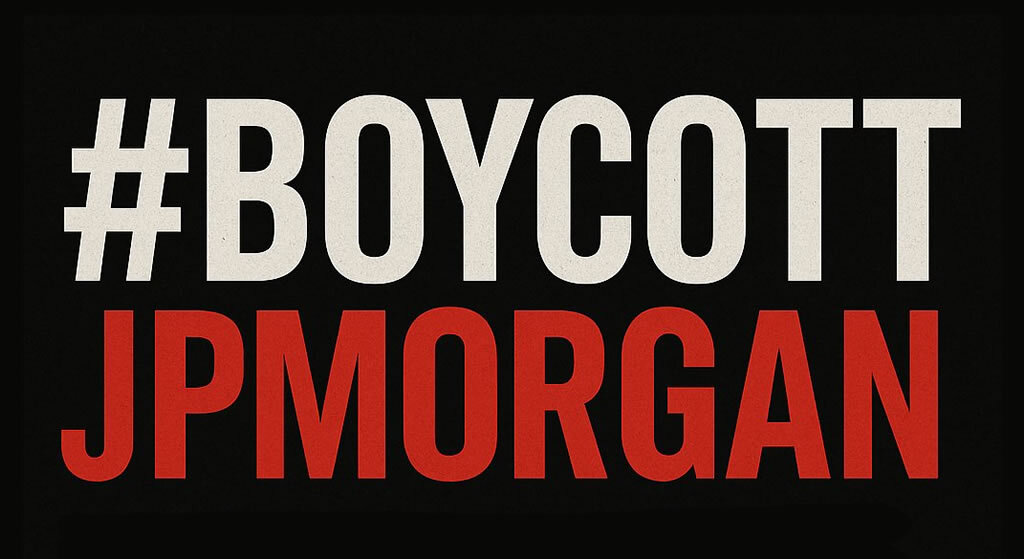
The saga’s ripples extended far beyond stock charts. Bitcoin advocates, fueled by years of distrust toward banks, launched #BoycottJPM, trending on X with over 100,000 mentions. High-profile figures like real estate mogul Grant Cardone pulled $20 million from JP Morgan, while Strike CEO Jack Mallers revealed his company was “debanked” by the institution. Even Eric Trump blasted the “dishonest” financial system on CNBC.

Politically, the timing was electric. With Donald Trump’s administration embracing Bitcoin—proposing a national reserve and friendly regulations—the saga took on partisan tones. Dimon, a known supporter of Kamala Harris, was accused of undermining Trump’s agenda, given Strategy’s strategic importance to U.S. Bitcoin holdings.
A key case study: Empery Digital, a public company holding over 4,000 BTC, publicly questioned JP Morgan’s motives, alleging delays in stock transfers to force liquidations. This echoed broader “debanking” stories in crypto, like Operation Choke Point 2.0, where banks allegedly restricted services to crypto firms.
On the flip side, JP Morgan’s foray into Bitcoin products—like the IBIT bond—demonstrates practical adoption. By tokenizing assets on networks like Coinbase’s Base, they’re bridging TradFi and DeFi, potentially unlocking trillions in efficiency. For everyday users, this means faster settlements and yield-bearing tokens, but only for those in the “permissioned” club.
These examples illustrate Bitcoin’s dual role: a refuge from institutional overreach and a magnet for it.
What side are you on—TradFi or the Bitcoin revolution?
Challenges and Risks: Volatility, Regulation, and Ethical Dilemmas
No saga is without pitfalls. For Strategy, the primary risk is leverage. With $8 billion in debt against volatile BTC holdings, a prolonged bear market could trigger margin calls or forced sales. Basel III regulations, treating Bitcoin as a high-risk asset (1250% risk weight), could further constrain banks from holding it directly, indirectly pressuring proxies like MSTR.
JP Morgan faces reputational risks from the boycott, with clients fleeing amid perceptions of hypocrisy. Dimon’s past criticisms now clash with the bank’s $343 million IBIT stake, eroding trust. Broader challenges include regulatory scrutiny: The SEC and Fed could crack down on “crypto contagion” in equities.
Societally, the saga highlights economic inequality. While institutions like JP Morgan front-run adoption, retail investors bear the volatility. Ethical questions arise: Is it fair for banks to amplify fears while building competing products? Analogous to shorting a stock while warning clients, it borders on manipulation.
Solutions? Greater transparency in index methodologies and margin policies could mitigate such conflicts. For investors, diversification beyond single-asset treasuries is key.
Future Outlook: Bitcoin’s Inevitable Integration?
Looking ahead, this saga may accelerate Bitcoin’s mainstreaming. If Strategy weathers the storm—potentially reaching 1 million BTC by 2030—it could inspire more corporations to adopt Bitcoin treasuries. JP Morgan’s pivot suggests even skeptics can’t ignore BTC’s upside, with analysts forecasting $140,000+ based on fundamentals like ETF inflows and halving cycles.
However, risks loom: Tighter regulations under Basel III or index exclusions could cap leveraged plays. On the positive side, Trump’s pro-crypto stance might foster a U.S. Bitcoin reserve, boosting adoption.
In five years, we might see hybrid models—banks offering tokenized BTC yields while companies like Strategy evolve into “Bitcoin banks.” The saga underscores a truth: Free markets force alignment, as Saylor noted. Bitcoin isn’t going away; it’s reshaping finance.
Lessons from the Frontlines of Crypto Evolution
The JP Morgan-MicroStrategy saga is more than a headline—it’s a masterclass in how disruptive technologies challenge entrenched powers. From Dimon’s skepticism to Saylor’s bold bets, it reveals Bitcoin’s transformative potential amid institutional resistance. Key takeaways:
- Understand Leverage Wisely: Strategy’s model offers high yields (up to 10%) but amplifies risks—always assess your exposure.
- Watch for Hypocrisy: Institutions may criticize crypto publicly while adopting it privately; stay informed via sources like CoinMarketCap or X threads.
- Diversify and Educate: For beginners, start with small BTC holdings via ETFs; intermediates, explore treasury strategies but heed volatility.
As the dust settles, remember: In the world of crypto, resilience wins. Subscribe to Cryptopress.site for more insights on blockchain fundamentals, or explore related articles like “Bitcoin as a Hedge Against Inflation.” What side are you on—TradFi or the Bitcoin revolution?.