

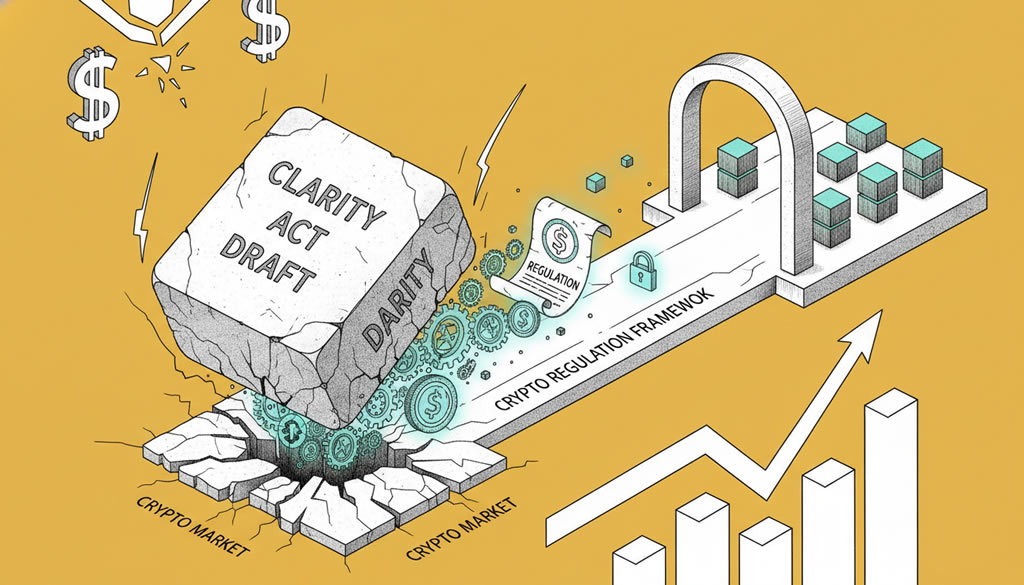
- Senate Banking Committee publishes 309-page Clarity Act text, outlining digital asset market structure rules ahead of May 14 markup.
- Bill clarifies CFTC/SEC jurisdiction, protects DeFi developers, and includes stablecoin yield restrictions while preserving certain transactional rewards.
- Democrats push for ethics provisions; Republicans emphasize consumer protection and illicit finance combat.
- Parallel developments include Circle’s $222M ARC token presale at $3B valuation and JPMorgan’s new tokenized money market fund filing.
The U.S. Senate Banking Committee has released the latest version of the Digital Asset Market Clarity Act, a comprehensive bill aimed at establishing clear regulatory frameworks for cryptocurrencies, stablecoins, and decentralized finance. The 309-page draft, made public just ahead of a scheduled markup vote on Thursday, represents a significant step toward providing long-sought legal certainty for the industry.
The Clarity Act seeks to delineate oversight responsibilities between the Commodity Futures Trading Commission (CFTC) and Securities and Exchange Commission (SEC), define digital commodities, and codify protections for DeFi protocol developers. It also addresses stablecoin rules, building on the GENIUS Act by limiting yield payments on idle balances while allowing certain transactional incentives.
Chairman Tim Scott highlighted the bill’s focus on consumer protection and curbing illicit finance. However, ethics provisions remain a point of contention, with some Democrats insisting on language addressing potential conflicts of interest for officials. The White House has expressed reservations about provisions targeting specific officeholders.
In tandem with the legislative push, major industry players are advancing infrastructure. Circle, issuer of USDC, announced a $222 million private placement for its ARC token, valuing the planned Layer-1 blockchain at $3 billion fully diluted. The presale, led by a16z crypto with participation from BlackRock, Apollo, and others, supports Arc’s development as a settlement layer for stablecoins and tokenized assets. Circle reported Q1 revenue of $694 million and USDC circulation reaching $77 billion.
Separately, JPMorgan filed for the OnChain Liquidity-Token Money Market Fund (JLTXX) on Ethereum, designed for stablecoin issuers to hold reserves in Treasury-backed instruments. The move follows Morgan Stanley’s similar product and underscores Wall Street’s deepening involvement in tokenized real-world assets.
Industry observers view the Clarity Act as pivotal for institutional adoption. Bloomberg’s Eric Balchunas noted the significance of low-fee tokenized products in this context. Risks remain, including potential fragmentation in tokenized markets flagged by the IMF and ongoing debates over DeFi safeguards.
The markup vote on May 14 could accelerate progress toward floor consideration, though bipartisan hurdles persist. For crypto investors and builders, the coming days may clarify the path for U.S.-based innovation amid evolving global competition.
Disclaimer: This article is for informational purposes only and does not constitute advice of any kind. Readers should conduct their own research before making any decisions.