

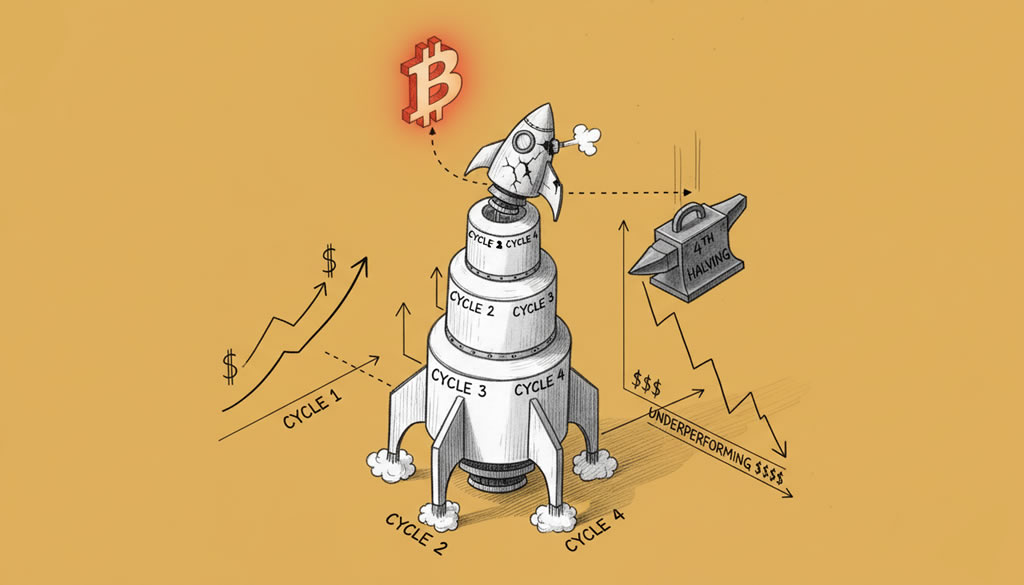
- Cycle comparison: The post-April 2024 halving cycle is “dramatically” weaker than the 2012, 2016 and 2020 cycles, according to Galaxy head of research Alex Thorn.
- Price gains: Bitcoin’s 2025 peak above $125,000 was only 97% above the April 2024 halving price near $63,000, versus 9,294% in 2012, 2,950% in 2016 and 761% in 2020.
- Volatility decline: The 30-day Bitcoin Volatility Index now sits at 1.75%, well below the 9.64% peak seen in the 2020 cycle.
- Market context: The March 2024 pre-halving all-time high above $70,000, driven by spot ETF approvals, has skewed cycle comparisons.
- Drawdown trends: Current declines from peak are around 50%, milder than the 80-90% drops in previous bear markets.
Bitcoin’s latest halving cycle continues to diverge sharply from historical patterns, exhibiting lower volatility and more modest price appreciation than its predecessors.
Galaxy head of firmwide research Alex Thorn described the current cycle as “dramatically underperforming prior cycles” in an analysis published April 20, 2026. Comparing price action since the April 2024 halving, Thorn noted the October 5, 2025 all-time high above $125,000 represented just a 97% gain from the halving price of around $63,000, according to Cointelegraph.
By contrast, the 2012 cycle delivered roughly 9,294% gains to a high near $1,163, the 2016 cycle saw 2,950% upside to $19,891, and the 2020 cycle posted 761% growth. Thorn posed the question in an X post: “Is this the new normal, or is it the new normal until it isn’t?”
Volatility has also compressed markedly. The 30-day Bitcoin Volatility Index has not exceeded 3.11% in the current cycle — last seen on August 24, 2024 — and currently stands at 1.75%, compared with a spike to 9.64% in April 2020 during the prior cycle.
Critics of the analysis point out that Bitcoin reached a then all-time high above $70,000 in March 2024, one month before the halving, largely on the back of U.S. spot Bitcoin ETF approvals in January 2024. This anomaly has compressed measured gains relative to earlier cycles that saw their peaks well after the halving event.
Drawdowns have similarly moderated. Bitcoin’s decline from the 2025 peak to around $60,000 equates to just over a 50% drop, compared with historical bear-market declines of 80-90%, noted Fidelity Digital Assets research analyst Zack Wainwright.
At the time of the report, Bitcoin was trading near $74,703, up almost 5% over the past seven days. While some observers, including VanEck CEO Jan van Eck, expect a gradual recovery in 2026, the muted cycle dynamics underscore shifting influences on Bitcoin’s price beyond the traditional halving narrative.
The analysis arrives as market participants continue to monitor institutional flows and macroeconomic factors for signals on the next leg of price action.
Disclaimer: This article is for informational purposes only and does not constitute advice of any kind. Readers should conduct their own research before making any decisions.