

- Stablecoin market cap reaches $234.8 billion, a new all-time high.
- Competition grows with major players like Tether and USDC, and new entrants integrating with traditional finance.
- Stablecoins connect with traditional finance through payments, lending, and institutional adoption.
- This growth suggests increased regulatory scrutiny, innovation, and potential for global financial inclusion.
Stablecoins and Their Rising Prominence
Stablecoins have emerged as a pivotal element in the cryptocurrency landscape, designed to maintain a stable value by being pegged to traditional assets, most commonly the US dollar. This stability makes them a reliable medium for transactions and a store of value, contrasting with the volatility of assets like Bitcoin and Ethereum.
The stablecoin market cap has reportedly reached a new all-time high of $234.8 billion, according to The Defiant, signaling robust growth and increasing adoption.
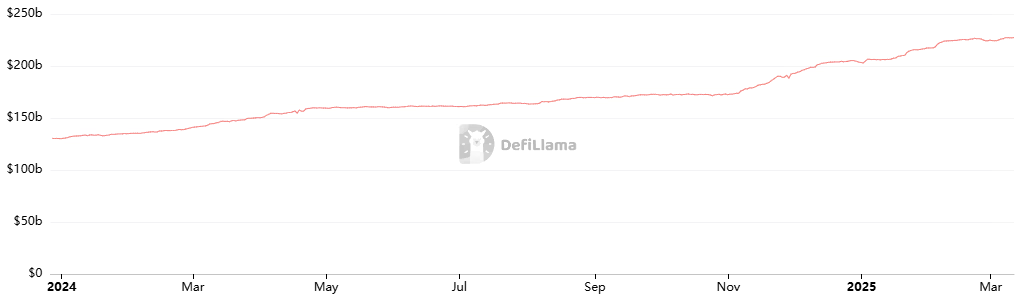
Reflecting the growing trust and utility of stablecoins in the financial ecosystem. This growth follows a period of consistent expansion, with stablecoins proving their worth in providing a stable medium of exchange and store of value, particularly within the decentralized finance (DeFi) space.
Data from DefiLlama highlights that Tether (USDT) leads with a market cap of over $143 billion, accounting for 63.11% dominance, while Circle’s USD Coin (USDC) follows with approximately $57 billion. Emerging players like Ethena USDe (USDE), with a market cap of $5.45 billion, are also gaining traction.
Integration with Traditional Finance
Stablecoins are increasingly integrating with traditional finance, acting as a bridge between the crypto and fiat worlds.
Payment Systems
Stablecoins facilitate fast and low-cost cross-border transactions, challenging traditional remittance services. For instance, they enable businesses to accept payments in dollars while operating in the crypto space, as noted in CoinPaper.
Lending and Borrowing
In DeFi, stablecoins serve as collateral for loans, providing an alternative to traditional banking. This is particularly popular in lending pools where users can earn interest, as described in CoinDesk.
Institutional Adoption
Some traditional financial institutions are exploring stablecoins for treasury management and digital asset strategies, recognizing their efficiency. This trend is supported by reports from S&P Global Ratings, which assess stablecoin stability for market stakeholders.