


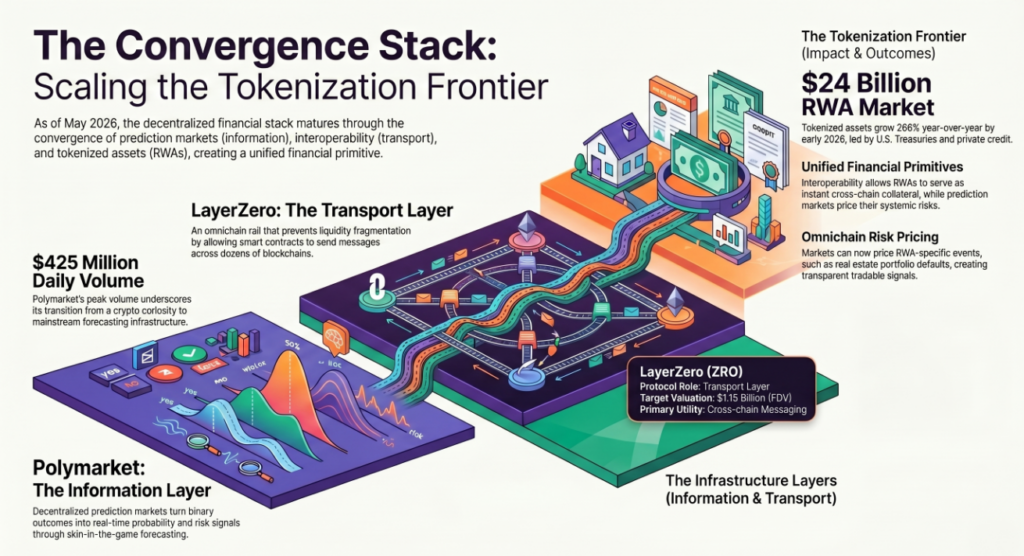
On February 28, 2026, Polymarket processed more than $425 million in single-day trading volume. That figure exceeded what many traditional derivatives venues handle in a week and underscored a structural shift: decentralized prediction markets have moved from crypto-native curiosity to mainstream forecasting infrastructure with real economic weight.
As Polymarket targets valuations in the $12–15 billion range and readies its POLY token launch later in 2026, while LayerZero’s ZRO token trades with a market capitalization around $300 million (FDV ~$1.15 billion), a deeper question surfaces. How do accurate, skin-in-the-game information markets and seamless cross-chain interoperability combine to unlock the next phase of real-world asset (RWA) tokenization?
This article examines the fundamentals, valuations, mechanics, and convergence of these two primitives — and why their interplay matters far beyond 2026.
The Mechanics of Prediction Markets: Prices as Probabilities
Prediction markets are simple in concept yet powerful in practice. Participants buy and sell shares in binary (Yes/No) outcomes. A share trading at 68¢ implies the market collectively assigns a 68% probability to that outcome occurring. If it resolves “Yes,” every share pays $1. If “No,” it pays $0.
This design creates several advantages over polls or punditry:
- Skin in the game: Traders risk real capital (usually USDC on Polymarket), aligning incentives with accuracy.
- Continuous updating: Prices adjust in real time as new information arrives.
- Aggregated wisdom: Historical studies (Iowa Electronic Markets, academic literature on the “wisdom of crowds”) show prediction markets frequently outperform traditional forecasting methods.
How Polymarket works step by step:
- A market is created (e.g., “Will Bitcoin close above $120,000 on December 31, 2026?”).
- Users deposit USDC and buy Yes or No shares via an order book or automated market maker.
- Prices fluctuate based on supply and demand, reflecting shifting beliefs.
- At resolution (via oracle or trusted outcome source), winning shares redeem for $1; losers go to zero.
- Liquidity providers and the platform may earn fees; traders can exit positions anytime before resolution.
Polymarket began on Polygon for low fees and has evolved into a hybrid model. Its 2025 acquisition of the CFTC-licensed QCEX exchange and subsequent regulatory approvals allowed a compliant U.S. offering while the core crypto platform continues serving global users.
This hybrid path is instructive: regulatory clarity does not have to kill on-chain innovation — it can expand addressable capital and user bases.
Polymarket’s Valuation Trajectory and the Coming POLY Token
Polymarket’s implied valuation climbed from roughly $9 billion in late 2025 to secondary market levels around $11.6 billion in early 2026, with fresh funding conversations targeting $12–15 billion.
These numbers reflect:
- Explosive volume growth (hundreds of millions on peak days).
- Category leadership in crypto-native and increasingly mainstream event contracts (elections, macro events, sports, crypto prices).
- Network effects: more liquidity → tighter spreads → better price discovery → more users.
The POLY token dimension
Polymarket has signaled a 2026 launch for its native POLY token, potentially accompanied by an airdrop. While details remain forthcoming, typical value accrual paths for such tokens include:
- Governance rights over market creation, fees, or treasury.
- Fee capture or revenue share from platform activity.
- Incentives for liquidity provision, market creation, or accurate resolution reporting.
Valuing an upcoming token against a $12–15 billion platform raises classic questions: What percentage of economic activity will the token capture? How will emissions and utility be designed? Early infrastructure tokens in DeFi often launched at fractions of their ecosystems’ eventual value — a dynamic worth watching closely here.
LayerZero: The Rails for Omnichain Coordination
If prediction markets are the information layer, interoperability protocols are the transport layer that prevents fragmentation.
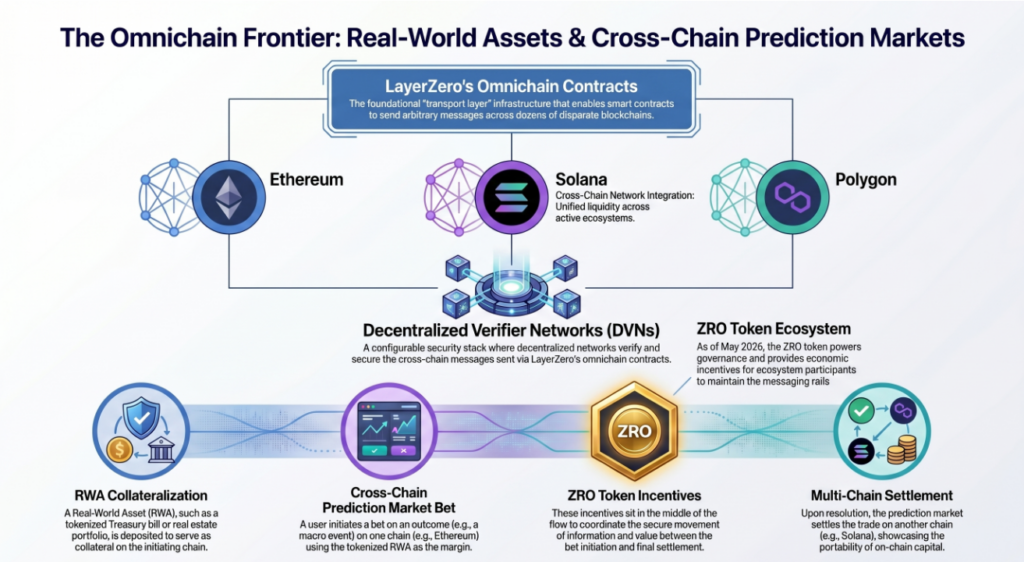
LayerZero enables smart contracts on one chain to send arbitrary messages to contracts on dozens of other chains. Its architecture relies on:
- Decentralized Verifier Networks (DVNs) for security and verification.
- Configurable security stacks (applications choose their own trust assumptions).
- The ZRO token for governance and ecosystem incentives.
As of late May 2026, ZRO trades near $1.15, with a circulating market cap in the $290–380 million range and fully diluted valuation around $1.15 billion.
This valuation reflects LayerZero’s position as one of the leading omnichain messaging infrastructures, powering applications from cross-chain DEXs (its own Stargate) to emerging RWA and DeFi use cases. Compared with Polymarket’s multi-billion-dollar platform valuation, LayerZero represents classic “picks and shovels” infrastructure — smaller today, but foundational if multi-chain activity scales.
Where Prediction Markets and Interoperability Meet RWAs
The real strategic convergence lies with real-world asset tokenization.
Tokenized RWAs surpassed $24 billion in total value by February 2026, up 266% over 2025. Growth drivers include tokenized U.S. Treasuries, private credit, and real estate. Yet scaling faces persistent frictions:
- Liquidity remains fragmented across chains.
- Moving a tokenized asset (or using it as collateral) across ecosystems is still cumbersome.
- Accurate, real-time pricing and risk signals for these assets are scarce.
Prediction markets + interoperability solve pieces of this puzzle:
- Cross-chain prediction markets: A Polymarket-style contract on Ethereum could seamlessly accept bets or receive resolution data from users or oracles on Solana, Base, or Polygon via LayerZero messaging. Unified liquidity and participation become possible without wrapped tokens or bridges that introduce new risks.
- RWAs as collateral or settlement assets: Interoperability lets a tokenized Treasury bill issued on one chain serve as margin or collateral in a prediction market on another chain — or move instantly when a market resolves.
- On-chain risk pricing: Prediction markets can directly price events relevant to RWAs (“Will this tokenized real estate portfolio experience a default event in 2027?” or “Will on-chain private credit TVL exceed $X by year-end?”). The resulting probabilities become transparent, tradable risk signals that traditional finance lacks.
- Composability at scale: Omnichain contracts reduce the need for every application to deploy on every chain. A single prediction market or RWA vault can serve users everywhere while maintaining coherent state.
In short, interoperability turns isolated prediction markets and siloed tokenized assets into a coherent, portable financial primitive layer.
Challenges and Realistic Risks
No discussion of valuation or convergence is complete without acknowledging friction:
- Regulatory execution risk: Polymarket’s CFTC path is a success story so far, but broader adoption of prediction markets on events with real economic consequences will attract scrutiny.
- Resolution and oracle integrity: Even the best markets are only as good as their outcome sources. Disputes or manipulation attempts remain live risks.
- Interoperability security: While LayerZero and peers have matured, any cross-chain system carries smart-contract and verification risks. Applications must choose security configurations deliberately.
- Liquidity chicken-and-egg: New cross-chain markets or RWA-linked contracts need initial liquidity and users. Incentives (including potential POLY and ZRO emissions) will matter.
- Adoption asymmetry: Retail excitement around prediction markets can outpace institutional comfort with tokenized RWAs or omnichain infrastructure.
These are solvable engineering, incentive, and regulatory problems — but they cap near-term valuations and require continued execution.
Future Outlook: Information, Assets, and Capital Allocation
Looking beyond 2026, three trends appear durable:
- Tokenization scales toward trillions if standardization and interoperability improve. Prediction markets will increasingly serve as decentralized pricing and hedging venues for those assets.
- POLY and ZRO represent different slices of the same stack. One captures value from high-velocity information markets; the other from the messaging layer that makes those markets (and RWAs) portable. Their relative performance will reveal how much value accrues to application layers versus shared infrastructure.
- Composability compounds. When accurate probabilities, portable tokenized assets, and seamless messaging coexist, entirely new primitives become possible — on-chain credit markets that price risk via prediction markets, automated treasury management that reacts to forecasted events, or DAO governance informed by live market signals.
The winners will be protocols and platforms that treat interoperability not as a feature but as table stakes, and that design tokenomics to align long-term incentives with genuine usage rather than short-term speculation.
Conclusion: Building the Coordination Layer for the Next Decade
Prediction markets and interoperability are not competing narratives — they are complementary pieces of infrastructure. Polymarket demonstrates that skin-in-the-game forecasting can achieve massive scale and command multi-billion-dollar valuations. LayerZero shows that the rails for moving information and value across chains can be built securely and adopted widely, even at more modest current token valuations.
As RWAs continue their march from experimentation to mainstream infrastructure, the platforms and protocols that best combine credible information markets with frictionless cross-chain coordination will capture disproportionate value.
The data already hints at the direction: hundreds of millions in daily volume on one side, hundreds of millions in infrastructure market cap on the other, and tokenized assets growing at triple-digit rates. The convergence is not theoretical — it is already underway.
Subscribe to Cryptopress.site for more evergreen deep dives on DeFi infrastructure, RWA tokenization, prediction markets, and the protocols shaping on-chain capital markets. Explore our related coverage on interoperability standards and the evolving regulatory landscape for decentralized forecasting.
Data and valuations referenced as of late May 2026. Always conduct your own research; crypto markets and regulatory environments evolve rapidly.