

On the evening of March 10, 2023, Circle disclosed that $3.3 billion of the roughly $40 billion in reserves backing USDC remained at Silicon Valley Bank after the bank had been closed by regulators. Within hours, USDC traded as low as about $0.87 on secondary markets. Coinbase and other platforms paused conversions over the weekend while banks were closed. The peg recovered once U.S. authorities guaranteed SVB deposits and Circle resumed redemptions on Monday, March 13. Circle later reported clearing a large backlog of requests.
The episode was not a shortfall of dollars on paper. It was a temporary failure of the banking rails that sit behind a fiat-backed stablecoin. It remains the clearest recent illustration that a “1:1” claim is a promise about reserves at a point in time, not a guarantee that those reserves can always be turned into spendable dollars when demand spikes.
As of early October 2026, the total dollar-stablecoin market stands near $290 billion. USDT accounts for roughly $181 billion, USDC about $73 billion, USDS around $7–10 billion, USDe near $4.8 billion, and DAI about $4.5 billion. Fiat-backed designs still represent the large majority of supply.
Three broad design families dominate the surviving instruments: fiat-backed, overcollateralized crypto, and delta-neutral (synthetic) models. Each handles redemption, reserves, and stress differently. None is immune to a bank-run dynamic; they simply fail along different paths.
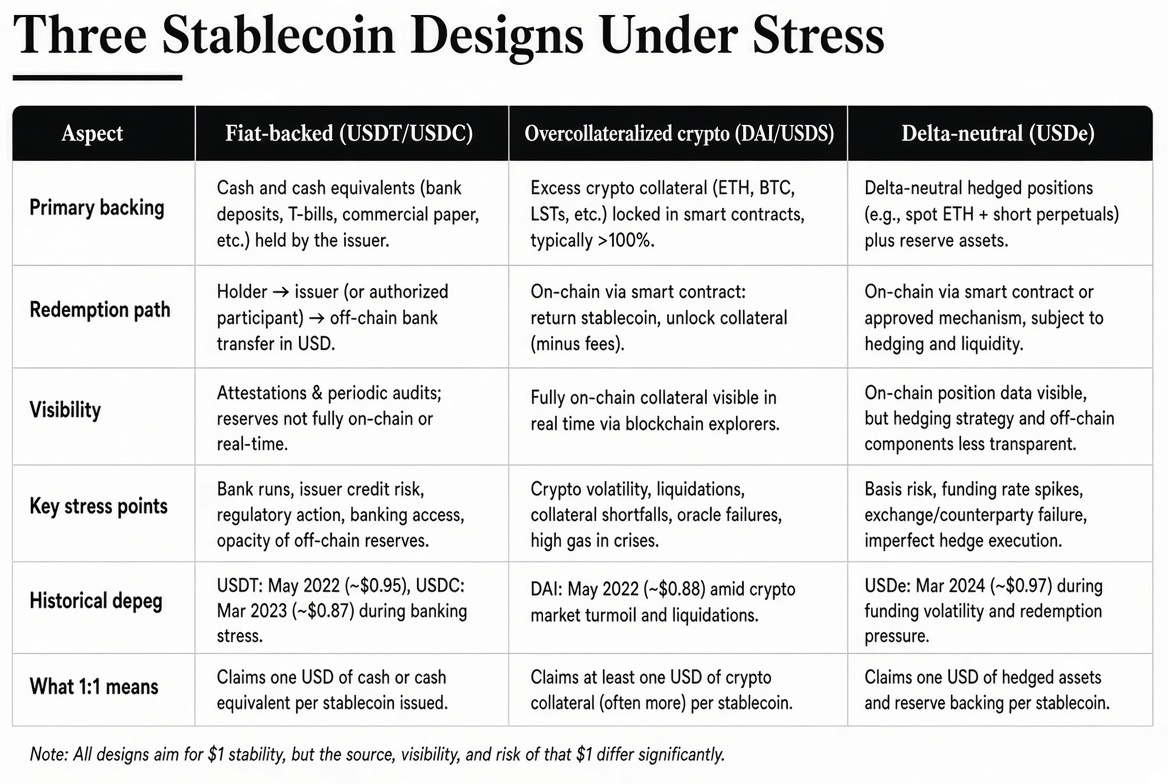
The table above summarizes the structural differences. Fiat-backed coins rely on an issuer that holds cash and short-dated Treasuries and promises 1:1 redemption. Overcollateralized designs lock crypto (and sometimes real-world assets) in smart contracts at ratios well above 100 percent and use liquidations to defend the system. Delta-neutral designs hold spot crypto and an offsetting short perpetual-futures position so that the net exposure is roughly flat; stability comes from the hedge plus arbitrage.
Fiat-Backed: Issuer Redemption and Banking Rails
In a pure fiat-backed model, a user deposits dollars (or wires them) with the issuer. The issuer mints one token and places the dollars into reserves—typically short-term U.S. Treasuries, government money-market funds, or cash at regulated banks. Redemption reverses the process: the user returns the token and receives dollars, subject to the issuer’s operational capacity and banking hours.
Visibility comes from periodic attestations. Circle publishes monthly examinations by Deloitte confirming that reserves equal or exceed tokens outstanding, with the bulk of assets in the Circle Reserve Fund managed by BlackRock. Tether publishes quarterly reports by BDO. These are point-in-time snapshots. They do not continuously monitor the days between reports, nor do they test the ability of the banking partners to process large simultaneous outflows.
Duration mismatch has narrowed as issuers have moved toward short-dated instruments, but it has not disappeared. A sudden rise in rates can still produce mark-to-market losses on longer holdings. More immediate is the bank-run channel: if a material portion of cash sits at a single institution that freezes or fails, primary-market redemptions halt even while secondary markets continue to trade. Blacklist powers add another layer. Both USDT and USDC contracts contain functions that allow the issuer to freeze addresses. Trackers show thousands of addresses and billions of dollars immobilized at various times, typically for sanctions or law-enforcement reasons. Under stress, those powers can be used, but they also mean the token is not purely bearer.
Overcollateralized Crypto: Liquidations and On-Chain Visibility
Overcollateralized designs (DAI, now largely migrated into USDS under Sky, LUSD, GHO, and others) do not rely on a central issuer holding dollars. Users lock crypto collateral—ETH, WBTC, liquid-staking tokens, or approved real-world assets—into a smart-contract vault at a ratio above 100 percent (commonly 110–200 percent depending on the asset). They mint the stablecoin against that collateral. If the collateral value falls below a liquidation threshold, the protocol seizes and sells the collateral to repay the debt.
Collateral is visible on-chain in real time. Anyone can query the contracts. There is no monthly attestation lag for the crypto portion. The trade-off is capital inefficiency: more value is locked than the stablecoin issued. The main stress path is a correlated, rapid drop in collateral prices. Liquidations then sell into a falling market, which can accelerate the decline and temporarily push the stablecoin off peg in either direction. On Black Thursday in March 2020, ETH fell roughly 50 percent in a day; DAI traded above $1.05 as liquidations and demand for the stablecoin interacted. MakerDAO absorbed a limited amount of bad debt.
Governance can change risk parameters, oracle feeds can fail or be manipulated, and smart-contract bugs remain possible. Real-world-asset collateral introduces off-chain dependencies again. The design removes the single-bank failure mode that hit USDC, but it replaces it with market-risk and execution-risk modes.
Delta-Neutral: Spot Plus Short Perpetuals
Delta-neutral or synthetic designs, exemplified by Ethena’s USDe, hold spot crypto (or other collateral) and an equal short position in perpetual futures. Gains on one side offset losses on the other, so the net dollar exposure is intended to stay close to flat. When funding rates on the short are positive, the position earns yield. Redemption is available through the protocol; large redemptions can occur without necessarily unwinding the entire hedge if the collateral itself is liquid.
The model is capital-efficient relative to overcollateralized designs, but it concentrates risk in the hedge, the exchanges or custodians where the positions sit, and the funding-rate environment. If funding turns sharply negative for an extended period, the yield becomes a cost. If an exchange experiences a dislocation, deposit/withdrawal freezes, or an internal oracle that prices the asset from a thin order book, the secondary-market price can diverge even while the protocol’s collateral remains intact.
On October 10, 2025, amid roughly $19 billion in crypto liquidations, USDe traded as low as about $0.65 on Binance. Prices on Curve, Uniswap, and other venues stayed close to $0.99. Ethena reported that mint and redeem functions continued to operate and that the system remained overcollateralized. The episode was largely a venue-specific liquidity and oracle event rather than a protocol-level shortfall, but it demonstrated how quickly a synthetic dollar can depeg on a major exchange when the pricing and arbitrage loop is interrupted.
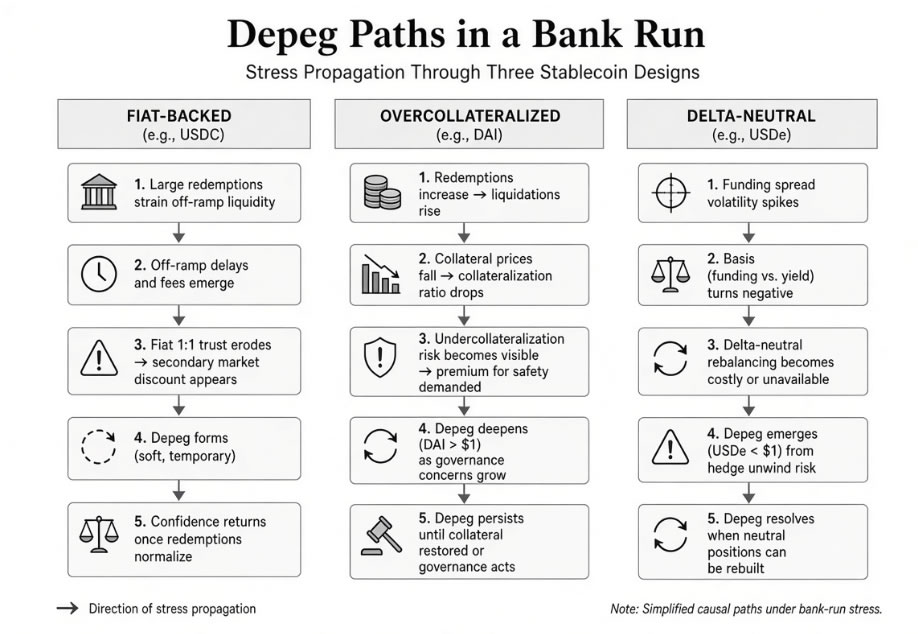
The diagram shows the three distinct propagation paths. In the fiat-backed case, the initial stress is often a freeze or queue at the banking layer; the secondary market discounts the token until rails reopen. In the overcollateralized case, the stress is a collateral price drop that triggers liquidations. In the delta-neutral case, the stress is a funding flip or an exchange-level dislocation that breaks the hedge or the arbitrage.
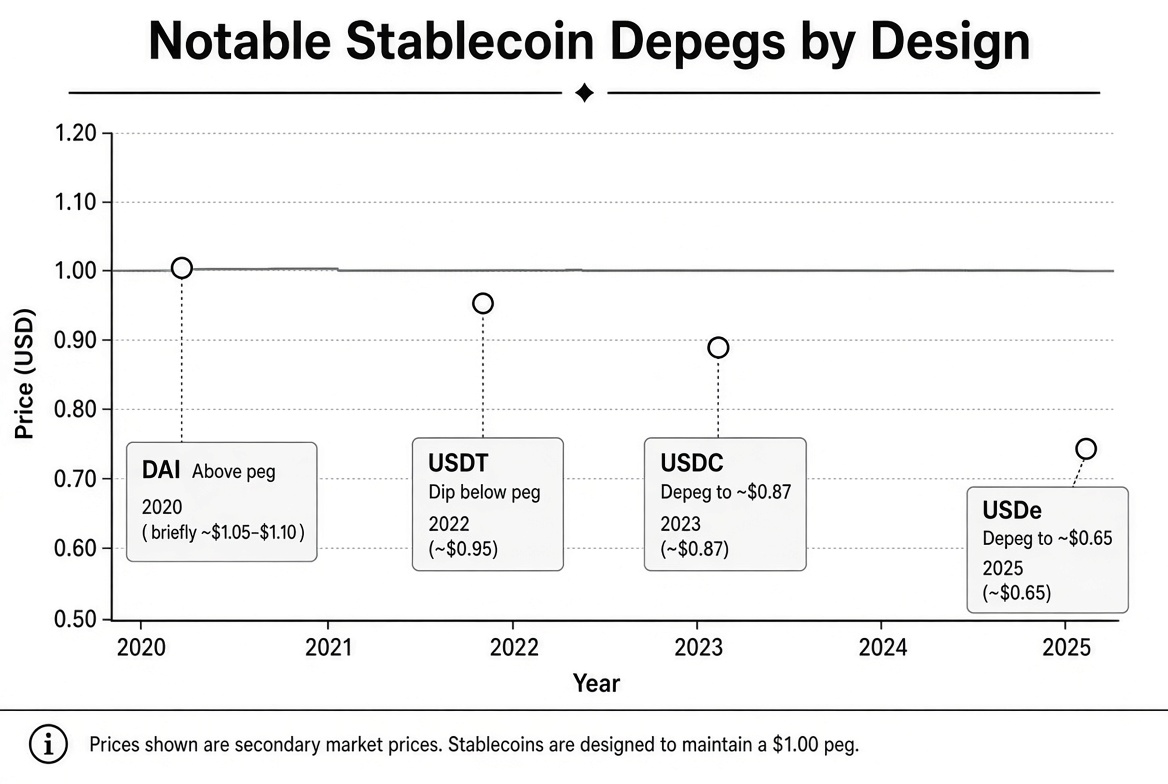
The timeline records the most widely observed episodes. Each design has already produced a visible depeg under real stress. Recovery speed and the presence or absence of lasting capital loss have differed.
What “1:1” Does and Does Not Guarantee
The phrase “1:1” is used across all three models, but it does not mean the same thing.
For a fiat-backed coin it usually means that, on the attestation date, the fair value of reserves equaled or exceeded the number of tokens outstanding. It does not mean the reserves are continuously monitored, that they are bankruptcy-remote from the issuer’s other activities, or that banking partners can process unlimited redemptions on a weekend. It also does not remove the issuer’s ability to blacklist addresses.
For an overcollateralized coin it means the protocol requires more collateral value than the debt issued. The buffer exists to absorb price moves before liquidation. It does not mean the system is capital-efficient, nor that liquidations will always clear without temporary dislocation.
For a delta-neutral coin it means the protocol aims for a roughly offsetting long and short exposure so that directional crypto risk is minimized. It does not mean the backing is cash or Treasuries, nor that exchange or funding risks have been eliminated.
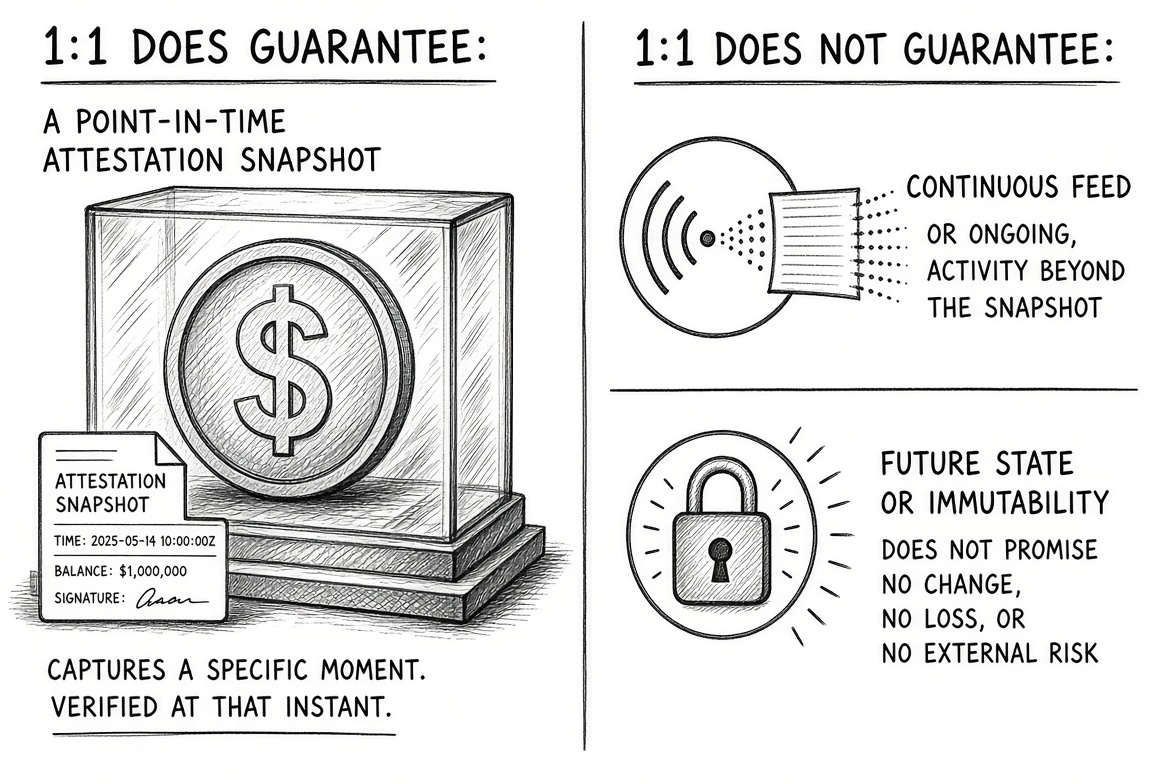
Attestation gaps, duration mismatch, and blacklist powers are therefore not side issues. They are central to what a user is actually holding when markets are stressed. An attestation that is clean on the 30th of the month says little about the 15th if a bank fails in between. A portfolio of longer-duration bonds can be solvent on a hold-to-maturity basis and still produce losses if forced to sell. A token that can be frozen is not the same instrument as one that cannot.
What Strengthens or Weakens a Design’s Resilience Under Stress?
A design’s practical resilience—its ability to keep the peg close enough for users to treat the token as dollars—depends on a few observable factors that can strengthen or weaken over time.
For fiat-backed coins, resilience strengthens when cash is held at a diversified set of systemically important banks, when the bulk of assets sit in short-dated Treasuries or registered government money-market funds with daily transparency, and when the issuer has access to emergency liquidity or has obtained a banking charter that places it under stricter supervision. Resilience weakens when a large share of reserves is concentrated at a single bank, when attestation frequency is quarterly rather than monthly, when the reserve mix includes less liquid or more volatile assets (secured loans, Bitcoin, gold), or when redemption operations depend on banking hours that do not match crypto market hours.
For overcollateralized designs, resilience strengthens with diversified collateral, conservative liquidation thresholds, robust oracles, and on-chain visibility that lets participants monitor health in real time. It weakens when collateral is highly correlated (mostly one asset), when oracles lag or fail, when governance can rapidly loosen parameters, or when real-world-asset collateral reintroduces off-chain custody and legal risk.
For delta-neutral designs, resilience strengthens when the hedge is executed across multiple venues, when funding-rate risk is actively managed or capped, when mint/redeem remains open during stress, and when secondary-market pricing relies on deep on-chain liquidity rather than a single exchange’s order book. It weakens when positions are concentrated on one exchange, when the protocol depends on positive funding for viability, or when users treat the synthetic dollar as equivalent collateral on platforms whose internal oracles can diverge.
These factors are not fixed. An issuer can shorten duration, add banks, or improve attestation cadence. A protocol can raise collateral ratios or diversify. A synthetic issuer can move more activity on-chain or distribute hedges. Each change alters the stress path.
Near-Term Indicators and Triggers That Matter
Several observable signals have historically preceded or accompanied stress. They are not forecasts; they are the variables that have moved first in past episodes.
For fiat-backed coins, watch the share of reserves held as cash at banks versus short-term Treasuries, the identity and concentration of those banks, the lag between month-end and the published attestation, and any public statement about wires or operational delays. A sudden halt in primary-market mint/redeem, or a widening of the secondary-market discount while banks are closed, is the classic trigger. Regulatory actions that restrict an issuer’s banking partners produce the same effect.
For overcollateralized coins, monitor system-wide collateral ratios, the share of collateral in the most volatile or correlated assets, oracle deviation reports, and the volume of liquidations relative to available liquidity. A rapid rise in utilization of the peg-stability module (where one exists) or a spike in bad-debt auctions signals that the buffer is being tested.
For delta-neutral coins, track funding rates on the major perpetual markets used for the hedge, the distribution of positions across exchanges, the depth of on-chain liquidity pools, and any discrepancy between the protocol’s reported collateral and exchange-quoted prices. A sharp negative funding spike combined with thinning order-book depth on a major venue has already produced a localized depeg even while protocol redemptions continued.
In all three cases, secondary-market volume and the size of the discount or premium relative to the primary redemption price are the most immediate real-time indicators. When the secondary market price diverges and the primary market is closed or congested, the design is already under the stress it was built (or not built) to handle.
Challenges That Persist Across Designs
No design has eliminated the possibility of a temporary depeg. Fiat-backed coins remain exposed to the banking system and to the issuer’s operational and legal decisions, including blacklist actions. Overcollateralized coins remain exposed to crypto market volatility and to the speed of liquidations. Delta-neutral coins remain exposed to derivatives markets, exchange infrastructure, and funding conditions.
Laws continue to change. The GENIUS Act in the United States and MiCA in Europe impose reserve composition, attestation, and licensing requirements that favor designs able to demonstrate short-duration, high-quality reserves and regular independent examinations. Designs that rely on crypto collateral or derivatives hedges face different compliance paths and, in some jurisdictions, restrictions on what can be used as backing. These rules do not remove the underlying mechanics; they change the cost and the available set of counterparties.
Blacklist powers remain a feature of the largest fiat-backed contracts. Users who require censorship resistance must either accept that risk or move to designs that do not contain such functions. Attestation gaps remain for any system whose critical assets sit off-chain. Duration mismatch can reappear if issuers lengthen maturities in search of yield. Each of these is a structural choice, not a temporary oversight.
Looking Ahead
The designs that have survived repeated stress episodes are those whose failure modes are either limited in size, quickly reversible, or visible enough that participants can exit or hedge before losses compound. Fiat-backed coins recovered from the SVB episode because the banking backstop restored the reserves and because the secondary-market discount was temporary. Overcollateralized systems have absorbed sharp collateral drops by liquidating positions and, in some cases, absorbing limited bad debt. Delta-neutral systems have so far contained exchange-level dislocations to individual venues while protocol redemptions continued.
None of these outcomes was automatic. Each depended on the specific reserves, the specific collateral ratios, the specific hedge distribution, and the presence or absence of external backstops at the moment of stress. As issuers adjust duration, as protocols change collateral, and as statutes redefine eligible reserves, the relative ranking of the three designs can shift. The underlying question stays the same: when redemptions exceed the speed of the rails, the liquidity of the collateral, or the integrity of the hedge, what actually happens to the token’s price, and who bears the temporary or permanent loss?
Readers who want ongoing coverage of stablecoin mechanics, reserve changes, and stress events can subscribe at https://cryptopress.substack.com/subscribe.
Related reading on Cryptopress
- The Rise of Yield-Bearing and Bank-Led Stablecoins: 414% Inflow Surges, OCC Approvals, and the New Programmable Payment Rails — how yield debates and bank-led issuance are reshaping the stablecoin market.