


In the not-so-distant future, quantum computers could shatter the cryptographic foundations that secure Bitcoin, Ethereum, and most of today’s blockchains. Algorithms like ECDSA, which protect private keys through elliptic curve mathematics, are vulnerable to Shor’s algorithm—a quantum method that could derive private keys from public ones in polynomial time.
While experts estimate a cryptographically relevant quantum computer is still 10–20 years away, the crypto industry isn’t waiting. A growing number of projects are implementing post-quantum cryptography (PQC)—algorithms designed to resist both classical and quantum attacks, often based on NIST-standardized methods like hash-based signatures, lattice-based cryptography, or code-based schemes.
These quantum-resistant currencies aren’t just theoretical; many are live networks with real market caps, transactions, and ecosystems.
Why Quantum Resistance Matters Now
Quantum computers threaten asymmetric cryptography (public/private key pairs) far more than symmetric encryption or hashing. Grover’s algorithm could mildly speed up brute-force attacks on hashes like SHA-256, but the real danger is to signatures: a quantum attacker could steal funds from exposed public keys.
Major chains like Bitcoin and Ethereum will eventually need upgrades—perhaps soft forks or new address formats—but transitioning billions in value is complex. Meanwhile, native quantum-resistant projects and privacy-focused networks offer partial or evolving paths forward.
As of January 2026, here are the main quantum-resistant cryptocurrencies and blockchains leading the space, drawn from expert analyses, market data, and active development.
The Leading Quantum-Resistant Projects
1. Zcash (ZEC)
A standout for its privacy features that provide meaningful quantum resilience today, combined with an active roadmap toward full post-quantum security.
- Market position: ~$6B market cap – the largest among privacy-focused coins and a frequent topic in quantum discussions due to recent hype.
- How it offers resilience: Shielded transactions (using the Orchard protocol) employ zero-knowledge proofs (zk-SNARKs) that conceal sender, recipient, and amounts. This hides public keys from the ledger, significantly reducing exposure to Shor’s algorithm compared to transparent chains.
- Additional defenses: Built-in “quantum recoverability” mechanisms give users and the network time to upgrade in case of a breakthrough. Its adaptable architecture allows faster integration of new cryptography than slower-consensus chains like Bitcoin.
- Limitations: Not fully quantum-resistant yet – underlying elements like ECC for address management remain vulnerable, and historical unshielded transactions could fall to “harvest now, decrypt later” attacks.
- Roadmap: Developers are planning post-quantum signature scheme upgrades, with wallet and protocol enhancements targeted around 2026.
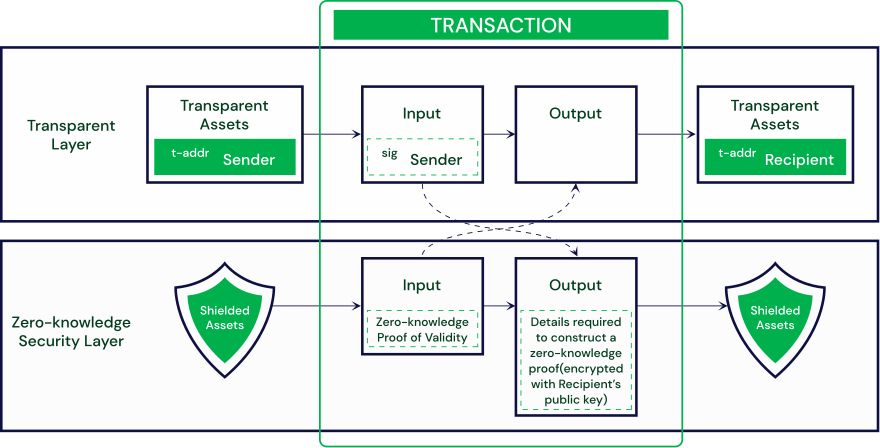
Zcash shielded transaction flow – illustrating how privacy layers reduce quantum exposure.

Chart showing shielded adoption trends in Zcash – privacy usage as a practical quantum mitigation.
2. Quantum Resistant Ledger (QRL)
The original dedicated quantum-resistant blockchain, launched in 2018 using the NIST-approved eXtended Merkle Signature Scheme (XMSS).
- Why it’s resistant: Stateful hash-based signatures immune to known quantum attacks.
- Market cap: ~$218M.
3. Starknet (STRK)
Ethereum ZK-rollup with inherently quantum-resistant STARK proofs.
- Market cap: ~$384M.
4. QANplatform (QANX)
Enterprise-focused layer-1 using lattice-based cryptography.
- Market cap: ~$29M.
5. Nervos Network (CKB)
Modular design with upgradeable cryptographic primitives.
- Market cap: ~$116M.
6. Algorand (ALGO)
Integrated Falcon signatures for post-quantum state proofs.
7. Hedera (HBAR)
Enterprise DLT exploring quantum-safe upgrades.
8. Abelian (ABEL) and Others
Privacy + lattice-based resistance; smaller but innovative projects.
Comparison Table: Key Quantum-Resistant Features
| Project | Primary PQC/Resistance Method | Key Strength | Market Cap (approx., Jan 2026) | Focus Area |
|---|---|---|---|---|
| Zcash (ZEC) | zk-SNARK privacy + planned PQC | Shielded tx hide keys | ~$6B | Privacy & resilience |
| QRL | Hash-based (XMSS) | Stateful hash signatures | ~$218M | Pure quantum security |
| Starknet | Hash-based (STARKs) | Scaling + proof resistance | ~$384M | Ethereum L2 |
| QANplatform | Lattice-based | Enterprise smart contracts | ~$29M | Developer platform |
| Nervos Network | Upgradeable primitives | Flexibility | ~$116M | Interoperability |
| Algorand | Falcon (NIST-standardized) | State proofs | Top 30 | General-purpose L1 |
| Hedera | Research + state proofs | Enterprise readiness | Large | DLT for business |
Challenges and Realistic Outlook
Even leaders face hurdles. Privacy coins like Zcash mitigate exposure through shielded pools, but unshielded or historical data remains at risk. Dedicated projects often have larger signatures and slower performance. “Harvest now, decrypt later” attacks underscore urgency across the board.
The threat remains distant—most estimates place scalable quantum breaks post-2035—but preparation varies. Zcash’s privacy gives it a head start, while pure PQC projects like QRL offer stronger guarantees today.
Major ecosystems are responding: Ethereum explores pre-compiles, Bitcoin considers overlays, and NIST standards mature.
Final Thoughts
Quantum-resistant cryptocurrencies are blockchain’s long-term insurance policy. Zcash stands out for blending established privacy with a clear upgrade path, attracting significant market attention. Dedicated pioneers prove full resistance is achievable now, while larger networks integrate gradually.
For beginners: Prioritize understanding the threat, then explore shielded usage in Zcash or native PQC coins on major exchanges.
Stay ahead—subscribe to Cryptopress.site for evergreen education on blockchain fundamentals, emerging risks, and practical strategies.