

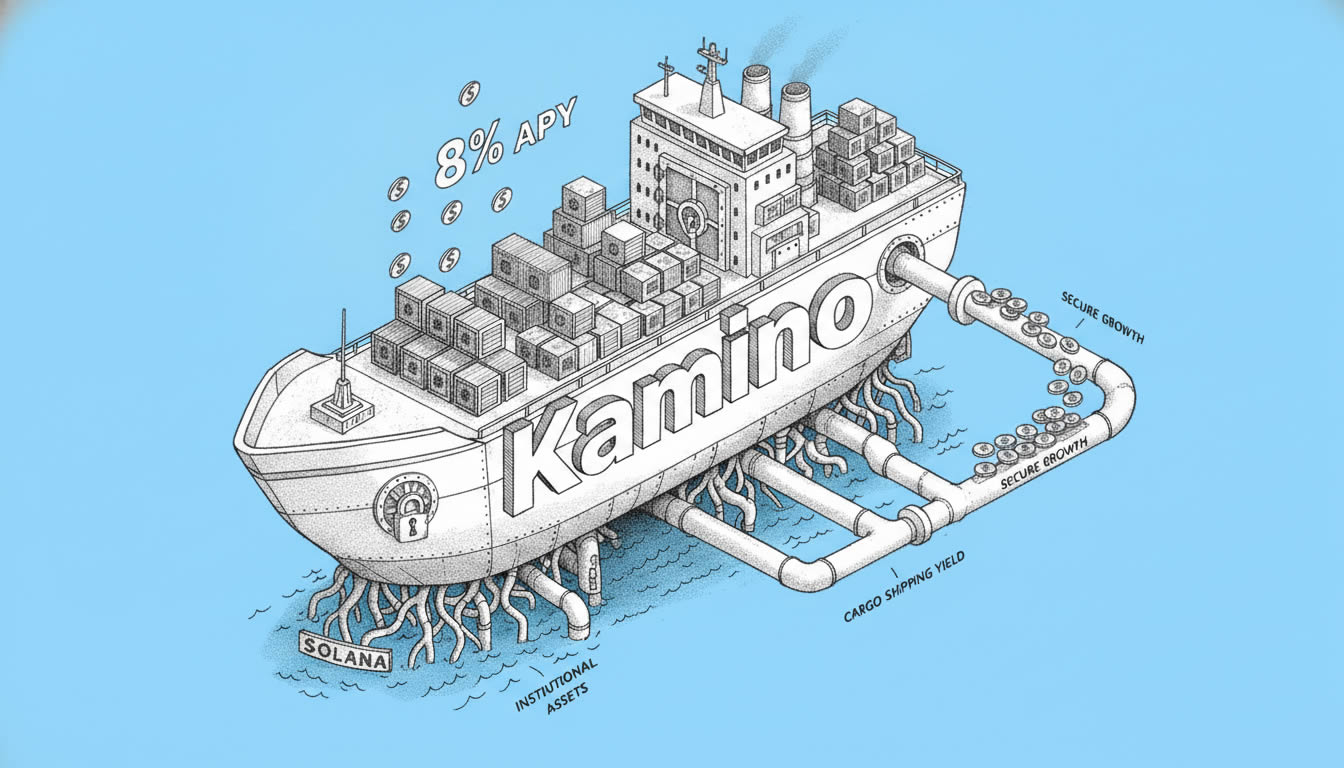
Kamino Institutional 8% APY on Solana Based on Cargo Shipping 🚢💰
Kamino’s Institutional Commodity Yield vault (kicUSDC) delivers 7–8% APY on USDC through off-chain, regulated trade finance on Solana. Learn the mechanics, risks, and yield steps.
Stablecoins are crypto’s hardest-working assets — except when they’re sitting idle. As OnChain Times’ recent “Cash Cargo” coverage highlights, a quiet migration is underway: treasuries and funds are loading their dollars onto Solana. The port of entry? Kamino’s Institutional Yield — a purpose-built product that converts parked USDC into lending-powered, auto-compounding returns.
What is Kamino?
Kamino Finance is a full-stack DeFi protocol on Solana, consistently ranking among the largest platforms by total value locked. The suite includes:
- Kamino Lend — isolated lending markets with risk-managed parameters and E-mode efficiency
- Kamino Liquidity — automated, concentrated liquidity vaults
- Multiply — one-click leveraged yield strategies
The protocol’s native token, KMNO, powers incentives and governance. With battle-tested risk controls and deep liquidity, Kamino has become the default money market where Solana’s leverage, market-making and hedging activity happens.
What is Kamino Institutional Yield?
Institutional Yield is Kamino’s dedicated product line for professional capital — treasuries, funds and fintechs that want money-market returns without managing positions manually. The design is deliberately boring (a compliment in this sector):
- 💵 Single-sided USDC deposits — no LP pairs, no impermanent loss
- 🛡️ Curated, risk-isolated configuration — exposure limited to vetted markets
- 🔄 Auto-compounding — yield accrues and reinvests automatically in USDC
- ⏱️ Liquidity on demand — no lock-ups or redemption queues
- 🧾 Tokenized receipt position — the vault mints a yield-bearing token that appreciates as interest accrues
Institutions onboard directly through Kamino’s institutional desk, while retail users can tap comparable lending yields in Kamino’s public markets and Earn vaults.
💸 How is revenue generated?
The yield is real interest, not emissions theater:
- Borrowers pay it. Leverage traders, market makers, perp-venue hedgers and institutional credit desks borrow against Kamino’s liquidity pools — and interest flows to depositors.
- Incentives top it up. Protocol and partner reward programs can boost effective APY during high-demand periods.
- Compounding scales it. Earned yield is automatically redeployed, so returns stack instead of sitting unclaimed.
Kamino itself takes protocol fees on activity — but for the depositor, revenue is simply borrower interest plus incentives, denominated in USDC.
📊 Factsheet
| Name | Kamino Institutional Yield (Kamino Finance) |
| Yield | ≈ 5–12% APY, variable (USDC-denominated; incentive periods can push higher) |
| Sector | Lending / Institutional DeFi yield |
| Chains | Solana |
APYs are dynamic and demand-driven — treat all figures as indicative ranges, not promises.
📌 Yield Steps:
To access the 7–8% APY through Kamino Institutional Commodity Yield:
- Set Up a Compatible Solana Wallet: Ensure your wallet (such as Phantom, Solflare, or Backpack) is funded with USDC for the deposit and a fractional amount of SOL (approx. 0.05 SOL) to cover network transaction fees.
- Access the Kamino App: Navigate directly to the official portal at
[kamino.com/earn/institutional](https://kamino.com/earn/institutional). - Select Commodity Yield: Locate the Commodity Yield vault featuring the
kicUSDCreceipt asset. - Review Legal Terms: Read the pop-up modal containing the Loan Agreement with the Institutional Yield SPV, acknowledging the legal structure and risks.
- Deposit USDC: Enter your intended deposit amount, check the live liquidity buffer indicator, and sign the transaction via your wallet.
- Track
kicUSDCAccrual: Once confirmed,kicUSDCtokens will appear in your wallet. The yield compounds directly into the token’s exchange value relative to USDC, viewable anytime on the Kamino portfolio dashboard.
⚠️ Risks & Fine Print
- 📉 Variable rates — APY floats with borrow demand; there is no guaranteed return
- 🖥️ Smart contract risk — audited code reduces, but never eliminates, exposure
- 🪙 Stablecoin risk — USDC depeg scenarios would hit deposits
- ⚡ Market risk — oracle disruptions or liquidation cascades in underlying markets can affect utilization and rates
Collateral Evolution: Cash to Cargo, Cargo to Cash
Unlike unsecured undercollateralized crypto loans, every commodity facility undergoes strict collateral staging:
- Stage 1 (Pre-Transit Escrow): The loan begins backed 1:1 by cash held in segregated escrow or by an irrevocable bank letter of credit.
- Stage 2 (In-Transit Cargo): Cash is only released to the supplier once independent verification agents inspect the cargo and confirm shipping documentation (bills of lading, certificates of origin, quality assays, and insurance). Legal ownership of the cargo transfers to the lending vehicle, overcollateralizing the loan since the goods are purchased below the forward contracted sale price.
- Stage 3 (Settlement & Repayment): Upon delivery, the end buyer settles the purchase. The proceeds repay the loan principal and interest back into controlled accounts, which then flow on-chain to accrue to
kicUSDCholders.
Legal Architecture & Oversight
Bridging decentralized liquidity with off-chain commercial physical trade requires a multi-layered legal setup:
- 🏢 Special Purpose Vehicle (SPV): Depositors do not lend directly to commodity merchants. Instead, depositors enter into an on-chain Loan Agreement with an independent Institutional Yield SPV.
- 🏛️ Regulated Lending Operation: The SPV deploys capital into an independent fund supervised by the Cayman Islands Monetary Authority (CIMA). This regulated vehicle originates and monitors the loan facilities.
- 📋 Monthly Independent Attestations: To verify the health of the underlying book, an independent accounting firm conducts monthly audits covering active loan balances, escrow status, and collateral records.
- ⚠️ Key Credit Distinction: Depositors hold an unsecured claim against the SPV, which holds claims against the CIMA-regulated lending vehicle. Depositors do not hold direct legal liens on the physical shipping containers or raw copper.
💧 Liquidity & Withdrawal Mechanics
Because physical trade loans run on fixed maturities of 1 to 3 months, liquidity cannot be 100% instant for all capital at all times. Kamino addresses this through a hybrid framework:
- 🟢 Instant Liquidity Buffer: A portion of vault capital is kept idle in liquid USDC. Redemptions within the limits of this buffer settle immediately.
- ⏳ FIFO Queued Withdrawals: If withdrawal demand exceeds the liquid buffer, redemption requests enter an on-chain First-In, First-Out (FIFO) queue. These settle systematically as underlying 30-to-90-day commodity loans reach maturity and repay principal into the vault.
🧾 The Bottom Line
Kamino Institutional Yield packages what money markets do best — borrower-paid interest — into a wrapper built for professional capital: simple deposits, transparent risk, on-demand liquidity. If idle stablecoins are your cargo, Kamino has built the port. As always, size positions to your risk tolerance and verify live rates on the official app before deploying.
This is not financial advice. Do your own research.