

Why Bitcoin Forks Came Back — After Five Quiet Years
Bitcoin’s rules have not changed since Taproot. In 2026 they almost did — twice. What a fork is, what actually split, and what still dies.
On August 8, 2026, a contested Bitcoin soft fork called BIP-110 opened its mandatory signaling window at block 961,632. Enforcing nodes rejected the block the rest of the network accepted. The breakaway branch mined two blocks, peaked at about 2.53 percent of hashpower, and stalled. Decrypt recorded the gap that followed: hours between blocks on a chain whose next difficulty adjustment sat roughly 350 days away.
Three weeks later Luke Dashjr pointed that same minority at a different exit. On or around September 1 the camp switched proof-of-work from SHA-256 to BLAKE2b so ordinary computers could mine the branch. Existing ASIC fleets could not follow. Major exchanges did not list it. One thin beta book floated under the ticker BTCB2 with a spread measured in triple digits. Adam Back reduced the episode to a line. The original chain produced blocks without interruption. BTC printed near $77,000 that day and was back around $84,000 by the last week of September.
That is the 2026 fork wave in miniature. Attempts rose. The chain that the market still calls Bitcoin did not move.
The same month Paul Sztorc’s Drivechain project kept a third calendar: alpha August 23, beta September 19, mainnet targeted at block ~973,728 on October 31 — the white paper’s eighteenth birthday — with a planned 1:1 credit of a new coin, ECX. Old coins moved too. After CME planned Bitcoin Cash futures for October 19 and Grayscale filed for a BCH product, BCH ran from the mid-$240s toward $366 and settled near $340, market cap near $6.8 billion. BSV rose with it.
Forks are not “on the rise” the way Bitcoin Cash was on the rise in 2017. What rose is the count of attempts, the share of nodes running a dissenting client, and the willingness of two developer camps to schedule a split rather than wait for a supermajority that has not appeared since Taproot. This article is a map of that distinction: what a fork is, which 2026 events were which kind, what still has a book, and which signals separate a network from a protest.
Four things people keep calling a fork
The word is doing too much work. Bitcoiners use “fork” for a GitHub repo, a mempool filter, a tightening of consensus, a loosening of consensus, and a new ticker. Those are not the same object.
A client is software. Bitcoin Core is the reference client. Bitcoin Knots, maintained by Luke Dashjr, is a patch set on Core that keeps the same consensus rules and tightens policy — what the node will relay and store in its mempool. After Core v30, shipped in October 2025, raised the default OP_RETURN relay limit from 83 bytes to 100,000 bytes and allowed multiple OP_RETURN outputs in one transaction, Knots refused the default. Reachable-node share for Knots, which had been a few percent in early 2025, printed in the high teens to mid-twenties through late 2025 and 2026 depending on the crawler and the week. Clark Moody’s node table has shown Core still in the low eighties and Knots in the mid-teens on some snapshots, with a sliver of nodes advertising BIP-110. That is a large protest. It is not a chain split. A block valid for Core is valid for Knots, and the other way around, as long as both stay on the same consensus rules.
A soft fork tightens the rules. Old nodes still accept the new blocks, so the network does not have to split if enough hashpower enforces the tighter set. SegWit in 2017 and Taproot in November 2021 were soft forks. BIP-110 was written as one: a temporary clamp on large arbitrary data, including fat OP_RETURNs and inscription-style constructions. Soft forks can still split the network if a minority starts rejecting blocks that the majority accepts. That is what happened on August 8. The rule change was a tightening. The activation design produced a two-block branch anyway.
A hard fork loosens rules or changes something old nodes cannot accept — a larger block, a new opcode that used to be invalid, a new proof-of-work. If both sides keep mining, you get two ledgers. Bitcoin Cash on August 1, 2017 is the clean example. Dashjr’s BLAKE2b swap is the 2026 example that failed to recruit the second ledger’s miners.
A new-coin hard fork copies Bitcoin’s history to a height and then runs different software on purpose. Holders do not “receive” coins in the airdrop sense of a team pressing send. Their keys still work on the copy. ECX is built as that machine.
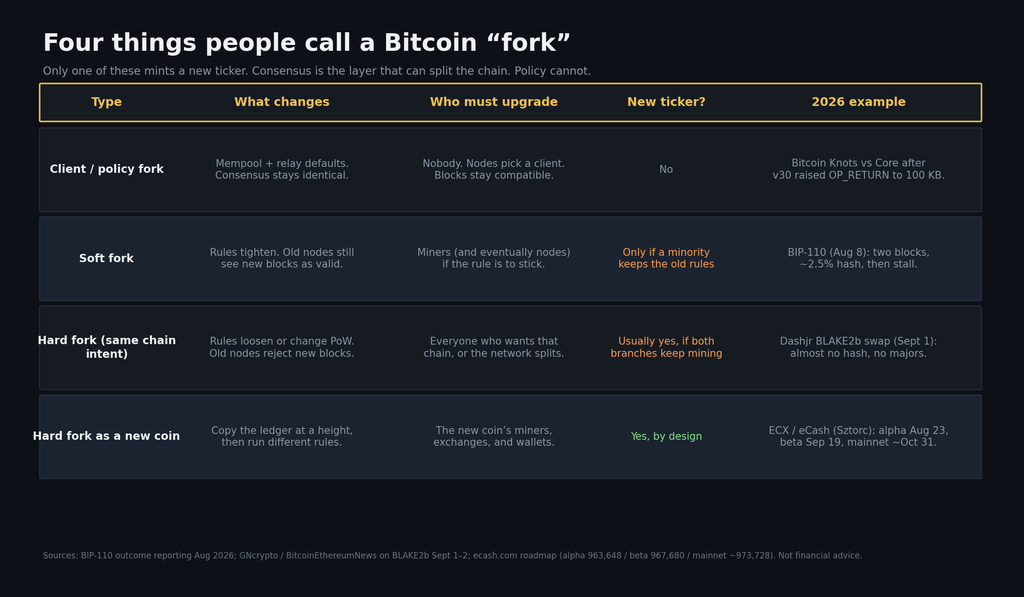
Keep those four rows separate. “Knots is winning” is a statement about node operators. “BIP-110 forked Bitcoin” is a statement about two blocks. “ECX is a Bitcoin fork” is a statement about a scheduled copy. Mixing them is how a reader thinks the ETF product split.
How a split actually shows up in a wallet
Bitcoin does not keep account balances. It keeps unspent transaction outputs — UTXOs. Before a split height, every honest node agrees on that set. After the height, two rulebooks look at the same coins and disagree about which next block is legal.
The 1:1 “airdrop” is that fact, restated as marketing. Your private key signs outputs on both ledgers. No form, no claim portal, no team wallet. ECX’s own copy says as much: at block ~973,728 every bitcoin address is credited, no registration. The same mechanism would have credited BIP-110 coins in August if that branch had lived.
The dangerous sentence is the next one. Because the keys are the same, a raw transaction published on chain B can often be copied onto chain A unless the fork adds replay protection — an extra byte, a different sighash, a forked hash that makes the signature invalid on the other book. BIP-110 did not ship replay protection. Developers including Kevin Loaec warned that moving coins on the minority branch could spend the coins on the majority branch. ECX advertises protection and a splitter. That difference is not a detail. It is the difference between a claimable extra balance and a way to lose the original.
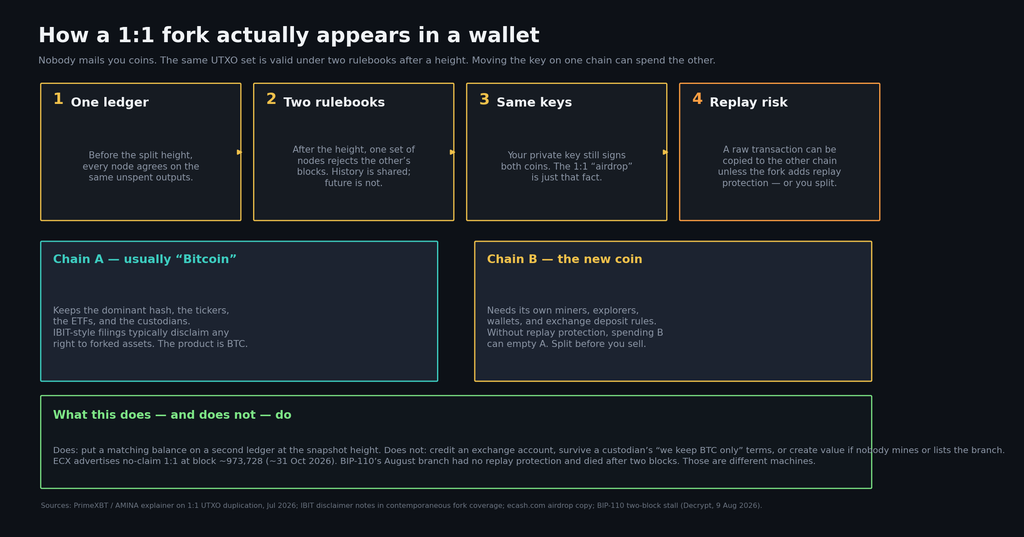
Custodians sit in the middle. A coin on an exchange is a claim on the exchange. If the terms say the product is BTC, the forked units stay with the house, or they never exist on that book at all. BlackRock’s IBIT filings were cited all summer for exactly that disclaimer. Self-custody is the only posture that even has a chance of seeing both ledgers, and only if the holder runs (or trusts) software for the second chain and splits before broadcasting.
That is the mechanical answer to “will I get free coins in October?” You will get a second UTXO set if the second chain exists, if your keys are not on a platform that kept the snapshot, and if you do not replay yourself. Value is a later question.
The last time this was a real war
The 2026 wave is loud because the previous one was quiet for a long time.
From 2015 through 2017 the fight was block size. Bitcoin XT, Bitcoin Classic, and Bitcoin Unlimited were clients that tried to raise the 1 MB cap. None locked in. Segregated Witness shipped as a soft fork in 2017 after a user-activated campaign (UASF) made miner signaling expensive to ignore. On August 1, 2017, the large-block camp left instead. Bitcoin Cash split at block 478,558. Every BTC holder had BCH. The new chain raised the cap — 8 MB, later 32 MB — and rejected SegWit.
That autumn was a factory. Bitcoin Gold copied the ledger on October 24 and switched mining to Equihash; it later suffered 51 percent attacks. SegWit2x was cancelled days before its November height. On November 15, 2018, Bitcoin Cash itself split: Bitcoin SV took the larger-block brief, lost the BCH ticker, and kept a chain. In 2020 the ABC line rebranded toward eCash (XEC) — a BCH descendant, not a fork of BTC.
Taproot activated on November 14, 2021, at block 709,632. It was the last consensus change Bitcoin itself has shipped. OP_CTV, OP_CAT, Drivechains, and later quantum-address proposals sat in the repository without an activation path that looked like Taproot’s.
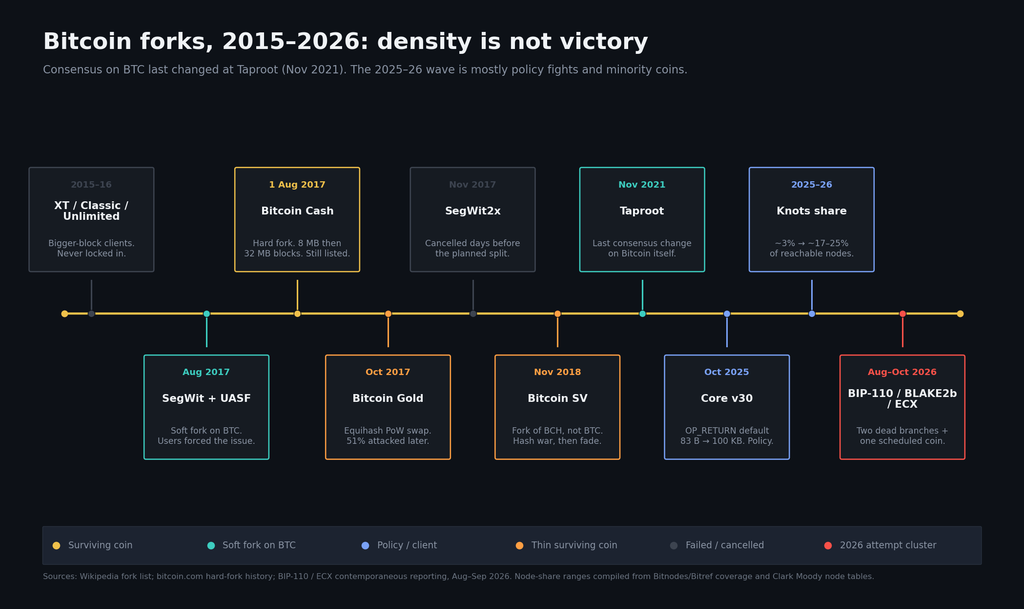
Fidelity’s explainer still uses the old round number: more than a hundred Bitcoin forks, most of them dead. That number was always a graveyard statistic. 2026 added bodies to the graveyard faster than it added rows to the living list.
Why the quiet broke
The trigger was not a new block-size war. It was a fight about what a block is for.
Ordinals inscriptions, BRC-20s, and then Runes taught a new audience that Bitcoin blockspace can carry data that is not a payment. Fees spiked in 2023–24 when inscriptions crowded the mempool, then eased. The philosophical split did not ease with the fees. One camp says anyone who pays the going rate has bought the right to use the space. The other camp says a monetary network that stores arbitrary files raises node costs, invites ugly content onto every archival disk, and trains the chain to be a bulletin board.
Core’s answer, argued from April 2025 and shipped as policy in v30 that October, was to stop pretending the old 83-byte OP_RETURN default was doing the job. Data was already landing in witness fields and in fake keys that bloat the UTXO set forever. OP_RETURN at least keeps the payload out of that set. Raise the relay default, allow more than one OP_RETURN per transaction, and stop pushing data users into worse hiding places. Large OP_RETURN activity had already jumped in the months before v30 shipped. Policy follows miners when miners are already packing the blocks.
Knots’ answer was the opposite default: keep a tight datacarrier cap (42 or 83 bytes, depending on the build), filter inscriptions and Runes at the mempool, treat “spam” as a thing a node is allowed to refuse. That is policy, not consensus — until someone writes a BIP that moves the refusal into the rulebook.
BIP-110 — Reduced Data Temporary Softfork, drafted by the pseudonymous Dathon Ohm with fingerprints the Knots camp does not hide — tried to move that refusal into consensus for a time. Activation used a 55 percent miner-signaling bar, far below older 95 percent designs, plus a mandatory window that would reject non-signaling blocks whether or not the threshold was met. That last clause is why August produced a split instead of a shrug.
Miner signaling never cleared a few percent. Ocean, the non-custodial pool Dashjr had chaired, was the visible hash. The rest of the industry stayed on the main chain. After two blocks the authors marked the BIP closed. Dashjr left Ocean. The BLAKE2b flag-day was the sequel: if SHA-256 miners will not follow, change the puzzle. They still did not follow.
Sztorc drew the other lesson. Soft forks since Taproot have failed to activate, he told crypto.news in September. Drivechains (BIP 300 and 301) had waited a decade for a Bitcoin coalition that never formed. ECX is the workaround: copy the ledger, turn Drivechains on, reset difficulty so the new chain can live even if BTC hash ignores it, and hand every holder a matching balance so the marketing writes itself. Alpha and beta were rehearsals — practice units, not the permanent coin. Mainnet is the one that matters, and it is still a date on a site, not a ticker with a book.
The old forks came along for the ride because traders already knew the tickers. CME’s BCH futures plan and a Grayscale filing are not a verdict on 2017. They are a reminder that a surviving minority chain can still be a listed commodity when the week is slow and the headline is familiar.
What is still standing
Put the living names on one board and the 2026 “rise” looks smaller.
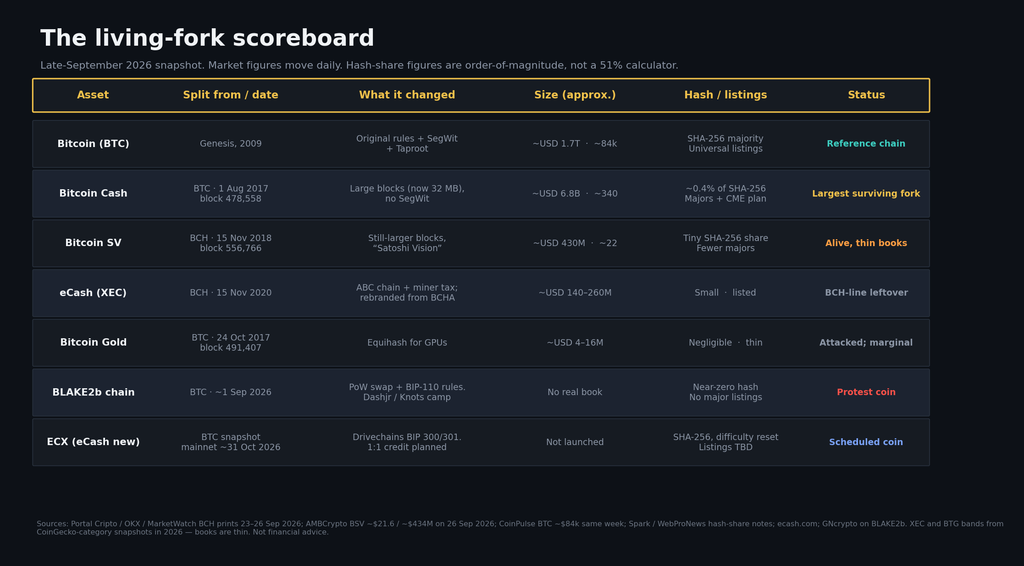
Bitcoin Cash is the adult in that room. It has exchanges, a derivatives headline, a payment-and-large-block story it has told for nine years, and a hash rate on the order of four-tenths of a percent of SHA-256. That last number is why BCH can exist as a market and still be easy to reorganize relative to BTC. Bitcoin SV is the same family, one split further from the original, with fewer listings and a market cap that printed near $430 million on September 26. XEC is the ABC leftover. Bitcoin Gold is a caution about changing the puzzle and then failing to keep honest hash.
The September 1 BLAKE2b chain is a protest coin until it has hash, listings, and a month of blocks that arrive on time. ECX is a scheduled coin until October 31, and then it is whatever miners, exchanges, and a Drivechain economy make of a difficulty-reset copy of Bitcoin. Those are not insults. They are the same tests BCH passed in 2017 and a hundred other tickers failed.
What makes a forked chain worth anything — and what weakens that claim?
A fork coin is not priced as “Bitcoin, but with a different readme.” It is priced as a separate network that happens to share a birthday.
The claim that supports value is narrow and old:
Hash that cannot be rented away for an afternoon. SHA-256 minorities live next to a much larger SHA-256 majority. Change the algorithm, as Gold and BLAKE2b did, and you escape that shadow — and inherit a smaller hardware market, plus the 51 percent history Gold already wrote.
A reason to transact that is not nostalgia. Cheap payments on large blocks. A sidechain thesis. A data ledger. Markets fade the slogan and keep the flow, if any.
Places to sell without a 100 percent spread. Listings, custody, futures. BCH’s September spike was a CME-and-Grayscale story before it was a philosophy story. The BLAKE2b book that opened at $82 bid / $190 ask was a philosophy story that never became a market.
Replay protection and sane wallets. If holders cannot separate the coins, the “free money” is a way to lose the expensive money. Exchanges will not list a chain that can drain BTC deposits.
A social settlement about the name. In 2017 both sides wanted to be Bitcoin. The market kept the name on the chain that kept the dominant hash, the existing brand, and the least-broken coalition. Every later fork that advertised itself as the real Bitcoin paid a tax to that settlement.
What weakens the claim is the mirror of that list. A difficulty that cannot adjust before the chain starves — BIP-110’s two blocks sat in front of a ~350-day adjustment clock. A PoW change that the installed hardware base will not run. A reassignment of dormant coins on the copy, which ECX’s critics flagged around Satoshi-linked balances on the forked chain (BTC itself is untouched). A custodian layer that has already disclaimed the asset. A node-share victory that never shows up in hash or in settlement.
BCH at launch traded as a high-single-digit percentage of BTC. By 2026 that ratio is a few tenths of a percent. The dollar price can still jump 35 percent in a week. The relative claim did not recover. That is the honest long chart for anyone who thinks a 2026 copy will “become Bitcoin.” It can become a listed side asset. It has not, in nine years of tries, become the reference.
Which signals separate a real network from a protest chain?
Ignore the manifesto for a week and watch the plumbing.
Blocks per day, not stars on GitHub. A living chain prints on a schedule its difficulty can defend. Two blocks and silence is a press release that ended. Thirty days of ten-minute-ish blocks with a rising difficulty is a network.
Hash source. If the only pool is the founder’s, you have a demo. If hash arrives from operators who also mine BTC and could leave tomorrow, you have a rented pulse. Dedicated hardware and a fee market that pays them to stay are the upgrade.
Replay protection in the first shipped binary, plus a splitter that non-developers can run. If that is missing, treat every movement as a way to spend the original.
Exchange deposit rules, not tweets about “listing talks.” A ticker with a chain ID, a minimum confirmation count, and a pause button during reorgs is a product. A beta book with a 130 percent spread is a screenshot.
Node count is the weakest of the loud metrics. Knots at ~17–25 percent of reachable nodes is a real fact about what operators want to relay. It did not move BIP-110 onto the main chain. Nodes filter gossip. Miners and economic nodes settle which history wallets treat as spendable. The 2017 UASF worked because enough economic weight stood behind the threat. Proof-of-node does not rename Bitcoin.
Custody and wrappers. Watch whether any ETF, broker, or large custodian amends a filing to carry the new asset. The default in 2026 is the opposite amendment: we keep BTC. Until that sentence flips, the “holders get a copy” pitch applies to people who already hold keys.
Near-term dates that are actually tests. October 19 is CME’s planned BCH futures date, subject to review — a test of whether the old fork still belongs in a listed complex. On or around October 31, ECX either produces a mainnet book or becomes another rehearsal. Neither date changes BTC’s rules. Both dates tell you whether “forks are back” means markets or mailing lists.
If those series stay dead while the rhetoric stays hot, you are looking at a client war and a coin factory. Those can run for years. They are not the 2017 split.
What still breaks people
Replay is the amateur trap. Ideology is the professional one.
A holder who broadcasts on the wrong chain without a split can donate the original. A holder who leaves coins on an exchange can discover the terms already assigned the extra units to the house. A holder who treats Knots versus Core as “two Bitcoins” will misread every headline until someone ships a consensus change that Core will not run.
There is a legal layer underneath the folklore. Forked assets have been taxed as new property in some places when they hit a wallet, ignored until sale in others, and simply not recognized when a regulated wrapper never took them. That is not advice. It is why “1:1” and “income” should not appear in the same unexamined sentence.
There is a content layer the BIP-110 camp will not drop: a public archive will eventually hold something a node operator does not want to store. Policy filters, consensus bans, and “charge a fee and do nothing” are three answers. 2026 proved the first two can fork a community without forking the asset the world prices.
Small SHA-256 chains can be reorganized with hash rented from BTC. Algorithm-changed chains can be 51-percent’d with whatever hardware their puzzle uses — Gold already wrote that case. A brand-new PoW with no installed base has the opposite problem: not enough honest hash to keep the clock.
The outlook that does not need a price
Bitcoin’s consensus rules can stay frozen and the word “fork” can still trend. Core and Knots can keep shipping different defaults. Covenants and quantum BIPs can stay specified. Sztorc can keep building the chain Bitcoin would not vote in. BCH can list a future.
None of that requires BTC holders to do anything, except the people who intend to touch a second ledger: wait for replay protection, split before you move, read the custodian sentence, and treat the new ticker as a new coin until hash and books say otherwise.
A fork is a disagreement about rules, recorded in software. Most disagreements end as clients. A few end as coins. One coin, so far, kept the name. The rest of the graveyard is why “on the rise” is a headline about attempts.
Key takeaways
Bitcoin’s last consensus change was Taproot in November 2021. The 2025–26 wave is mostly policy (Core v30 vs Knots), one failed UASF (BIP-110), one ignored PoW swap (BLAKE2b), and one scheduled copy (ECX).
A client fork is not a chain split. Knots at roughly a fifth of reachable nodes is a political fact. It does not mint a ticker.
Soft forks can still split a network if activation makes a minority reject majority blocks. BIP-110 did that for two blocks and then died.
A 1:1 fork credit is the same UTXO set under a second rulebook. Exchanges and ETFs often disclaim it. Replay protection is the difference between an extra balance and a way to lose BTC.
BCH remains the only Bitcoin-line fork with a multi-billion-dollar book (~$6.8B near $340 in late September 2026). BSV is an order smaller. The new 2026 coins are not on that board yet.
Value on a fork tracks dedicated hash, a reason to transact, listings, and the right to the name. Manifestos and node-share screenshots do not clear that bar.
Watch blocks-per-day, who is mining, replay tooling, actual deposit rules, and whether any regulated wrapper changes its sentence on forked assets. October’s BCH futures date and ECX’s Halloween target are tests of those series — not of Bitcoin’s rules.
The rise is real if you are counting calendars. It is small if you are counting chains that still settle.
Subscribe for more research like this: https://cryptopress.substack.com/subscribe