

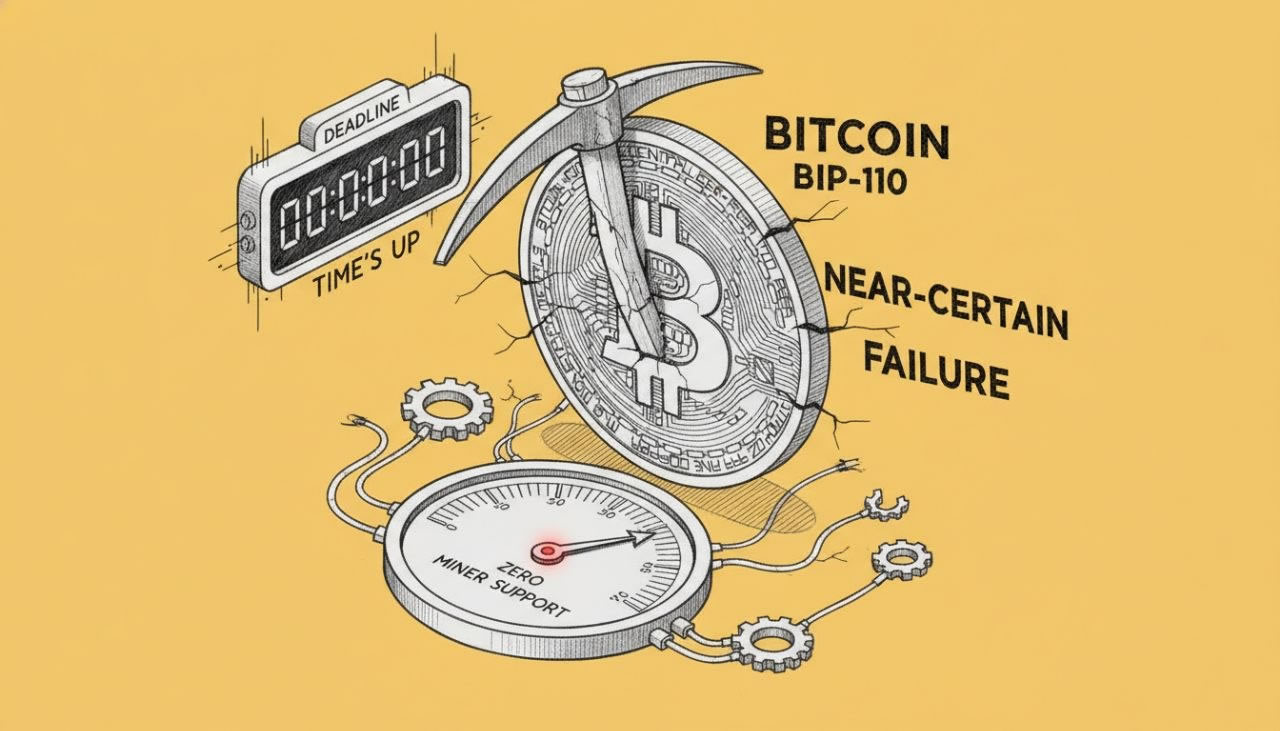
- BIP-110, a proposed temporary soft fork to limit non-financial data like inscriptions, heads toward an early August deadline with miner signaling below 1% and currently at zero.
- Strategy’s Michael Saylor and Blockstream’s Adam Back publicly oppose the measure, arguing it turns a spam debate into a dangerous consensus change that could invalidate valid transactions.
- Node adoption remains in the low single digits, making a network-wide activation highly unlikely and pointing instead to a potential minority fork.
As Bitcoin grapples with ongoing debates over block space usage, a controversial proposal to temporarily restrict arbitrary data is on track to fail, underscoring the network’s resistance to protocol changes amid low miner and node support.
The BIP-110 proposal, formally the Reduced Data Temporary Soft Fork, seeks to cap OP_RETURN outputs and limit larger data pushes—methods commonly used for Ordinals inscriptions and other non-monetary content—for one year. Proponents argue it would refocus Bitcoin on its core role as peer-to-peer electronic cash and ease burdens on node operators following recent relaxations in Bitcoin Core.
However, signaling data tells a clear story. Miner support has never exceeded about 1% and stands at zero in the current period, far below even the lowered 55% threshold for its user-activated soft fork mechanism. Node adoption hovers in the low single digits, primarily via alternative clients like Bitcoin Knots.
Michael Saylor, Executive Chairman of Strategy (formerly MicroStrategy), strongly criticized the idea in a July 11 X post: “There are 110 things more dangerous to Bitcoin than spam. BIP 110 turns a spam dispute into a consensus change that would invalidate some currently valid, fee-paying transactions. That precedent is the danger.” (via X).
Blockstream co-founder Adam Back echoed similar concerns, telling supporters: “Bitcoin respectfully says no to what you want,” suggesting those seeking the change should fork away if needed, but the main chain would not join.
The deadline looms with the current signaling period ending around block 959,615, followed by a voluntary lock-in at block 961,542 in early August. Even if a small subset of nodes enforces it, the lack of broad consensus would likely result only in a minority chain split rather than altering Bitcoin for the majority.
This outcome highlights Bitcoin’s conservative approach to consensus changes. While block space concerns are valid—non-financial data has increased since adjustments in Bitcoin Core 30—the network’s decentralized governance prioritizes stability over targeted interventions. Critics of BIP-110 warn that altering rules to deem certain fee-paying transactions invalid sets a risky precedent that could erode trust in Bitcoin’s immutability.
As of July 13, 2026, with Bitcoin trading near $63,000, the focus remains on market dynamics and institutional adoption rather than internal protocol disputes. The BIP-110 episode serves as a reminder that meaningful changes require overwhelming agreement across miners, nodes, and the broader community—something this proposal has conspicuously failed to achieve.
Disclaimer: This article is for informational purposes only and does not constitute advice of any kind. Readers should conduct their own research before making any decisions.