

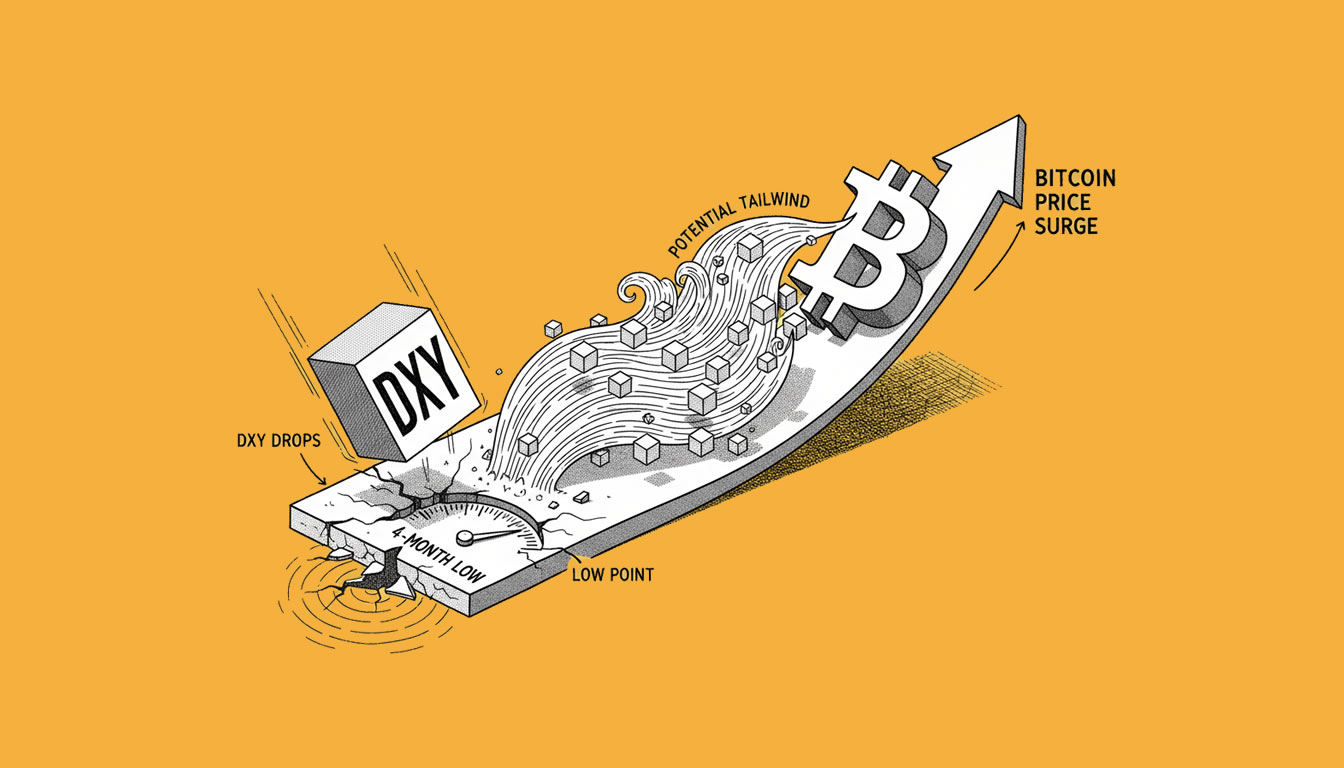
- The US Dollar Index (DXY) fell to its lowest level in four months, nearing the 97 mark.
- Dollar weakness often acts as a catalyst for Bitcoin and other risk assets.
- Bitcoin’s current price action is mixed, pressured by major crypto ETP outflows ($1.7 billion) and general risk-off sentiment.
- Gold has significantly outperformed crypto, surging past $5,000 amid macro uncertainty.
The US Dollar Index (DXY) continued its descent, reaching a four-month low near 97 on January 26, 2026. This dip signals growing market anticipation that the Federal Reserve may adopt a more dovish monetary policy stance soon.
The index’s decline below key technical levels has historically created a favorable environment for risk assets, including Bitcoin, as a weaker dollar typically drives capital toward alternatives perceived as inflation hedges. A soft dollar often correlates inversely with BTC prices.
However, Bitcoin’s response has been underwhelming. Trading near $87,000, BTC is struggling under the weight of recent negative flows; exchange-traded products (ETPs) saw net outflows totaling $1.7 billion last week, the largest such exodus since November 2025. This indicates persistent risk aversion in the market.
In a notable divergence, traditional safe-haven assets like gold have surged, crossing the $5,000 threshold. This suggests investors are favoring established hard assets over digital assets during this period of macroeconomic and geopolitical apprehension.
While the DXY’s technical breakdown provides a potential long-term tailwind for Bitcoin (BTC), immediate price action remains constrained by derivatives positioning and broader market sentiment. Traders are keenly awaiting the Fed’s policy update for definitive direction.
Major altcoins, including Ethereum (ETH), are mirroring the cautious trading pattern observed in the flagship cryptocurrency.
Disclaimer: This article is for informational purposes only and does not constitute advice of any kind. Readers should conduct their own research before making any decisions.