
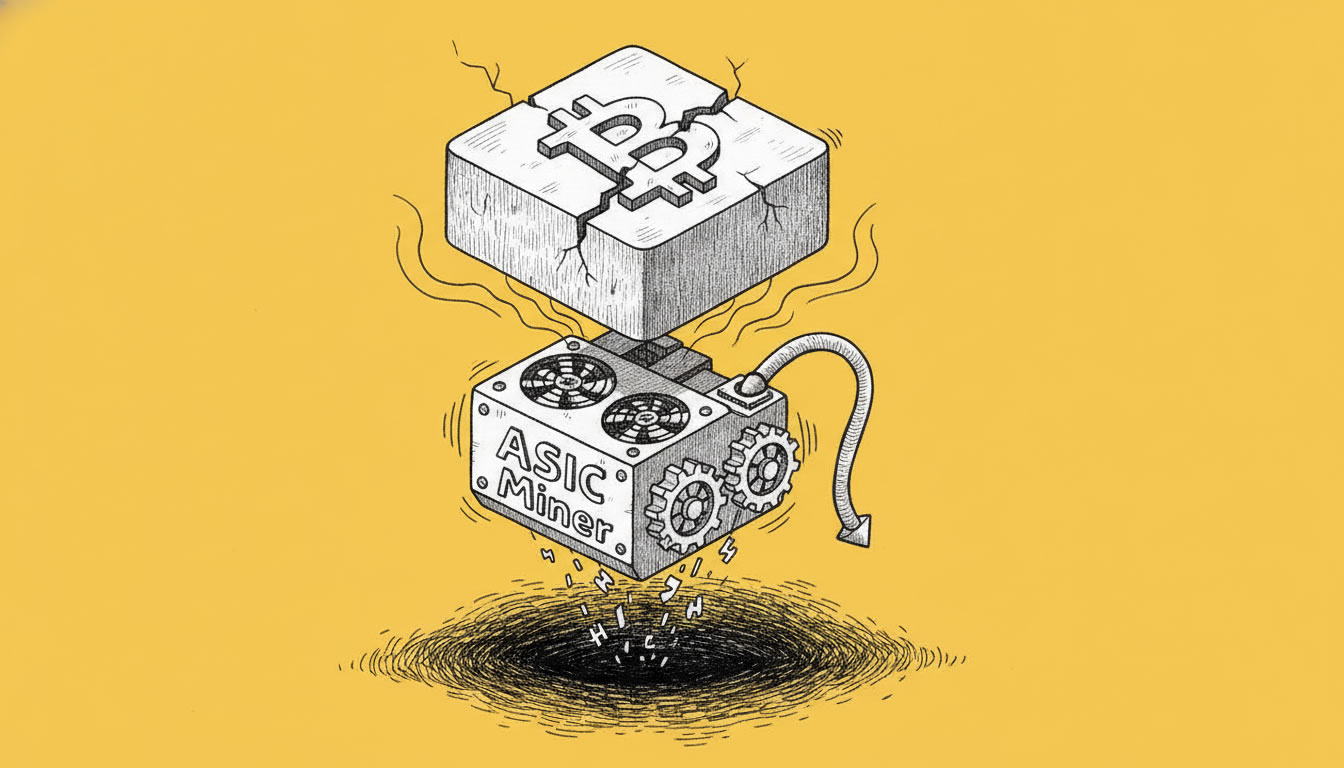
In mid-August 2026, Bitcoin’s network hashrate sits roughly 17% below its all-time high. Trackers show it retreating from a late-2025 peak above one zettahash per second into a range near 850–920 exahashes per second. Difficulty has followed, posting year-over-year declines for only the second time in the network’s history. Public miners are redirecting power and capital toward artificial-intelligence data centers. Hashprice has compressed. Block rewards after the 2024 halving leave less room for error.
This is not the China ban of 2021. There is no single government decree. Yet the numbers look familiar: sustained hashrate contraction, multiple downward difficulty adjustments, and miners deciding that electricity has better uses than pure SHA-256 hashing. The question is what the drop actually signals for Bitcoin itself.

What Hashrate Actually Measures
Hashrate is the total computational power dedicated to finding valid blocks. Every second, miners across the network perform quintillions of SHA-256 hashes, searching for a nonce that produces a hash below the current difficulty target. The higher the collective hashrate, the more work an attacker would need to rewrite recent history or stage a 51% attack.
Difficulty adjusts every 2,016 blocks—roughly two weeks—so that blocks arrive on average every ten minutes regardless of how much power is online. When hashrate falls, blocks slow. The next adjustment lowers the target, making mining easier for remaining participants until equilibrium returns. The mechanism is automatic, transparent, and has operated without interruption since 2009.
A drop in hashrate therefore does two things at once. It reduces the absolute cost of an attack in the short term, and it triggers the protocol’s built-in response that restores the ten-minute cadence. The system is designed for exactly this kind of fluctuation.
Why Hashrate Is Falling in 2026
Three overlapping forces are at work.
First, mining economics tightened after the April 2024 halvings cut the block subsidy from 6.25 to 3.125 BTC. When Bitcoin later fell roughly 49% from its October 2025 peak near $125,000, hashprice—the expected daily revenue per petahash—slid toward the high $20s and low $30s. Older, less efficient ASICs fell below breakeven. Operators unplugged them.
Second, publicly listed miners discovered a more lucrative use for the same infrastructure. Facilities already equipped with high-power electrical connections, cooling, and land became attractive hosts for AI and high-performance computing workloads. Companies such as Hut 8, Core Scientific, TeraWulf, and IREN signed multi-billion-dollar contracts. Hut 8’s AI portfolio alone has been reported above $26 billion. Across the public sector the cumulative figure exceeds $70 billion. Power that once hashed Bitcoin is now rented to train models. In some cases the AI business already generates more revenue than mining itself.
Third, smaller regional pressures added friction: Texas 4CP curtailment seasons, elevated electricity prices in certain grids, and isolated outages. None of these alone would produce a multi-month drawdown. Together they reinforced the economic signal.
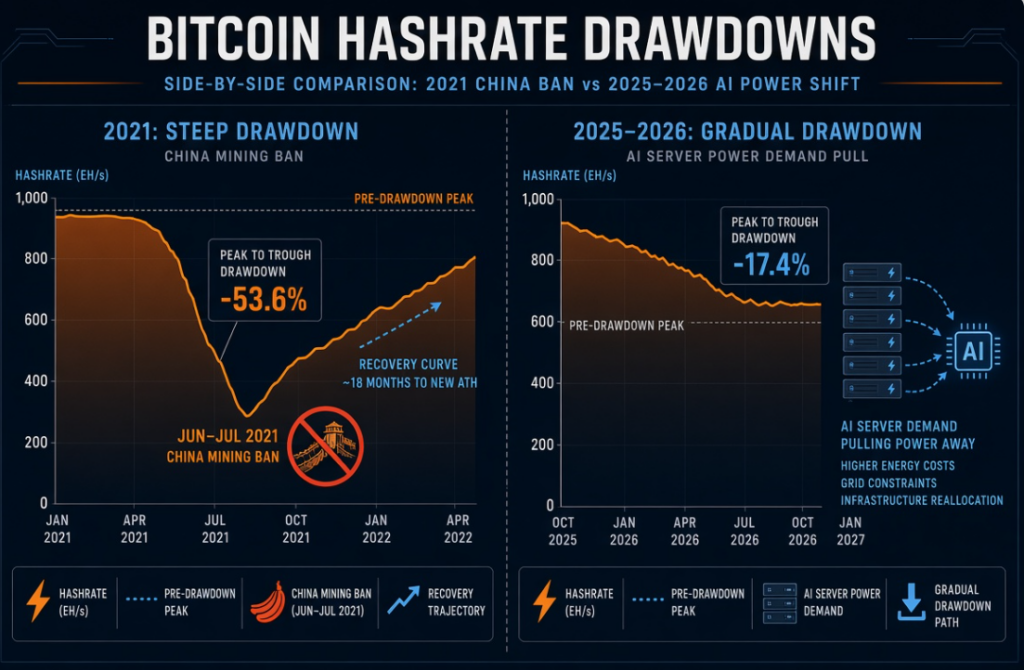
The result is the third-deepest hashrate contraction of the ASIC era and the first sustained year-over-year difficulty decline since the China exodus. Unlike 2021, there is no policy reversal expected that will force the departed machines back online.
Historical Perspective: The 2021 China Ban
In the summer of 2021 China ordered the shutdown of domestic mining. Hashrate collapsed more than 50% in weeks. Difficulty recorded its largest single drop. For a moment the network looked vulnerable. Within months the same machines reappeared in the United States, Kazakhstan, Russia, and elsewhere. Hashrate recovered, then exceeded previous highs. Difficulty climbed to new records. The protocol absorbed the largest geographic shock in its history without missing a block or suffering a successful attack.
The 2026 episode is smaller in percentage terms—around 17% from the peak rather than more than 50%—but longer in duration and driven by market incentives rather than prohibition. Miners are not fleeing regulation; they are reallocating capital toward higher expected returns. The same difficulty adjustment mechanism that protected the network in 2021 is operating today. Block times stretch modestly, difficulty falls, remaining miners become more profitable on a per-hash basis, and the incentive to return or expand gradually reappears.
Security Implications
A lower hashrate reduces the raw computational cost of an attack. In absolute terms the network is less expensive to overwhelm than it was at the peak. Yet several factors keep the practical risk low.
First, the remaining hashrate is still measured in hundreds of exahashes. An attacker would need to assemble and power an enormous amount of specialized hardware, most of which is already committed to honest mining or AI workloads. Second, difficulty adjusts downward, but it does so gradually and transparently. Third, the economic cost of acquiring enough ASICs and electricity remains prohibitive for most actors, especially when the reward would be a short-lived chain reorganization that markets would reject.
Bitcoin’s security has never rested solely on the absolute level of hashrate. It rests on the combination of proof-of-work incentives, the difficulty adjustment, the geographic and ownership distribution of miners, and the social consensus that only the heaviest valid chain is Bitcoin. Those elements remain intact.
What It Means for Miners and Markets
For efficient operators the difficulty decline is a temporary relief. Lower difficulty raises the expected share of blocks for any given hashrate, partially offsetting the lower Bitcoin price. Older hardware still faces pressure; newer fleets with better joules-per-terahash ratios can continue. Public miners that successfully pivot to AI host contracts gain a more stable revenue stream and may treat Bitcoin mining as a flexible, opportunistic use of residual capacity rather than the sole business.
On the market side, public miners sold more than 32,000 BTC in the first quarter of 2026 alone—more than they sold in all of 2025. That supply has already been absorbed. Transaction fees remain a small fraction of miner revenue (near 0.7% in some recent readings), so the block subsidy still dominates. Any future rise in fee pressure or a sustained price recovery would improve the equation for pure miners.
The structural shift is the more interesting long-term development. Mining companies are becoming dual-use infrastructure providers. The same substations, transformers, and land can serve either Bitcoin or AI depending on relative profitability. This increases the opportunity cost of pure hashing and may keep hashrate more sensitive to price and energy markets than in previous cycles.

Broader Implications for Bitcoin’s Design
Satoshi’s difficulty adjustment was written for a world in which hashrate would fluctuate. It has now been tested by state-level bans, energy crises, halvings, and, in 2026, the emergence of a competing high-value use for the same physical capital. Each time the network has continued to produce blocks at the target rate once difficulty recalibrated.
The current episode also illustrates that Bitcoin’s security budget is not static. After the next halvings the subsidy will shrink further. Fees and the willingness of miners to operate at thinner margins will matter more. The AI pivot accelerates that conversation by demonstrating that electricity and capital have alternatives.
None of this requires panic or celebration. It is the protocol functioning as designed under new economic conditions. Hashrate is a lagging indicator of miner profitability and opportunity cost. Difficulty is the automatic governor. Price, energy markets, and competing demand for power determine where the equilibrium settles.
Looking Ahead
Hashrate will not stay at any particular level permanently. If Bitcoin’s price recovers or energy costs fall, marginal machines return and new capacity is added. If AI demand continues to outbid mining for power, the dual-use model expands and pure hashrate growth slows. Both outcomes are compatible with a functioning Bitcoin network.
The deeper lesson is resilience. A drop that once would have been framed as existential is now understood as the difficulty adjustment doing its job. The network that survived the loss of more than half its hashrate in 2021 is navigating a smaller, market-driven contraction in 2026 without drama.
For readers watching the charts, the useful questions are practical rather than alarmist: How quickly is difficulty responding? Are remaining miners geographically and operationally diverse? Is the AI pivot creating more flexible capacity that can swing back to Bitcoin when conditions improve? Those answers will matter more than any single percentage decline from an all-time high.
Bitcoin’s hashrate has always been a reflection of incentives. When the incentives change, the hashrate follows. The protocol continues.
Subscribe to Cryptopress for more evergreen analysis of Bitcoin’s fundamentals and the forces shaping its network: https://cryptopress.substack.com/subscribe