

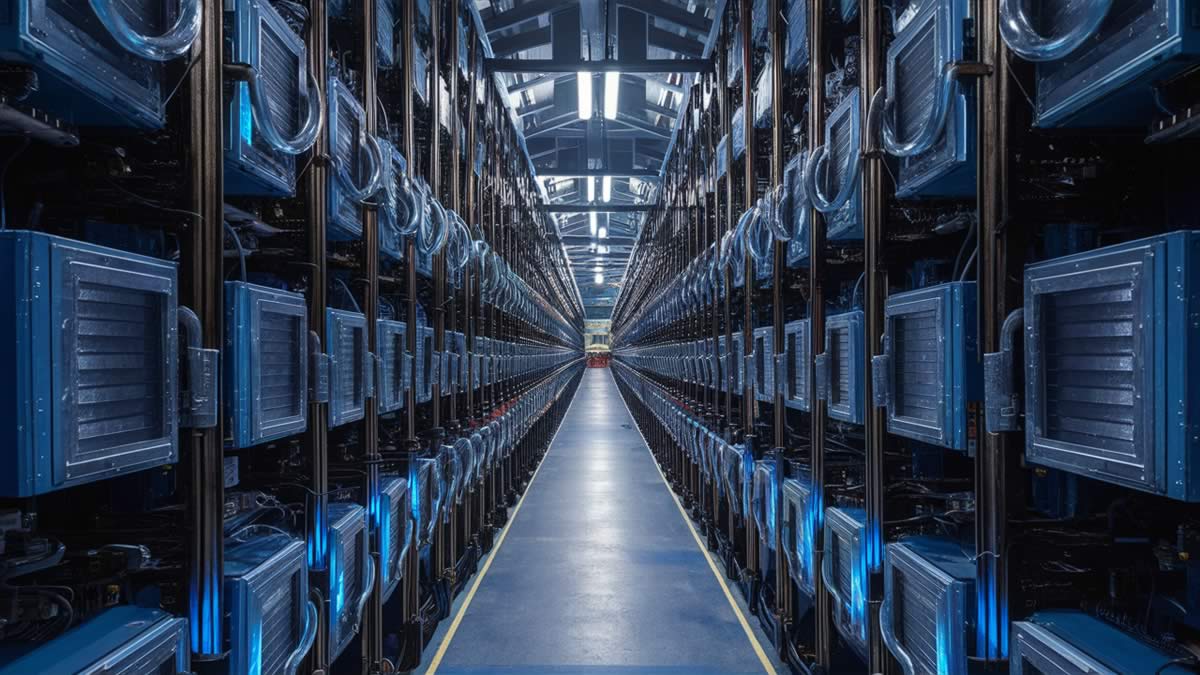
Cryptocurrency mining has evolved from an activity carried out by enthusiasts in their homes to a professionalized industry with dedicated data centers. In this article, we will discuss the mining process, technological advancements, and profitability in the current context.
The Cryptocurrency Mining Process
The foundation of cryptocurrency mining is blockchain technology. This digital ledger records all transactions of a cryptocurrency. Miners play a crucial role in verifying these transactions and grouping them into blocks that are then added to the chain.
Miners use powerful computing equipment to solve complex mathematical problems. This process, known as proof of work (PoW), involves finding a unique value (nonce) that, when fed into an algorithm, produces a hash that meets certain criteria. The first miner to solve the problem adds the block to the blockchain and receives a cryptocurrency reward.
Rewards and Halving
Rewards are a key incentive for miners. However, in cryptocurrencies like Bitcoin, these rewards are cut in half roughly every four years in an event called a “halving.” This controls inflation and the total supply of the cryptocurrency.
Mining Equipment: From CPU to ASIC
Initially, mining was done with CPUs, the central processing units of regular computers. As mining difficulty increased, miners migrated to GPUs, more efficient graphics cards for parallel processing.
The introduction of ASICs (Application-Specific Integrated Circuits) marked a milestone in cryptocurrency mining. ASICs are chips specifically designed to perform the mining task extremely efficiently. Their ability to solve mathematical problems at a much faster rate and with lower power consumption makes them the preferred choice today.
Profitability of Mining
To evaluate the profitability of this activity we must take into account, among others, the following factors:
Operating Costs
Operating costs, such as electricity consumption and hardware maintenance, are critical components. In regions with cheap electricity, mining can be more profitable.
Cryptocurrency Price
The price of the cryptocurrency is also a determining factor. An increase in the value of the cryptocurrency can significantly increase profitability, while a drop can make mining less attractive or even unsustainable.
Mining Difficulty
Mining difficulty, which is regularly adjusted based on the total network power, influences the amount of time and resources required to mine a block. Higher difficulty can reduce individual miners’ earnings.
Rewards and Commissions
In addition to block rewards, miners receive fees for the transactions included in each block. These fees can be an additional source of income, especially during times of high network activity.
Current Mining Trends
Data Centers and Cloud Mining
Today, mining has largely become a professional activity. Large data centers with thousands of ASICs operate in strategic locations with low electricity costs. In addition, cloud mining allows investors to rent hashing power without the need to manage hardware.
Environmental Impact and Sustainable Solutions
Cryptocurrency mining, especially Bitcoin, has been criticized for its high energy consumption. However, the industry is exploring sustainable solutions, such as using renewable energy and optimizing mining processes to reduce their environmental impact.
Cryptocurrency mining remains a critical activity for the operation and security of blockchain networks. Despite challenges such as high energy consumption and market volatility, hardware innovation and the pursuit of more sustainable practices keep mining a viable and evolving activity. For those interested in this sector, it is crucial to stay informed about technological developments and market conditions in order to maximize profitability and contribute responsibly to the cryptocurrency ecosystem.