

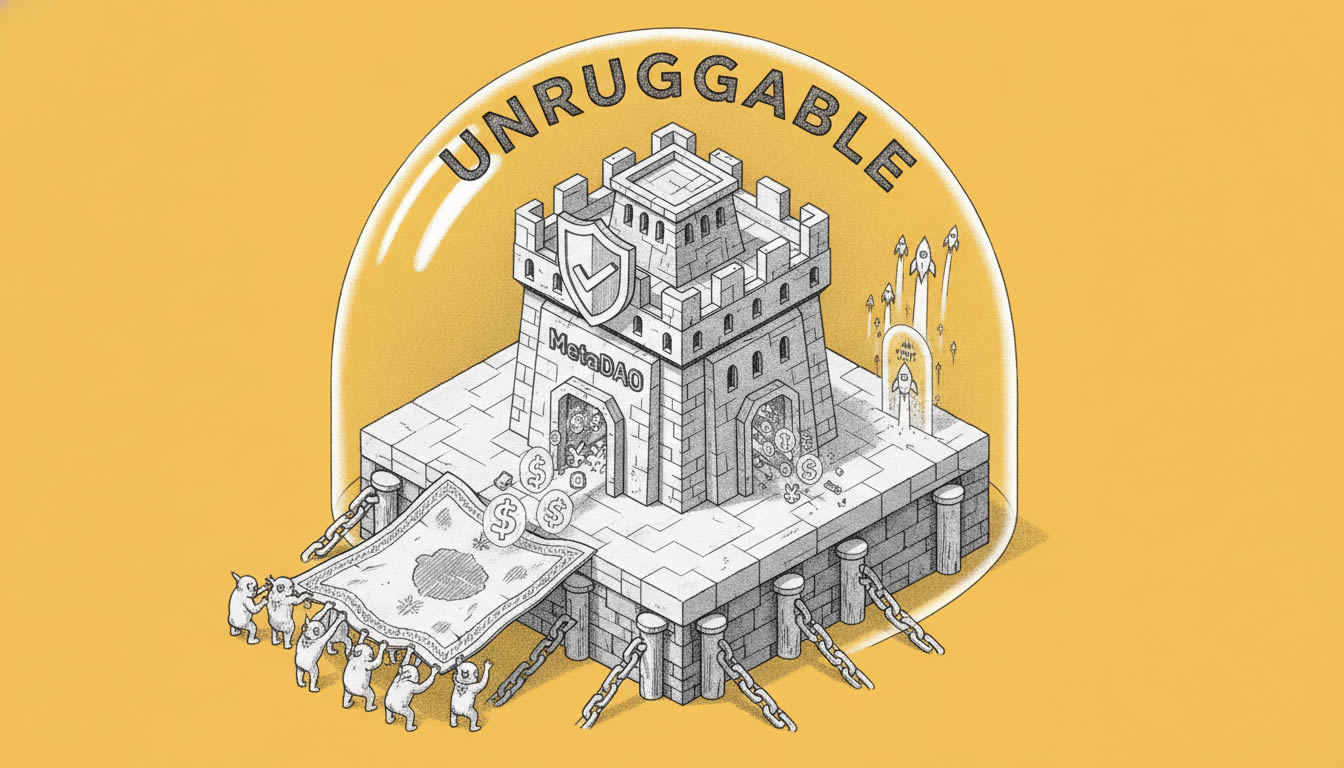
In four days in 2025, wallets committed about $155 million of USDC to Umbra, a Solana privacy protocol raising on MetaDAO. The project kept $3 million. The rest went back.
That gap is the whole story in miniature. Public token sales are noisy again. They are not the 2017 version of public token sales. The money that actually stays in a treasury is smaller, slower, and — if the pitch is honest — harder to steal. MetaDAO, a Solana venue that started as a governance experiment in November 2023, has spent two years turning that pitch into a product: a four-day ICO, a market-governed treasury, a legal wrapper around the intellectual property, and a token, META, that the market has already re-rated faster than the operating results.
On August 18, 2026, the U.S. Securities and Exchange Commission proposed Regulation Crypto Assets. Buried in that release is a Startup Exemption — proposed Rule 200 — that would let an issuer raise up to $5 million over four years from U.S. retail, with general solicitation and no individual check-size cap, so long as it files a notice and keeps a principles-based narrative online. Most of the raises MetaDAO has accepted already live inside that $5 million band.
This is not a prediction that 2017 is returning. It is a map of the machine MetaDAO built, what it collects in fees, why META trades where it trades, and which observable things — a final rule, launch cadence, a fee switch, another Paystream — would support or weaken that price.
The ICO did not die. It changed rooms.
The first coin-offering boom was a jurisdictional accident. Ethereum made it cheap to sell a token to anyone with a browser. U.S. securities law did not disappear; it was ignored until it was not. By 2018 the pipeline had moved into private rounds, exchange-run IEOs, then “fair launches,” then points, then low-float listings at venture valuations. Retail still bought. It bought later, and worse.
The last eighteen months put public sales back on the calendar without restoring the old shape. CryptoRank’s compilation of disclosed ICO, IEO, and IDO figures from 2020 through mid-June 2026 counts roughly $8.25 billion across 6,957 sales. The interesting number is not the total. It is the concentration. Average disclosed proceeds rose to $2.08 million in 2025 and $3.15 million in 2026 year-to-date — even as the count of sales collapsed. May 2026 printed thirteen public sales, the weakest month since late 2020. Second-quarter 2026 proceeds were about $58 million, against $849 million in the first quarter of 2025.
Capital did not leave the industry. It changed rooms: venture rounds with no token, Coinbase’s purchase of Echo, Legion’s MiCA-licensed book, Pump.fun’s $600 million PUMP sale. Community ICOs on those newer rails raised more than $340 million in a 62-day stretch late in 2025.
MetaDAO is not trying to win that game on volume. It is trying to win it on a claim that most of those venues still treat as marketing: the team cannot leave with the money.
What MetaDAO actually is
MetaDAO is two products sharing one market.
The first is futarchy — a word Robin Hanson put into circulation two decades ago, and which here means something concrete. When a proposal is posted, the protocol opens two conditional markets, PASS and FAIL. Traders buy and sell the project token in each world. After a window, the protocol compares time-weighted average prices. The world in which the token is more valuable is the decision. Losing trades revert. Winning trades settle. People who want a proposal to pass have to pay for the privilege of being right about the token, not just about the chat.
The second product is the ownership-coin launch. A founder publishes terms: minimum raise, monthly allowance, optional performance package, list of intellectual property that will be assigned to an entity. Investors commit USDC for four days. Everyone pays the same price. Allocations reward size and time-in-pool — an accumulator that grows with committed dollars times seconds, plus a fill boost for people who funded when the book was still thin. The founder then chooses a discretionary cap: how much of the committed pile the project actually keeps. Fail the minimum and everyone is refunded.
If the sale clears, three things move at once. The USDC goes to a treasury the founder does not unilaterally control. Mint authority goes with it. Twenty percent of the USDC and 2.9 million tokens seed liquidity pools, which in practice buy the token below the ICO price and sell it above. Ten million tokens go to the sale. Insiders, if they opted in, sit in a separate performance package of up to 12.9 million tokens that unlock in five tranches only if a three-month TWAP prints 2×, 4×, 8×, 16×, then 32× the ICO price, with at least eighteen months on the clock.
The legal layer is the part that makes the slogan expensive. MetaDAO’s write-ups and third-party reviews describe the same structure: treasury plus IP (repos, domains, social accounts) assigned to a Marshall Islands DAO LLC or a segregated portfolio that is contractually bound to treat the futarchy as controller. That is not a U.S. registration. It is an attempt to make “we might just incorporate somewhere else and keep the product” a lawsuit instead of a tweet.
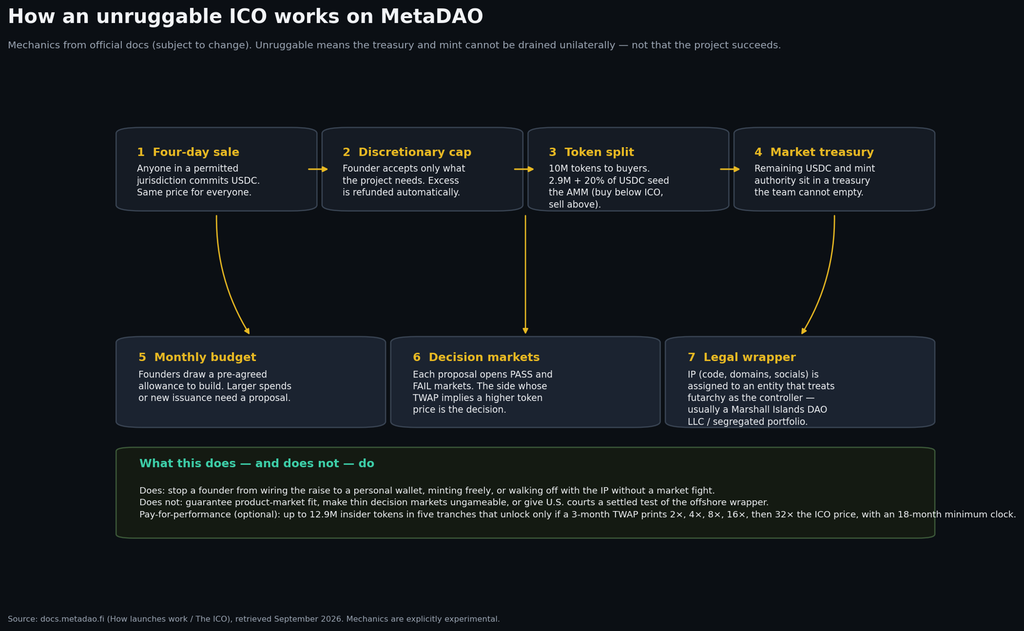
Diagram: the sale, the cap, the AMM seed, the monthly tap, the decision markets, and the wrapper. Official docs still flag the sale design as experimental.
Call the design what it is. It makes an exit rug expensive. It does not make a product. It does not make a thin market honest. It does not tell you whether a Marshall Islands clause survives the first serious U.S. complaint. Those are different sentences, and the platform is more useful when they stay different.
What has actually launched
The first ICO on the pad was mtnCapital, a futarchy-governed fund, which closed on April 9, 2025 at about $5.8 million from roughly 1,900 wallets. It later redeemed and returned capital — the unglamorous proof that “unruggable” can mean “we gave the money back.” Omnipair followed in July 2025 at $1.12 million from 321 wallets.
The book got louder after that. On-chain tallies compiled by blocmates on Dune show the shape of demand versus proceeds on the larger curated sales:
- Umbra: $3.0 million raised against $155 million committed (about 207×), 10,519 wallets.
- Solomon: $8.0 million against $103 million, 6,604 wallets.
- Ranger: $8.0 million against $86 million, 8,761 wallets. Ranger was the first MetaDAO raise with existing investors and a leftover cap table, which is a different animal from a clean genesis sale.
- Avici: $3.5 million against $34 million, 7,352 wallets. The company has since said weekly active users moved from about 1,000 to about 10,000.
- Loyal: $2.5 million against $76 million.
- ZKLSOL: about $0.97 million against $15 million.
- Paystream: $0.75 million against $6.1 million.
- Rip Cars: on the order of $250,000 kept against roughly $32 million committed.
Commitments across the pad have run into the hundreds of millions of dollars. Accepted proceeds have not. 01Resolved, which tracks the ownership-coin set, counted 21 MetaDAO-launched coins and about $43 million raised through early September 2026. Snapshots on the official site have printed $33 million to $45 million depending on the week and on whether permissionless Futardio sales are in the total. The honest range is “tens of millions kept, not hundreds.”
Two post-raise outcomes matter more than the oversubscription screenshots.
Avici is the brochure case: a fintech with a card and a founder willing to say the launch was one of the better decisions the company made. Paystream is the other case. After nine months and several pivots, a decision market in early September 2026 passed a proposal to cease operations and liquidate the treasury. That is the mechanism working in the direction nobody puts on a landing page.
The founder pipeline is no longer only outbound. By late 2025 the team was describing inbound flow and a move toward “quasi-permissionless” listings, with Futardio as the actual permissionless door and a curated queue still in front of the flagship pad. Intake still asks for a burn rate, a minimum viable raise, a performance-package config, and a list of IP the founders will give up. That last item is the filter.
STAMP — Simple Token Agreement, Market Protected — is the pre-sale contract meant to replace a SAFE. Private capital is supposed to sit in restricted accounts, with boxed allocations and vesting tied to a delivery notice. Ranger shows the hangover arriving anyway: existing investors, a points preference, a performance package with price gates. The pad is maturing by getting messier, which is what maturity looks like.
Why is META worth what it is worth?
META is the venue token. After a 1-for-1,000 migration from the old METAC contract, circulating supply and total supply sit together around 22.7 million. There is no hard cap; new issuance needs a passed proposal. Paradigm led a $2.2 million seed in August 2024. Variant and 6MV added later checks. Coinbase listed the token in May 2026. A MiCA white paper was filed with the Irish regulator in July 2026.
The cash register is narrow. The Futarchy AMM takes 25 basis points on volume. DeFiLlama treats protocol fees and protocol revenue as the same number because nothing is routed to holders. The fee switch is off. There are no programmed buybacks, burns, or dividends. Holders’ revenue on DeFiLlama is $0.
Cumulative fees through mid-September 2026 are about $3.16 million. The trailing thirty days were about $146,000 — call it $1.75 million annualized if that month is a fair run-rate, which it may not be. Quarterly prints on DeFiLlama’s token income statement:
- Q4 2025: $1.82 million (the breakout quarter; Pine Analytics, using a wider definition that includes more pool-side fees, printed $2.51 million for the same window).
- Q1 2026: $556,000.
- Q2 2026: $377,000.
- Q3 2026 through early September: $409,000, and the quarter is not over.
On September 10, 2026, META last printed around $4.80 to $4.88. Market cap sat near $109–$111 million. The all-time high was $10.84 on October 21, 2025, a little over $240 million at today’s supply. Blockworks Research, in its September 8, 2026 note — the third year running the desk has covered the project — said the token was up about 250% since the prior report and more than 8× at the January peak, while launch cadence stayed below two ICOs a month against a forecast of five, and while revenue missed even the bear case from a year earlier.
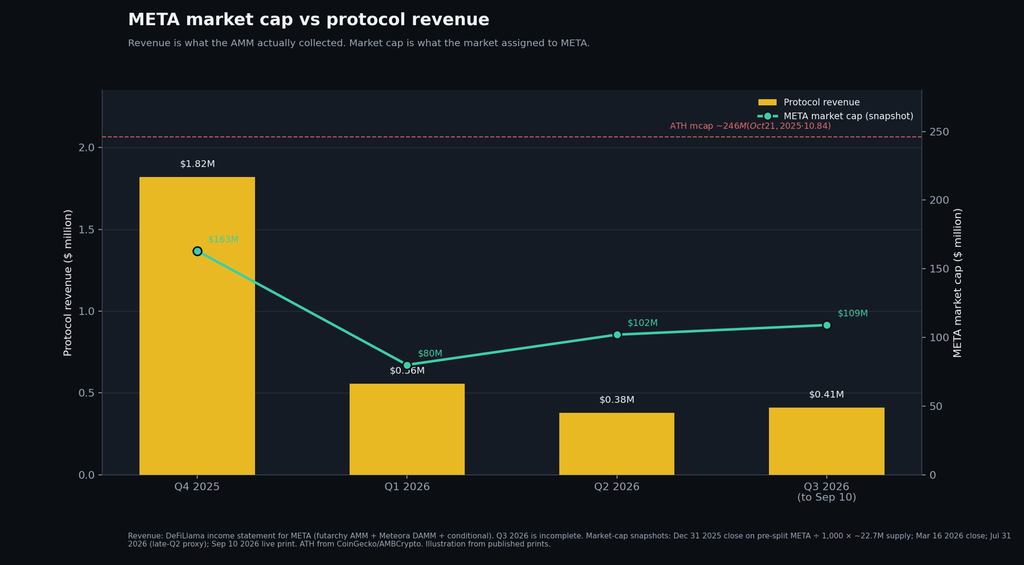
In the chart: the market cap line did not follow the revenue bars down one-for-one. Q4 2025 was the fee peak. The token still trades as if the venue is bigger than its last four fee prints.
So what is the $110 million buying?
Part of it is a claim on future AMM volume. Every successful ICO seeds a pool. Decision markets on those tokens, plus META itself, trade on the same venue. Sanctum, Jito, Drift, ORE and others have used the markets without being MetaDAO-native launches; August 2026 was a loud month for that side of the book, with 01Resolved recording $713,000 of decision-market volume across six resolved proposals in the ownership-coin set, on top of another $501,000 from Sanctum. Volume is not revenue at 25 basis points until it is repeatable. August’s spike followed a July that was almost silent.
Part of it is the treasury. 01Resolved’s September 1 compilation put MetaDAO’s own treasury at $11.5 million and the whole ownership-coin treasury set at $33.3 million. DeFiLlama’s protocol TVL around the same week was $13 million. A buyer of META is not buying a claim on Solomon’s or Avici’s USDC. Those sit in other treasuries. What META holders do have, in principle, is the same futarchy lever over MetaDAO’s own purse that every ownership-coin holder has over theirs.
Part of it is scarcity of a clean story. After a cycle of points programs and low-float listings, a venue that forces high float, a public price, a monthly tap, and an IP assignment is easy to narrate. Narratives re-rate tokens. They do not pay the team. On a $146,000 thirty-day fee print, $110 million of equity value is a very large number. On a belief that U.S. retail will legally buy $5 million ICOs through this exact machine, it is a call option. Readers can decide which sentence they are living in. The chart does not decide it for them.
What would raise or lower that value — and which signals are already visible?
Four things move this premium. None of them is a price target.
1. Whether Regulation Crypto Assets becomes a rule, and in what shape.
The proposing release is dated August 18, 2026. Commissioner Hester Peirce’s statement framed two exemptions: a startup path at $5 million over four years, and a fundraising path at up to $75 million in a twelve-month window, plus a conditional safe harbor for when an investment contract can later “delink” from the asset. Proposed Rule 200, in the law-firm summaries, is Form NOR on EDGAR, narrative disclosure, retail buyers, no rule-based holding period, antifraud still on, generally one-time per asset. Non-cash consideration counts toward the $5 million at fair value.
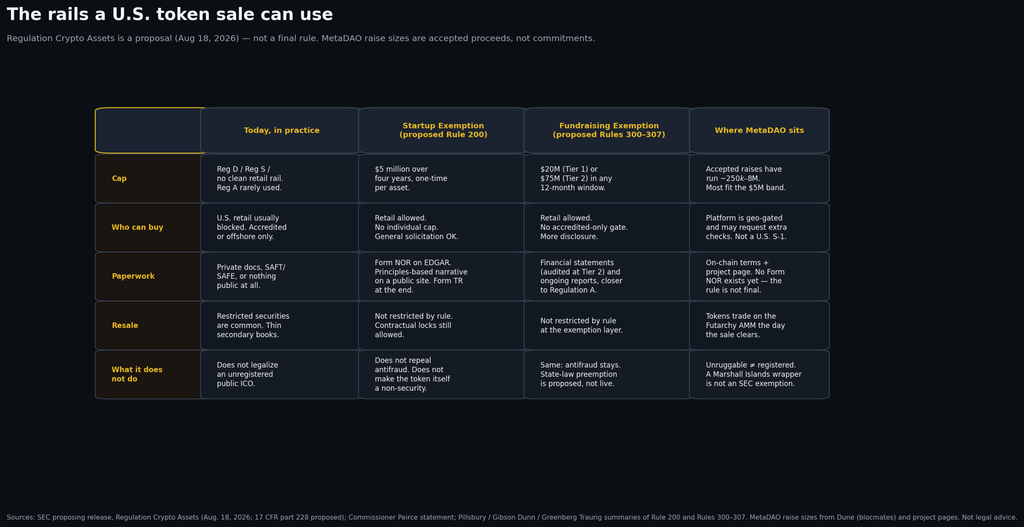
In the table: MetaDAO’s accepted raise sizes already look like Startup Exemption deals. That is an alignment, not a license. The proposal is a proposal.
A final rule that keeps the $5 million retail path would make MetaDAO’s existing ticket sizes look like compliance rather than a workaround. A final rule that adds investment caps, forces U.S. incorporation, or treats the ownership coin itself as the security would push the same ticket sizes back offshore. A proposal that dies in comment would leave the status quo: geo-fencing, accredited side-doors, and a product that is easier to sell to a founder in Singapore than to a founder who wants American customers on the cap table.
Watch the comment file and the adopting release. Do not watch a keynote.
2. Launch cadence versus the story already in the price.
Five curated ICOs a month was the 2025 research assumption. Fewer than two was the 2026 reality. August 2026 had no curated close on the flagship pad; two small Futardio sales (Kimia $60,000, Basket $10,000) were the month’s origination. July was busier. Throughput is the cleanest operating metric on a venue whose fees come from trading the things it lists. A quarter with four to six curated clears and live decision markets is a different business from a quarter with two.
3. The fee switch, and whether holders ever see a dollar.
As long as 25 basis points stay in a treasury that spends them on the organization, META is a governance coin with a narrative. A passed proposal that turns the switch on, or that buys and burns, would change the multiple math overnight. The absence of that proposal is also information. For now the protocol can point to enforceable rights and still print $0 of holders’ revenue.
4. The failure rate after the raise.
Paystream’s liquidation vote is not an indictment of the pad. It is the pad doing what the brochure promised. A world in which one in five ownership coins returns capital is, paradoxically, a better advertisement than a world in which every coin grinds to zero with the treasury still sealed. A world in which founders stop assigning IP because the first lawsuit lands in Manhattan is the opposite. Watch the ratio of liquidations-with-returns to silent deaths. Watch whether inbound founders still accept the IP assignment once a large raise is on the table.
Secondary signals sit around those four. Decision-market depth tells you whether futarchy is a market or a costume. Coinbase already listed META; the token did not stay at the October high. Competitors are not theoretical: Metaplex Genesis, Sonar, Legion, Coinbase-owned Echo, Pump.fun, and EVM copies such as Launcher all want the same founder. The combination of issuance, custody, wrapper, and governance is the product. Any one piece can be copied.
The risks that survive the slogan
Legal risk is not a footnote. A Marshall Islands entity that “recognizes” an on-chain market has not been the subject of a reported U.S. appellate opinion. Tokenholder rights that are “self-enforced” on Solana can still be argued, in a courtroom, as a security, a partnership interest, or a nothing. Regulation Crypto Assets, even if adopted, would cover the sale. It would not automatically bless the wrapper.
Market risk inside the decision markets. Futarchy assumes someone is willing to lose money to be right. On a quiet token with a thin pool, a determined desk can lean on a TWAP. A 2024 Pantera-linked proposal to buy META at a steep discount sent the spot price vertical and then failed — useful theater, not a guarantee the next thin market behaves.
Execution risk on the venue. The launch process is still partly a conversation with two co-founders. Until intake is automated, throughput is a calendar problem. Solana Compass has also noted that no formal third-party audit of the programs has been publicly disclosed. That is an odd omission for a venue whose pitch is that the programs are the law.
Adverse selection. The founders most eager to assign IP and live on a monthly tap may be the founders who could not raise a priced equity round. The founders least eager may be the ones with the best alternatives. Ranger’s hybrid cap table is an early look at what happens when a real company, with real existing paper, walks through the door. The pad will either absorb that mess or lose those companies to Echo and to venture.
“Unruggable” is a specific claim. Revenue that never hits the treasury, a product fork under a new brand, a slow spend-down of the monthly allowance on salaries with no shipping, a decision market that nobody trades — none of those is a cartoon rug. All of them leave holders with a token. Paystream at least put the ending on-chain.
What “revival” would actually look like
A serious ICO revival in the United States would not look like a Telegram group in 2017. It would look like a Form NOR, a website of narrative disclosures, a $4.2 million public sale that U.S. retail can legally enter, and a secondary market that opens without a restricted-legend fight. MetaDAO’s current objects — four days, one price, a tap, a market that can fire the budget — are closer to that picture than a bonding curve with an anonymous deployer. They are not that picture yet.
Outside the United States the revival is already a format war. Europe has MiCA. Coinbase has a captive origination pipe. MetaDAO’s bet is that some founders will accept a worse short-term extraction in exchange for a cleaner cap table and a story they can still tell in 2029. That fraction does not have to be large. It has to keep the AMM busy, the inbound calendar full, and the decision markets thicker than a group chat.
The useful test is boring. Count the curated clears. Count the fees. Count the Form NORs if the rule lands. Count the treasuries that came back to holders when the product failed. If those four series go up together, the premium on META has a foundation. If only the token goes up, you have already seen that chart. It peaked in October.
Key takeaways
- Public token sales returned as a format, but proceeds concentrated into fewer deals. The 2017 machine is not what came back.
- MetaDAO puts committed USDC, mint authority, and (on paper) IP under futarchy, then pays founders a monthly tap. That is a real constraint, not a success guarantee.
- Commitments have run into the hundreds of millions. Accepted raises have stayed in the high six and low eight figures.
- META’s ~$110 million market cap sits well above the recent fee run-rate, with the fee switch off and holders’ revenue at zero.
- The proposed Startup Exemption is the first U.S. rail that looks like MetaDAO’s ticket sizes. It is not law.
- Watch a final rule, launch cadence, any move to route fees to holders, and how often failed projects return the treasury.
The ICO is a tool. Tools pick up the habits of the people who hold them. MetaDAO’s wager is that a market can hold this one more carefully than a founder can. Sometimes the market will vote to build. Sometimes it will vote to send the USDC home. Both outcomes are the product.
Subscribe for more research like this: https://cryptopress.substack.com/subscribe