
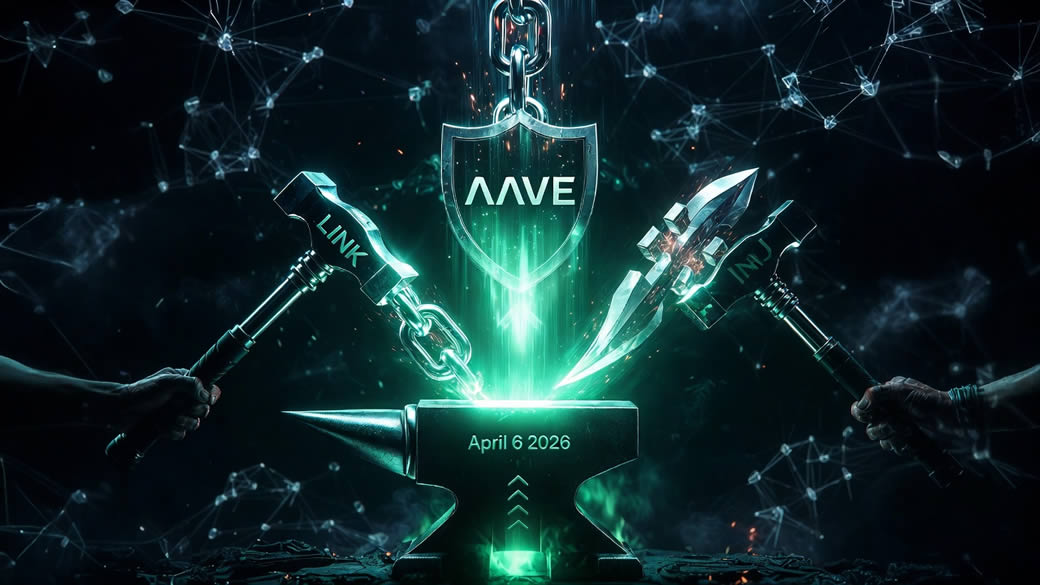
On April 6, 2026, Santiment dropped a fresh leaderboard that cut through the noise: Chainlink ($LINK) still sits at #1 in DeFi development activity, DeepBook ($DEEP) holds steady at #2, and Lido DAO ($LDO), Aave ($AAVE), and Injective ($INJ) are climbing with clear upward arrows.
While price action grabs headlines, this metric—built on filtered GitHub events—reveals who is actually shipping code. In a low-volatility environment where retail FOMO has quieted and institutions demand reliability, the projects with sustained builder activity are the ones positioning DeFi for the next cycle.
This isn’t another “top 10 by hype” list. Santiment tracks notable development events across 4,000+ projects: meaningful code contributions that exclude noise like forks, comments, or basic maintenance. The result is a clean signal of real engineering progress. LINK and DEEP held their positions (➡️), while LDO, AAVE, and INJ gained ground (📈). Uniswap slipped. That pattern tells a story: infrastructure and utility-focused primitives are pulling ahead of pure trading hype.
What “Development Activity” Actually Measures (and Why It Matters)
Santiment’s methodology strips away vanity metrics. Instead of raw commit counts—which can be gamed or inflated by forks—they count predefined events that represent tangible progress: new features, bug fixes, architectural upgrades, and integrations that move the protocol forward.
Why this matters in 2026:
- Markets are maturing. Total DeFi TVL hovers in a range, stablecoin volumes are steady but not explosive, and users reward protocols that deliver consistent UX and security over flashy launches.
- Capital is selective. Builders who keep committing code during quiet periods signal long-term conviction.
- Low-volatility favors durability. When price swings shrink, on-chain utility (lending, oracles, derivatives infrastructure, staking) becomes the differentiator.
Think of it like Argentina’s inflation playbook—citizens didn’t chase meme coins; they turned to Bitcoin and stable infrastructure because it worked when everything else failed. The same logic applies here: dev activity is the on-chain equivalent of “saving in something real.”
The New Top 10 Breakdown: Builders vs. Hype
Here’s the exact Santiment ranking as of April 6, 2026 (directional shift since last month):
- Chainlink ($LINK) ➡️ – The undisputed oracle king.
- DeepBook ($DEEP) ➡️ – Sui’s native on-chain order book.
- Lido DAO ($LDO) 📈 – Liquid staking infrastructure.
- Aave ($AAVE) 📈 – Modular lending pioneer.
- Injective ($INJ) 📈 – High-performance derivatives & cross-chain DEX.
- Euler ($EUL) 📈
- Uniswap ($UNI) 📉
- Curve ($CRV – Ethereum) 📈
- Curve ($CRV – Arbitrum) 📈
- Babylon ($BABY) 📈
The standouts the angle highlights—LINK, AAVE, and INJ—aren’t riding narrative waves. They’re executing on core DeFi primitives that solve persistent problems.
Chainlink ($LINK): Still #1 because oracles are the connective tissue of DeFi. Every lending liquidation, derivative settlement, or RWA price feed runs through Chainlink. In 2026, the team continues expanding CCIP (Cross-Chain Interoperability Protocol), DECO privacy-preserving oracles, and AI-native data feeds via the Chainlink Runtime Environment. Privacy + verifiable data = the foundation for institutional adoption.
Aave ($AAVE): Climbed to #4 after shipping V4 in late March 2026. The “hub-and-spoke” architecture isolates risk pools, enables modular markets for RWAs, and supports custom collateral types (think tokenized treasuries or custody-backed assets). This isn’t incremental—it’s the upgrade that lets Aave evolve from crypto-native lending into regulated, capital-efficient infrastructure.
Injective ($INJ): Jumped to #5 with MultiVM mainnet on the horizon (EVM + SVM + WASM in one liquidity pool), USDC native integration, and record transaction throughput. Injective isn’t just another DEX; it’s building the fastest derivatives venue in DeFi with sub-second finality and deflationary tokenomics (60% of fees burned). Low-vol environments love perps and synthetics that don’t require constant hype to stay liquid.
Honorable mentions in the climb: Lido’s continued staking optimizations and DeepBook’s fully on-chain central-limit-order-book on Sui show that liquid staking and order-book DEXs are also winning the builder race.
Pairing the Data with Messari’s Confidential Computing Thesis
Santiment’s leaderboard alone is powerful. Paired with Messari’s March 2026 report on Decentralized Confidential Computing (DeCC)—the privacy layer for an AI-native on-chain world—it becomes predictive.
DeCC solves the core tension in DeFi + AI: you need private data (trading strategies, model weights, medical/financial records) computed verifiably without exposing it. Projects like LINK (DECO + CRE), AAVE (modular isolated pools that can integrate confidential logic), and INJ (high-speed execution layers that pair with encrypted compute) are structurally positioned to capture this.
In a low-vol market:
- Users want private positions and strategies (no more front-running on public mempools).
- Institutions want compliant, verifiable AI agents executing on-chain without leaking IP.
- Builders who ship privacy-preserving primitives win the next tranche of capital.
This is the “builders vs. hype” thesis in action. Hype projects chase TVL with incentives; these protocols keep shipping the rails.
Real-World Implications and Case Studies
- Chainlink in action: Powers Aave liquidations, GMX perps, and Swift’s tokenized asset pilots. When volatility drops, reliable price feeds and cross-chain messaging become the boring-but-essential backbone.
- Aave V4 early traction: Within days of launch, V4 deposits crossed $10M despite conservative caps—proof that modular design attracts serious liquidity.
- Injective’s throughput edge: Over 2 billion transactions processed with 25,000+ TPS shows it can handle institutional derivatives flow without congestion. In low-vol, consistent execution > flashy yields.
Compare this to projects that dropped in the ranking: they often rely on community-driven hype or single-chain liquidity farming that dries up when incentives end.
Challenges and Risks (No Sugarcoating)
Dev activity is a leading indicator, not a guarantee:
- Adoption lag: Code doesn’t equal users. LINK has led dev charts for years, yet price action still correlates with broader market sentiment.
- Governance friction: Aave’s recent risk manager exit and governance debates show that even top builders face internal hurdles.
- Competition: New L2s and app-chains can siphon liquidity overnight.
- Regulatory overhang: Privacy tech (DeCC) walks a fine line with compliance.
The solution? Focus on protocols with proven product-market fit, transparent roadmaps, and deflationary or utility-driven tokenomics.
Future Outlook: Low-Vol Winners Will Be Boring (in the Best Way)
As volatility compresses and institutions allocate, DeFi primitives that emphasize:
- Verifiable data (LINK)
- Modular, risk-isolated lending (AAVE)
- High-performance derivatives & cross-chain execution (INJ)
- Liquid staking infrastructure (LDO)
- On-chain order books (DEEP)
…will compound quietly. The Messari DeCC lens adds the AI multiplier: confidential compute turns these into private, intelligent financial rails.
This isn’t 2021-style “number go up” DeFi. It’s 2026+ infrastructure DeFi—the kind that survives multiple cycles and actually gets used by the real economy.
Key Takeaways
- Santiment’s April 6, 2026 leaderboard confirms sustained dev activity beats narrative hype.
- LINK, AAVE, and INJ are climbing or holding because they solve foundational problems: data, lending, and execution.
- Pair this with decentralized confidential computing and you get the blueprint for AI-native, privacy-first DeFi.
- In low-vol environments, builders win—track GitHub signals, not just TVL charts.
Ready to go deeper?
Subscribe to Cryptopress.site for more evergreen DeFi deep dives, builder-focused research, and no-hype analysis.
© Cryptopress. For informational purposes only, not offered as advice of any kind.