

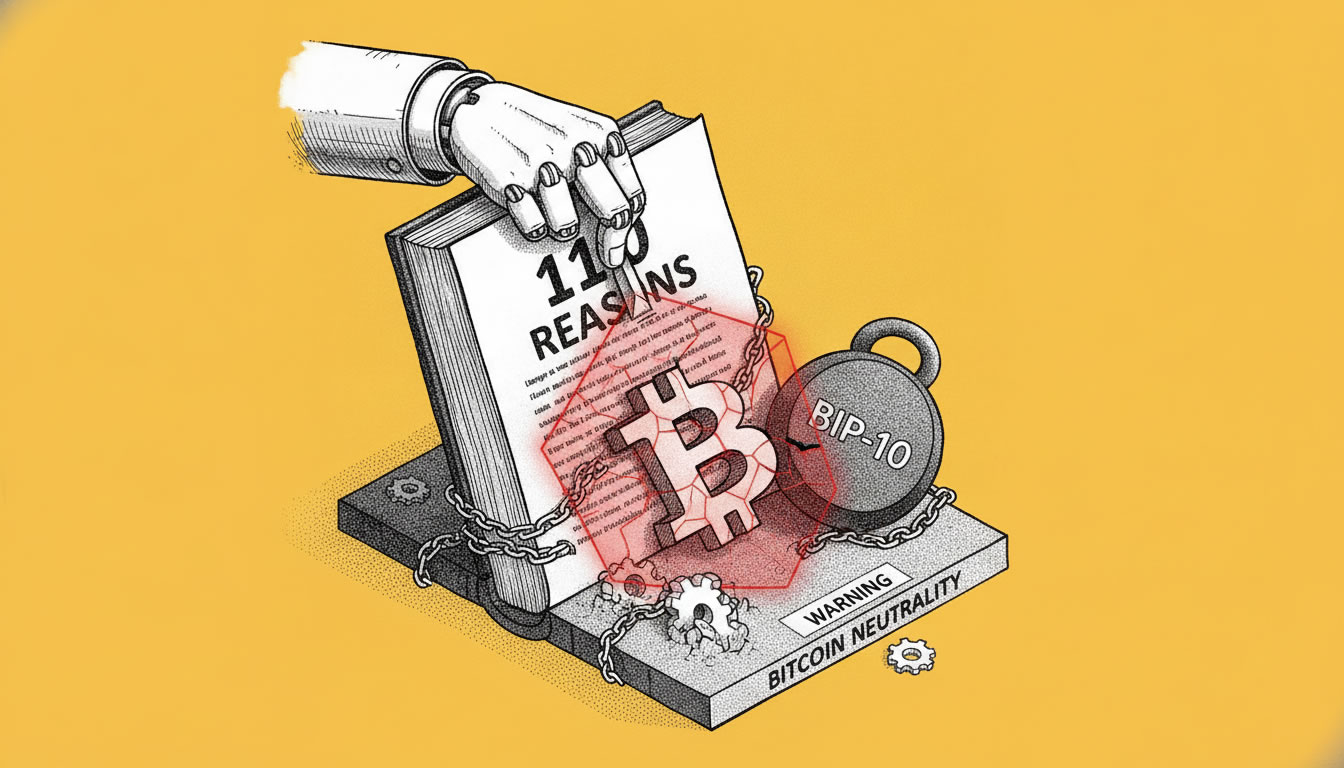
- Bitcoin advocate Michael Saylor has published a detailed critique opposing BIP-110, a proposed temporary soft fork to restrict non-monetary data storage on the blockchain.
- The proposal, aimed at curbing “spam” like Ordinals and Runes to reduce node costs and bloat, would impose seven consensus changes for about one year and use a 55% miner signaling threshold for activation.
- Saylor argues the “proposed cure is more dangerous than the condition,” advocating for neutrality, policy-based tools, and permissionless innovation instead of consensus restrictions that could set censorship precedents.
Michael Saylor, executive chairman of Strategy, has intensified the debate over Bitcoin’s protocol governance by releasing an extensive post detailing 110 reasons why BIP-110 represents a flawed approach to addressing data storage on the blockchain.
In the post on X, Saylor acknowledges concerns from supporters about node operator costs, chain bloat from inscriptions and similar uses, and preserving Bitcoin’s focus on sound money. However, he contends that changing consensus rules to discourage certain valid, fee-paying transactions risks undermining the network’s core principles of neutrality and permissionless innovation.
BIP-110, formally the “Reduced Data Temporary Softfork,” proposes limiting scriptPubKeys to 34 bytes (with exceptions), capping pushed payloads and witness items at 256 bytes, prohibiting the Taproot annex and certain OP codes, and other restrictions for roughly one year. Pre-activation UTXOs would be grandfathered. The goal, according to proponents, is to lower validation and storage burdens for nodes while keeping block space prioritized for monetary transactions.
Saylor counters that such measures elevate contested judgments about “spam” versus legitimate use into protocol law, where Bitcoin cannot discern intent. He warns this creates a dangerous precedent: “The proposed cure is more dangerous than the condition.” Future disputes could similarly seek to exclude disfavored but valid activities through soft forks.
The proposal modifies activation mechanics with a lower 55% miner threshold (versus standard 95% in BIP 9), mandatory signaling, and an EXPIRED state, aiming for quicker deployment amid what authors call urgency. Saylor and critics argue this lowers the bar for contentious changes and increases risks of coordination failures or chain splits.
Supporters view it as essential protection for decentralization and node accessibility against growing non-financial data. Saylor maintains that better alternatives exist, such as improved relay policies, mining filters, fee markets, and pruning solutions, without altering consensus validity rules.
In coverage from CoinDesk, the debate is framed around Saylor’s opposition to using consensus changes for what he sees as a social or policy issue rather than a critical technical failure.
The debate highlights tensions in Bitcoin governance as the ecosystem evolves with Layer 2s, Ordinals, and other innovations. With discussions around an August timeline and reportedly low miner support, the outcome could influence perceptions of Bitcoin’s adaptability.
While the proposal seeks to safeguard the network’s monetary primacy, Saylor’s intervention underscores the importance of preserving optionality and neutral rules. “Bitcoin does not need guardians of purity. It needs guardians of neutrality,” he concluded in the detailed analysis.