


Sending money from Argentina to Japan with the traditional system it might take days, involve multiple banks, hidden fees, and currency exchanges that eat into the amount. What if you could make that same transfer settling in seconds, at a fraction of a cent, with full transparency. This isn’t science fiction—it’s the reality that XRP enables today on the XRP Ledger (XRPL).
XRP, the native cryptocurrency of the XRPL, was designed from the ground up to solve the inefficiencies of global payments. While many cryptocurrencies focus on speculation or niche uses, XRP stands out for its practical, enterprise-grade utility in bridging currencies worldwide.
We’ll explore now what XRP is truly used for, how it works under the hood, the growing ecosystem of applications built on the XRPL, real-world implementations, challenges, and what the future holds as of early 2026.
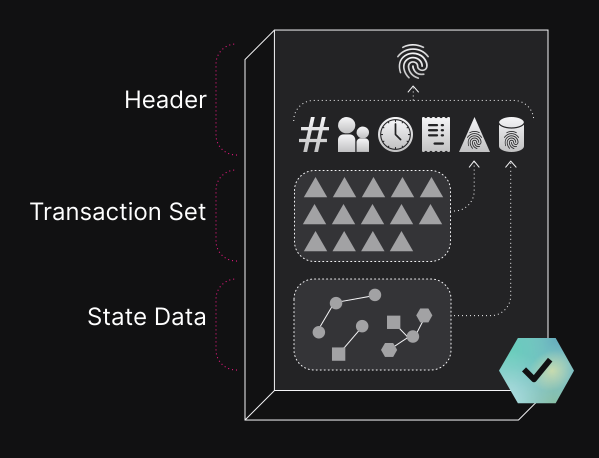
What Is XRP, and How Does the XRP Ledger Work?
The XRP Ledger launched in 2012 as one of the earliest blockchains, predating Ethereum. Created by Jed McCaleb, Arthur Britto, and David Schwartz (with Ripple Labs later becoming a major contributor), the XRPL is a decentralized, open-source layer-1 blockchain optimized for speed and efficiency.
Unlike Bitcoin’s Proof-of-Work or Ethereum’s shift to Proof-of-Stake, the XRPL uses a unique consensus protocol where trusted validators agree on transaction order every 3-5 seconds. This enables:
- Thousands of transactions per second
- Costs of fractions of a penny
- Final settlement without energy-intensive mining
XRP is the native asset, pre-mined with a total supply of 100 billion tokens (about 55 billion in circulation as of 2026, with the rest in escrow or held by Ripple).
Its primary roles:
- Transaction fees — A tiny amount of XRP is burned per transaction to prevent spam.
- Bridge asset — For seamless currency exchanges on the built-in decentralized exchange (DEX).

Primary Use Case: Cross-Border Payments and On-Demand Liquidity
XRP’s flagship application is facilitating cross-border payments. Traditional systems like SWIFT rely on correspondent banks, pre-funded accounts (nostro/vostro), and slow settlement—often taking 2-5 days with fees up to 7%.
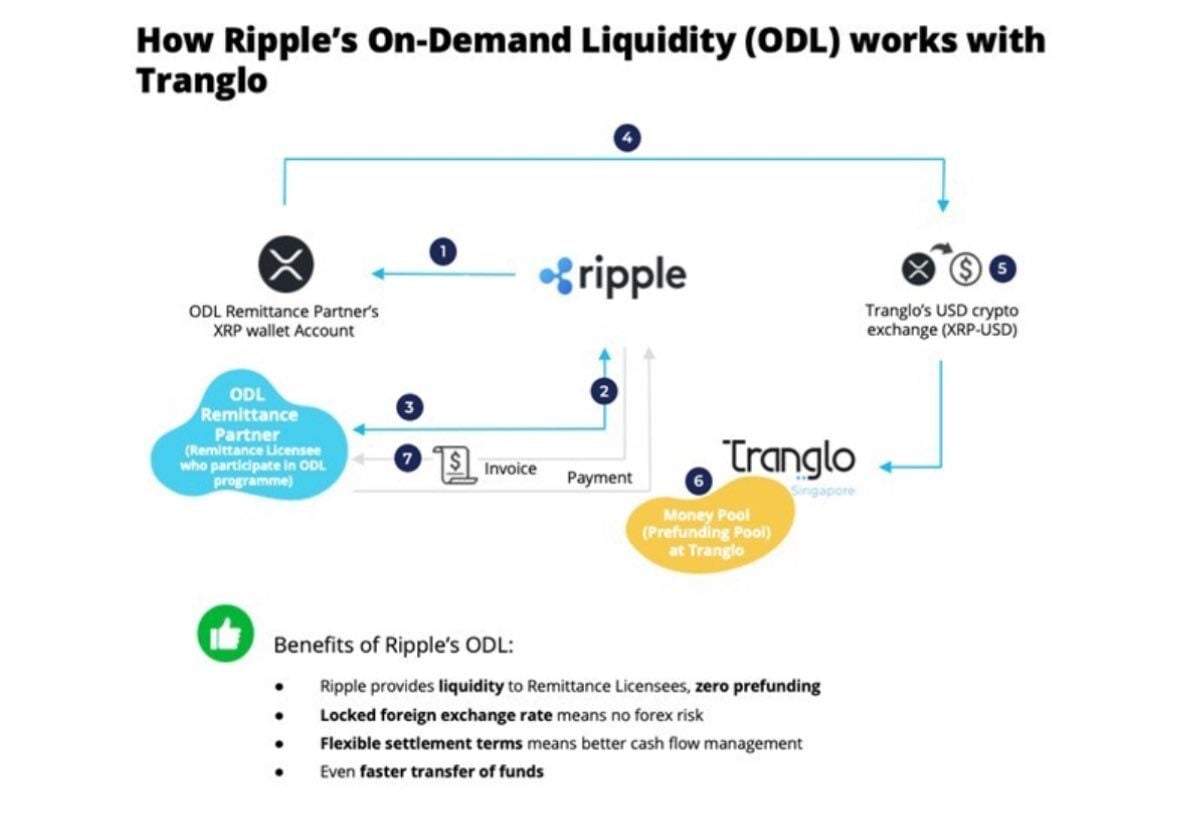
Ripple’s solution, Ripple Payments (formerly RippleNet), uses XRP through On-Demand Liquidity (ODL)—now integrated into broader payment flows.
Here’s how ODL works step-by-step:
- A sender initiates a payment in their local currency (e.g., USD).
- The originating financial institution converts the amount to XRP.
- XRP transfers instantly across the XRPL to the recipient’s side.
- The receiving institution converts XRP back to the destination currency (e.g., JPY) and pays out.
This eliminates pre-funding trapped capital, reduces FX risk, and enables 24/7 settlement.
In 2026, Ripple reports significant volume through these rails, with partnerships expanding in regions like Asia-Pacific, Latin America, and Europe. Institutions like Santander and SBI Holdings have integrated it for remittances and treasury flows.

The Growing XRP Ledger Ecosystem: Beyond Payments
While payments remain dominant, the XRPL has evolved into a robust ecosystem with native features that attract developers and users.
Key built-in functionalities:
- Decentralized Exchange (DEX) → Includes a traditional order book and, since 2024, Automated Market Makers (AMMs) for liquidity pools.
- Tokenization → Easy issuance of custom tokens, including stablecoins and real-world assets (RWAs).
- Hooks → Lightweight smart contract-like functionality for custom logic.
Main Applications and dApps in the XRPL Ecosystem (2026)
The ecosystem has grown substantially, with focus on DeFi, NFTs, and tokenization. Here are some of the leading projects and apps:
- Sologenic — A comprehensive DEX platform supporting tokenized stocks, commodities, and crypto trading. It leverages XRPL’s AMM for swaps and liquidity provision.
- xrp.cafe — Leading NFT marketplace on XRPL, enabling creation, buying, and selling of digital collectibles with low fees.
- XPMarket — DeFi hub offering AMM pools, farming, and analytics for XRPL assets.
- Magnetic X / First Ledger — Emerging DeFi protocols for lending, borrowing, and yield opportunities.
- Ripple’s RLUSD — Ripple-issued USD stablecoin on XRPL, boosting liquidity for payments and DeFi.

Other notable developments:
- Lending protocols (e.g., upcoming native lending via amendments).
- Tokenized RWAs, including stablecoins from various issuers.
- Gaming and micropayments using payment channels.
Data from platforms like DappRadar shows XRPL ranking among top ecosystems for activity in payments and tokenization.
| Category | Top Apps/Projects | Key Features |
|---|---|---|
| DEX & DeFi | Sologenic, XPMarket, Magnetic X | AMM pools, trading, liquidity provision |
| NFTs | xrp.cafe | Minting, marketplace |
| Payments | Ripple Payments (ODL) | Cross-border with XRP bridging |
| Stablecoins/RWAs | RLUSD, various issuers | Tokenization of fiat and assets |
Challenges and Risks
Despite strengths, XRP faces hurdles:
- Centralization perception → Ripple holds a large portion of XRP supply, though escrow releases are predictable.
- Regulatory history → The SEC lawsuit resolved in Ripple’s favor (XRP not a security for secondary sales), providing clarity in the US and elsewhere.
- Competition → From stablecoin networks like USDT/USDC on Ethereum or Swift’s own blockchain experiments.
- Adoption pace → While growing, full replacement of legacy systems takes time.
Volatility remains a risk for holders, though utility demand (e.g., from transaction volume) provides a floor.
Future Outlook
As of January 2026, momentum is strong: XRP spot ETFs have launched with billions in inflows, RLUSD enhances stability, and upgrades focus on privacy, programmability, and DeFi scalability.
The XRPL’s energy efficiency and speed position it well for institutional adoption, especially in emerging markets with high remittance needs—like parts of Latin America facing inflation.
Forward-looking, expect deeper integration with central bank digital currencies (CBDCs), more RWA tokenization, and expanded DeFi tools.
Conclusion: Why XRP Matters in the Crypto Landscape
XRP isn’t about moonshots—it’s about reliable, real-world financial infrastructure. By serving as a neutral bridge asset on a battle-tested ledger, it addresses one of blockchain’s most valuable use cases: moving value across borders efficiently.
Whether you’re a beginner exploring crypto utility or an intermediate user diving into ecosystems, understanding XRP highlights how blockchain can complement—and sometimes improve—traditional finance.
Practical next steps:
- Explore the XRPL via wallets like Xaman.
- Track real-time activity on xrpl.org or explorers.
- Consider utility-driven holdings over pure speculation.
Subscribe to Cryptopress.site for more evergreen deep dives into blockchain fundamentals, from payments to tokenization.