

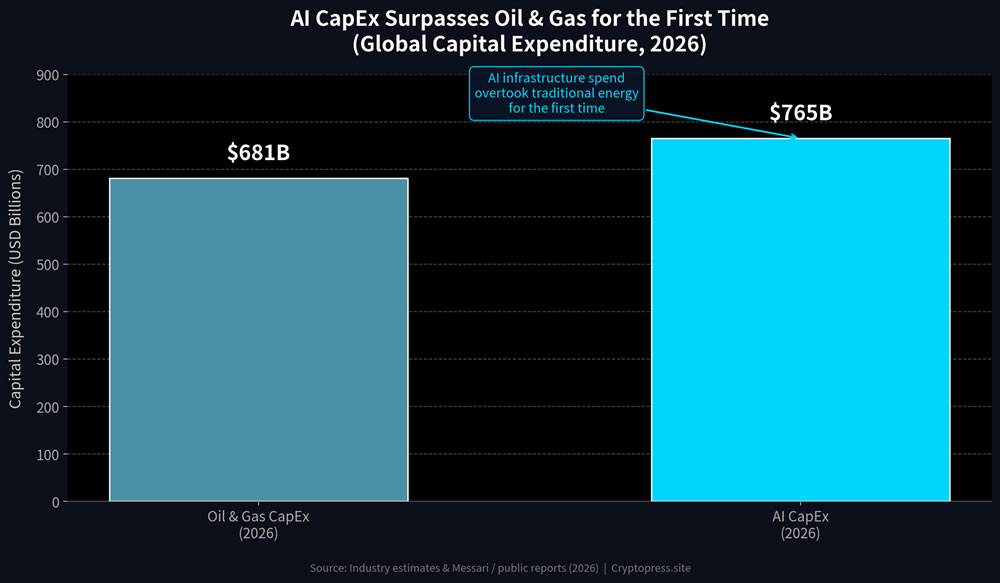
In May 2026, three major venues listed cash-settled GPU futures within sixteen days. CME partnered with Silicon Data. ICE followed with Ornn. Architect’s American Innovation Exchange joined shortly after. At least six ETF filings appeared before a single contract traded. Larry Fink had already framed the thesis: compute is becoming an asset class. AI capital expenditure hit roughly $765 billion that year, surpassing oil and gas for the first time. The resource powering the next industrial wave needed price discovery, hedging tools, and capital markets.
A Compute Capital Market lets producers and consumers of GPU time hedge and speculate the same way energy, metals, and agricultural markets do. The stack has four layers. Spot and forward capacity platforms—neoclouds, GPU-as-a-service providers, and decentralized compute networks—deliver the physical hours. Index providers turn fragmented rental quotes and private trades into reference prices. Exchanges list standardized, mostly cash-settled futures and options. OTC dealers warehouse the residual basis risk.
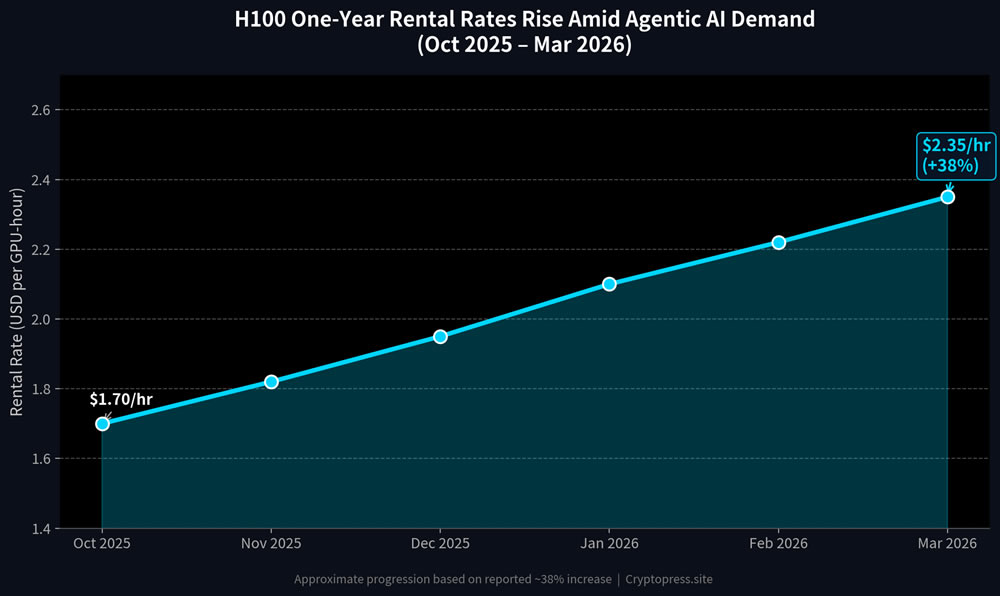
This is not abstract finance. Producers fear inventory clearing below cost. Consumers—inference platforms and the growing agentic layer—fear compute becoming more expensive. Agentic AI, models that run multi-step tasks autonomously, burns far more compute than a single prompt. One-year H100 rental rates rose roughly 38 percent in five months from late 2025 into early 2026 while on-demand supply sold out. Both sides need hedges. Traditional venues are racing to supply them. Crypto’s opening sits in the layers those paper markets leave open: cryptographic verification of quality, on-chain financing of hardware, and delivery of capacity into real networks rather than pure speculation.
Why Compute Resists Clean Financialization
GPU hours are not barrels of oil. Two H100s of the same model can deliver meaningfully different throughput depending on configuration, cooling, networking, and region. Silicon Data’s benchmarking across thousands of GPUs found performance spreads of more than 30 percent even within the same chip family. A single index papers over differences in SKU, location, contract term, and service level. Cash settlement against an off-chain price avoids physical delivery problems, yet it also leaves the hard questions untouched: proof that the compute actually ran at the promised quality, reliable sourcing of capacity for hedgers who need physical settlement, and persistent basis risk across configurations.
Commodity markets have solved similar problems before. Benchmarks emerge through trading. Reservations standardize as curves deepen. The current dealer-intermediated structure is the seed, not the end state. Still, the non-fungibility of high-end accelerators, the speed of hardware generations (Blackwell ramping while residual values of prior chips remain uncertain), and the concentration of power and interconnect create friction that pure financial instruments cannot fully erase.
Crypto’s Role in the Pipeline
Decentralized Physical Infrastructure Networks and related primitives do not need to replace hyperscalers. They need to intermediate specific chokepoints in the AI hardware and data pipeline where traditional capital is slow, verification is weak, or supply is fragmented.
On the financing side, tokenization is already turning GPUs into collateral and cash-flow assets. Projects structure GPU-backed instruments that let operators convert capital expenditure into operating expense while giving investors yield tied to utilization. Akash’s Starbonds approach is one example: SEC-compliant securities designed to fund protocol-aligned, higher-quality GPU capacity that can be deployed into a mesh rather than pure idle-rack marketplaces. Similar models treat data-center racks or individual accelerators as warehouse receipts under commercial law frameworks, unlocking private credit and DeFi liquidity against productive hardware. The same primitives that tokenized real-world assets for real estate or commodities can intermediate the AI supply chain’s most capital-intensive layer.
On the delivery side, decentralized compute networks aggregate dispersed supply—consumer GPUs, edge nodes, underutilized enterprise racks—and surface it through reverse auctions or standardized leases. Akash, Render, io.net and others have moved beyond early speculative staking toward measurable utilization, though availability, quality verification, and enterprise SLAs remain works in progress. The more durable position is the wholesale supply layer: aggregating capacity, providing verifiable resources, and selling in bulk to inference platforms or middle layers rather than competing head-on with AWS for every developer.
Verification is the missing piece traditional futures leave open. Cryptographic proofs that a workload ran on specific hardware at claimed performance, confidential computing environments, and continuous resource attestation turn opaque rental markets into something closer to auditable infrastructure. Without them, cash-settled indices remain vulnerable to gaming and quality disputes.
Data and coordination layers complete the picture. Bittensor’s subnet architecture turns AI work itself into competitive markets. Miners produce outputs, validators score them, and emissions flow toward higher-value contributions. Updates have focused on reducing leakage, concentrating rewards around productive subnets, and improving value capture for the root token. The network does not replace centralized labs; it creates permissionless coordination for specialized tasks, inference, and data pipelines that can feed the broader AI economy. Helium’s trajectory illustrates a parallel maturation in another DePIN vertical. After years of coverage-building, the network shifted toward carrier offload economics, measurable data traffic, and platform-layer positioning. Revenue from real usage began to decouple from pure token speculation, even as token price action remained challenging. The same pattern—usage and cash flow preceding valuation recovery—appears across more mature DePIN networks.
Real-World Mechanics and Case Studies
Consider the flow of a hedged AI workload. An inference platform locks capacity via a forward contract or futures position. The index provides the reference price. If physical delivery is required, a decentralized network or neocloud supplies the hours. On-chain financing may have funded the underlying GPUs. Proofs confirm execution quality. Settlement occurs against the index or through usage-based payments. Crypto primitives sit at the financing, verification, and fragmented-supply aggregation layers rather than owning the entire stack.
Akash’s evolution from idle-rack marketplace toward protocol-aligned capacity and regulated financing instruments shows one path. Bittensor’s subnet competition and emission refinements show another: turning intelligence production into a market with its own internal capital allocation. Helium demonstrates that DePIN can achieve carrier-scale traffic and measurable offload when incentives align with real demand rather than pure coverage mining. Across these examples, the common thread is the move from subsidy-driven bootstrap to revenue-generating infrastructure that can intermediate parts of the AI pipeline.
Private capital has continued to flow into the sector even as public token valuations compressed. DePIN startups raised substantial seed and Series A capital while on-chain revenues at leading networks grew. The sector as a whole reached roughly $10 billion in circulating market capitalization with tens of millions in annual on-chain revenue, trading at far lower multiples than earlier cycles. The shift from speculative experiments to infrastructure businesses with real cash flows is underway, unevenly and with plenty of failures.
Challenges and Risks
Financialization does not eliminate physical constraints. Power availability, interconnect quality, cooling, and chip supply remain binding. Residual value risk on GPUs is real; aggressive assumptions have burned lessors in prior technology cycles. Index construction can be gamed or simply fail to capture the configurations buyers actually need. Regulatory treatment of tokenized hardware, securities-style instruments, and cross-border capacity remains evolving.
Token economics in many networks still lean heavily on emissions. When emissions exceed revenue capture, price pressure persists even as usage grows. Concentration of control—whether in validator sets, foundation decision-making, or key hardware providers—introduces governance and single-point risks. Quality verification at scale is hard; cryptographic proofs help but do not yet cover every workload type or performance dimension.
Crypto’s advantage is speed of capital formation, transparent incentives, and the ability to aggregate long-tail supply that traditional markets ignore. Its disadvantage is the same as in other infrastructure verticals: the gap between token narrative and durable unit economics. Networks that close that gap by tying rewards tightly to verified usage and by providing genuine delivery or financing utility will intermediate the pipeline. Those that do not will remain speculative overlays.
Outlook: Intermediation, Not Replacement
The AI supply chain will not run on pure Web2 architecture, nor will it be fully decentralized. The more likely path is a hybrid stack in which traditional capital markets and hyperscalers handle the bulk of high-reliability, high-performance demand while crypto primitives intermediate financing, verification, fragmented supply, specialized coordination, and elastic overflow. Compute capital markets make the price of GPU time visible and hedgeable. Tokenization and DePIN turn hardware and data into programmable, financeable assets. Networks that produce measurable intelligence or bandwidth become participants in that market rather than pure token experiments.
For builders and capital allocators the practical questions are concrete. Can the network deliver verifiable capacity at competitive all-in cost? Does the token capture a meaningful share of the economic activity it enables? Is the financing structure robust to hardware depreciation and utilization volatility? Does the coordination mechanism surface higher-quality outputs over time?
The race to financialize compute is already underway in traditional venues. Crypto’s edge lies in the layers those venues cannot easily touch: cryptographic quality proofs, permissionless aggregation of long-tail hardware, and native capital formation for the physical assets themselves. The networks that occupy those layers will not own the AI supply chain. They will intermediate critical segments of it—and that is enough.
Key takeaways:
- Compute is becoming a tradable commodity with futures, indices, and hedging demand driven by AI capex and agentic workloads.
- Crypto primitives fit best in financing (tokenized GPU-backed instruments), verification (proofs of quality), and fragmented supply aggregation rather than full hyperscaler replacement.
- Mature DePIN examples show usage and revenue beginning to decouple from pure speculation, though token economics and quality assurance remain challenges.
- The durable opportunity is intermediation of the AI hardware and data pipeline through programmable, verifiable infrastructure.
Subscribe for deeper coverage of the infrastructure layers powering the next wave of crypto utility: https://cryptopress.substack.com/subscribe