

It’s an open secret in every newsroom: most press releases never get read past the headline. Journalists routinely receive hundreds of pitches a month, and a press release written in generic, adjective-heavy AI prose is one of the fastest ways to end up in the trash folder. That’s the paradox facing anyone using artificial intelligence to write press releases in 2026 — the same technology that can draft a release in ninety seconds can also make it instantly recognizable as filler, and filler gets ignored.
For crypto projects, this problem is amplified. Token launches, protocol upgrades, and funding rounds all lean heavily on press releases to build legitimacy with exchanges, media, and investors. Getting the writing right — and understanding what happens after the writing, in distribution — is often the difference between a release that lands on CoinDesk or a major wire service, and one that disappears into a spam filter.
This guide breaks down how AI press release tools actually work, which ones are worth using in different situations, and — just as importantly — where AI’s usefulness ends and where distribution economics take over. Press release distribution, the process of getting a finished release in front of journalists, databases, and search engines, remains a separate discipline from writing one, and conflating the two is the single most common mistake newcomers make.
Key Takeaways
- AI writing tools speed up the drafting stage of a press release, not the distribution stage — the two are separate problems with separate costs.
- General-purpose AI models (Claude, ChatGPT) tend to produce the most natural-sounding prose but have no built-in PR structure or distribution features.
- PR-specific tools (Jasper, Prowly, Signal Genesys) add templates, brand-voice controls, and sometimes SEO/schema features, usually at a higher price.
- Bundled writer-plus-distribution platforms (like EIN Presswire) trade some editorial control for convenience and a lower barrier to entry.
- The biggest risk with AI-drafted releases isn’t grammar — it’s sounding generic enough that neither journalists nor search engines treat it as newsworthy.
How AI Press Release Tools Actually Work
To understand which tool fits your situation, it helps to understand what “AI press release writing” actually means under the hood. Most tools in this category are built on the same foundation: a large language model (LLM) — a type of AI trained on massive amounts of text to generate human-like writing — wrapped in a template that mimics standard press release structure (headline, dateline, lead paragraph, boilerplate, contact information).
The tools differ mainly in three areas:
- How much structure they enforce. A general-purpose AI assistant like Claude or ChatGPT will write a press release if you ask it to, but it relies entirely on your prompt for structure, tone, and accuracy — it has no PR-specific guardrails. General-purpose AI models offer flexibility and customizable prompts but no dedicated PR structure, which means the quality ceiling is high but so is the amount of editing and formatting you’ll need to do yourself.
- How they handle brand consistency. Purpose-built tools like Jasper let a team feed in a style guide, past releases, and product information so that new drafts sound consistent across different writers and campaigns. This matters more for organizations publishing frequently — a crypto project putting out a release every few weeks benefits from this far more than a startup writing its first-ever announcement.
- Whether they include distribution. Some tools stop at the draft. Others, like EIN Presswire’s AI generator, are free with an account and sit inside a distribution platform, and can even convert a recorded interview into a draft — meaning the writing tool is really a front door to a paid distribution service, not a standalone product.
A Note on “AI Smell”
Search engines and increasingly sophisticated readers have gotten good at detecting formulaic AI writing — overuse of phrases like “in today’s fast-paced world” or “revolutionary breakthrough.” This matters for press releases specifically because wire services and journalists actively filter out copy that reads as templated marketing spam. The practical implication: whichever tool you use, plan to spend time editing the output into something that sounds like it came from a person who understands the news, not a bot filling in blanks.
Applications and Examples: Comparing the Main Tool Categories
Below is a comparison of the main categories of tools used for AI-assisted press release writing, based on how they’re positioned in the market as of 2026.
| Tool / Category | Best For | Key Features | Distribution Included? | Typical Starting Price |
|---|---|---|---|---|
| Claude / ChatGPT (general-purpose AI) | Highest writing quality, full customization | Flexible prompting, adapts to any tone or industry | No | ~$20/month |
| Jasper | Teams needing consistent brand voice at scale | Brand voice training, templates, team collaboration | No | ~$49/month+ |
| Prowly / Signal Genesys | PR professionals wanting SEO-optimized releases | Keyword optimization, SERP analysis, schema generation | Partial (media outreach features) | Custom pricing |
| Copy.ai | Fast, simple first drafts | Multiple templates, easy interface | No | Free tier available |
| Writesonic | Budget-conscious solo founders | Affordable, decent output quality | No | ~$19/month+ |
| EIN Presswire AI generator | Startups sending their first release | Free draft generator tied to a distribution network | Yes | Free (distribution billed separately) |
| PR Newswire Smart News | Enterprises with high release volume | Integrated drafting, analytics, guaranteed wire placement | Yes | Enterprise pricing |
A pattern emerges from this table: the tools with the best raw writing quality (general-purpose AI models) have no distribution built in, and the tools with distribution built in are usually weaker writers. This isn’t a coincidence — it reflects two genuinely different business problems (content generation vs. media logistics) that most companies haven’t yet merged well.
The practical takeaway for crypto teams: many experienced PR practitioners draft with a general-purpose AI model for quality, then run the polished result through a dedicated distribution service. Using one tool for both jobs is possible, but usually means compromising on one side or the other.
Visualizing the Full Pipeline
Writing the press release is only one link in a longer chain. The diagram below shows where AI genuinely accelerates the process, and where human judgment and paid infrastructure still do most of the work.
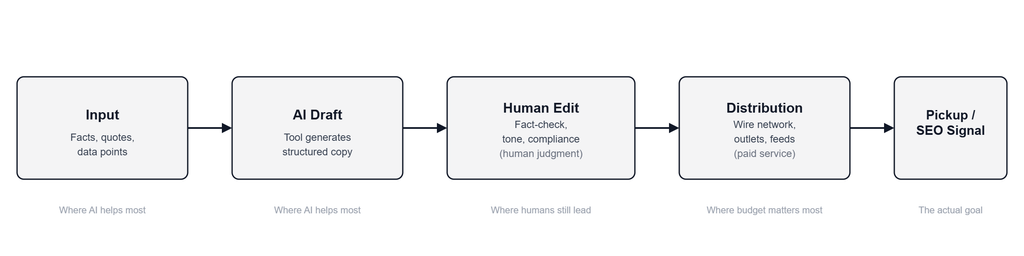
As the diagram shows, AI’s contribution is concentrated in the first two steps. From there, human editing, paid distribution infrastructure, and actual media pickup are governed by entirely different dynamics — reputation, relationships, timing, and budget — that no writing tool, however advanced, can substitute for.
How Do These Tools (and Distribution Networks) Actually Make Money?
Understanding the business model behind a tool tells you a lot about its incentives — and about where the real cost of a “free” AI press release generator actually shows up.
There are three common revenue models in this space:
- Flat SaaS subscription. Tools like Jasper and Grammarly Business charge a recurring monthly fee regardless of how many releases you write. The company’s incentive is retention — keeping you as a subscriber — which generally aligns with continuously improving the writing quality and feature set.
- Per-release or pay-as-you-go pricing. Some smaller, PR-specific tools charge per document generated or per campaign, which suits companies that publish infrequently and don’t want an ongoing subscription.
- Free writer bundled with paid distribution. This is the model behind tools like EIN Presswire’s generator: the AI drafting tool costs nothing because the company’s real revenue comes from the distribution fee once you’re ready to publish. The “free” writing tool functions as a funnel into a paid service — a common and reasonable model, but one worth recognizing so you can compare the all-in cost, not just the advertised price.
For crypto-focused PR specifically, distribution networks that specialize in the industry (crypto-specific wire services and niche outlets) often charge a premium over general business wire services, reflecting the smaller, more targeted audience of crypto journalists and exchanges they can reach. That premium is the real economic engine of this market — not the AI writing layer, which has become largely commoditized.
What Makes an AI-Written Press Release Succeed or Fail?
Because this is a tool category rather than a single asset or company, there’s no “price” to rise or fall. But there is a real, observable equivalent: whether a release actually gets picked up — by journalists, aggregators, or search engines — or whether it disappears unread. Several factors determine this outcome, and most of them have little to do with which AI tool was used to write the first draft.
Factors that improve pickup and effectiveness:
- A genuinely newsworthy hook. No AI tool can manufacture news value. A release announcing a real product launch, a verifiable partnership, or audited data will always outperform one describing routine internal milestones, regardless of how well it’s written.
- Human editing for specificity. Releases edited by someone who removes generic AI phrasing and replaces it with concrete numbers, named sources, and direct quotes consistently perform better with journalists and readers alike.
- Distribution network fit. Sending a crypto-specific announcement through a general business wire, or vice versa, wastes the release’s reach regardless of writing quality.
- Timing and embargo discipline. Releases coordinated with relevant news cycles (a major protocol upgrade, a regulatory decision, an industry event) get materially more attention than ones sent on an arbitrary date.
Factors that reduce effectiveness over time:
- Search engines and readers getting better at detecting formulaic AI content, which increasingly gets filtered or deprioritized — this is an active, evolving trend rather than a one-time risk.
- Overuse of AI-generated boilerplate language across many releases from the same source, which erodes credibility with journalists who track a company’s output over time.
- Distribution fatigue, where an outlet or wire service becomes associated with low-quality or spam-like releases, reducing the value of publishing through it even for legitimate news.
Signals worth watching, if you’re evaluating whether your current approach is working:
- Falling open or click-through rates on releases sent through the same distribution channel over time
- A rising ratio of “distributed” releases to actual journalist pickups or backlinks
- Feedback (or silence) from press contacts who’ve received several releases from you in a row
None of these are predictions about any specific tool’s future — they’re observable, trackable signals any team can monitor to judge whether their press release strategy, AI-assisted or not, is actually working.
Challenges and Risks
AI press release tools solve a real time problem, but they introduce risks worth planning for:
- Factual accuracy. LLMs can produce fluent, confident-sounding text that contains subtly wrong figures, misattributed quotes, or outdated claims. Every AI-drafted release needs a human fact-check pass before distribution — this is non-negotiable for anything involving financial figures, token metrics, or regulatory claims.
- Regulatory sensitivity in crypto. Press releases announcing token sales, staking yields, or investment returns are subject to securities and advertising regulations in many jurisdictions. AI tools have no legal judgment; a compliance or legal review remains essential regardless of how the draft was produced.
- Brand voice drift. Without careful prompt engineering or a tool with brand-voice training, successive AI-drafted releases can subtly shift in tone, undermining the consistency that builds trust with recurring media contacts.
- Over-reliance on templates. Heavy reliance on rigid AI templates can make genuinely important announcements sound identical to routine ones, diluting the impact of releases that deserve more attention.
- Cost stacking. As shown in the comparison table, the “cheap” writing tool and the “real” distribution cost are often separate line items. Budgeting for one without the other is a common early mistake.
Future Outlook
The trajectory of this space is fairly clear, even without speculating on specific tools or prices. Three structural trends are worth tracking:
- Convergence of writing and distribution. The gap between AI drafting tools and distribution platforms is likely to keep narrowing, as both wire services and AI vendors recognize that customers want a single workflow rather than two separate purchases.
- Rising detection of formulaic AI content. As AI-generated writing becomes ubiquitous, both search engines and human readers are getting better at spotting generic patterns. This will continue to reward tools and workflows that emphasize genuine editing and specificity over pure automation.
- Specialization by industry. Just as crypto-specific distribution networks already charge a premium for reaching a targeted audience, expect more industry-specific AI writing tools (fine-tuned on sector terminology, compliance norms, and journalist expectations) rather than one-size-fits-all generators.
None of this changes the fundamentals: a press release, AI-assisted or not, only works if it says something genuinely worth reporting.
Conclusion
AI has made drafting a press release faster than at any point in the industry’s history — but speed was never the hard part of public relations. The hard part is still writing something true, specific, and newsworthy enough that a journalist with hundreds of pitches in their inbox decides to open yours, and getting it in front of the right distribution channel once it’s ready. Tools like Claude and ChatGPT are excellent for producing natural, high-quality first drafts; PR-specific platforms like Jasper or Prowly add structure and consistency for teams publishing regularly; and bundled tools like EIN Presswire lower the barrier to entry for a first release. None of them replace the judgment of a human editor who understands your audience and your industry’s regulatory reality.
If you’re building a press release workflow for a crypto project, start by separating the two costs clearly in your own head: what you’re paying (in time or money) to write the release, and what you’re paying to actually distribute it. Treat AI as a drafting accelerant, not a substitute for editorial judgment — and always route financial or regulatory claims through a human review before anything goes out.
Want more practical, no-hype breakdowns like this one? Subscribe to Cryptopress for evergreen guides on the tools, mechanics, and economics shaping crypto media: https://cryptopress.substack.com/subscribe
Sources referenced: ClickUp AI Press Release Generator guide; Semrush “Best AI Tools for PR”; ContentGrip AI press release writing tools review; Signal Genesys AI press release writer comparison.