
- Payward completes acquisition of Bitnomial, unlocking CFTC-regulated derivatives on Kraken and NinjaTrader platforms.
- Deal provides full suite of licenses: Futures Commission Merchant, Designated Contract Market, and Derivatives Clearing Organization.
- Rollout begins with spot margin services, followed by perpetuals and options for eligible U.S. users.
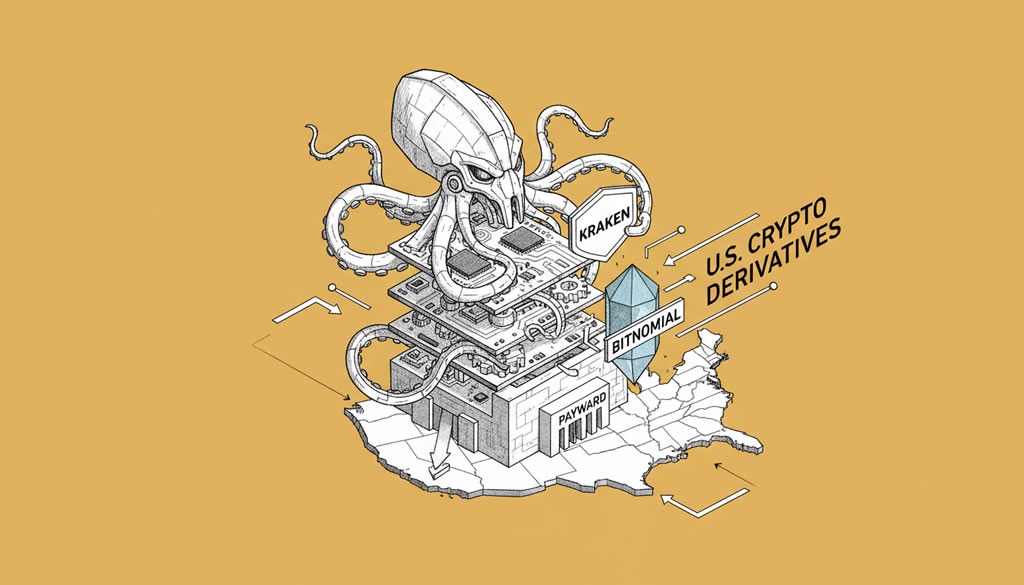
Payward, the parent company of cryptocurrency exchange Kraken, has completed its acquisition of Bitnomial, marking a significant step toward offering a full range of CFTC-regulated crypto derivatives to U.S. clients.
The transaction, first announced in April, closed recently, giving Payward control over the first fully CFTC-licensed crypto-native derivatives stack in the United States. Bitnomial holds key licenses including a Futures Commission Merchant (FCM), Designated Contract Market (DCM), and Derivatives Clearing Organization (DCO).
According to a company statement, this infrastructure “enables Payward to bring CFTC-regulated spot margin, perpetuals and options to eligible U.S. clients on Kraken and NinjaTrader.” Arjun Sethi, co-CEO of Payward and Kraken, noted that the rollout will start with spot margin services, with perpetual futures and options to follow. “That stack is what makes the next set of products possible,” Sethi said.
Bitnomial, a Chicago-based platform, has been a pioneer in listing new assets under U.S. regulation, such as Aptos futures. Post-acquisition, it will continue operating within Payward while retaining its licenses and third-party businesses. Payward plans to expand the team to build out its U.S. derivatives offerings.
The deal, valued at up to $550 million in cash and stock (valuing Payward’s equity at $20 billion), aligns with the company’s broader strategy. This includes a $200 million investment from Deutsche Börse Group and confidential IPO preparations. Payward already operates regulated derivatives businesses in the UK and EU.
The move addresses a long-standing gap for U.S. crypto participants, reducing reliance on offshore platforms for derivatives trading. It also opens channels for partners like banks and brokerages to offer compliant products to their clients.
Industry observers see this as strengthening Kraken’s position in a maturing regulatory environment, potentially accelerating institutional adoption of crypto derivatives while maintaining compliance. No financial terms of the final closing were disclosed.
Disclaimer: This article is for informational purposes only and does not constitute advice of any kind. Readers should conduct their own research before making any decisions.