


It’s late February 2026. Headlines flash U.S.-Israeli strikes on Iranian targets. On X, Reddit, and Telegram, the phrase “World War 3” explodes across crypto feeds. Santiment’s social-volume tracker lights up like a siren.
Yet something counterintuitive happens next.
Bitcoin, after an initial sharp dip, begins to rebound. Institutional ETF inflows accelerate. Meanwhile, classic safe-haven gold surges higher. The crowd screams fear. The data whispers opportunity.
This is the “World War 3” premium in action — and it is quietly rewriting what it means to be a safe-haven asset in 2026.
Safe-Haven Assets in a Fractured World
A safe-haven asset is simple in theory: something that holds or gains value when everything else falls apart. For centuries, that role belonged to gold. It has no counterparty risk, cannot be printed at will, and people have trusted it through wars, empires, and currency collapses.
Bitcoin was born with the same promise. Satoshi Nakamoto’s 2008 whitepaper arrived during the Global Financial Crisis. The genesis block even carried a headline about bank bailouts. From day one, Bitcoin positioned itself as “digital gold” — scarce, borderless, and outside any government’s control.
But theory meets reality in crises. And the reality in 2026 is more nuanced than the early hype suggested.
Lessons from History: Fear Has a Pattern
Every major geopolitical shock since Bitcoin’s birth has followed the same emotional arc.
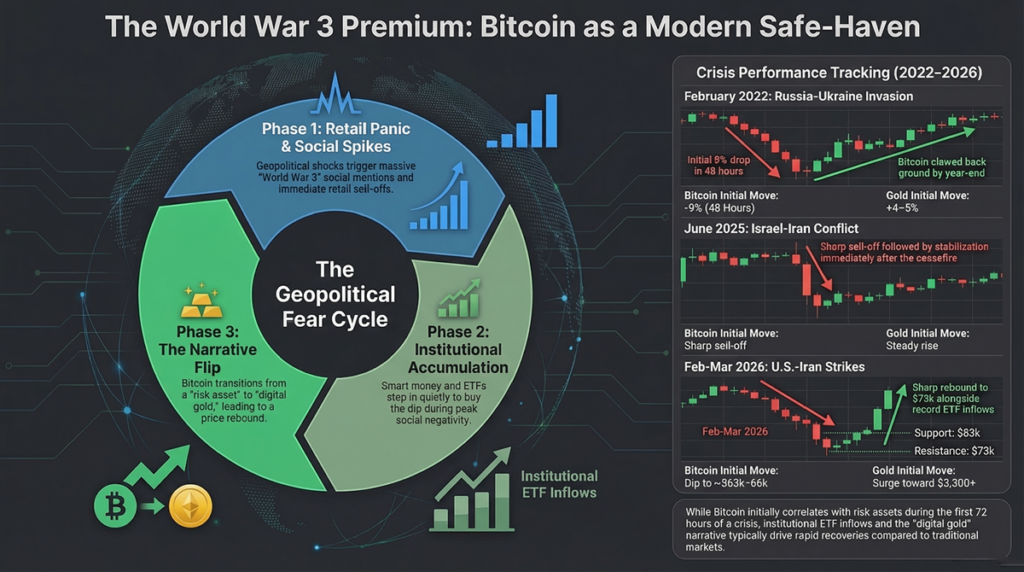
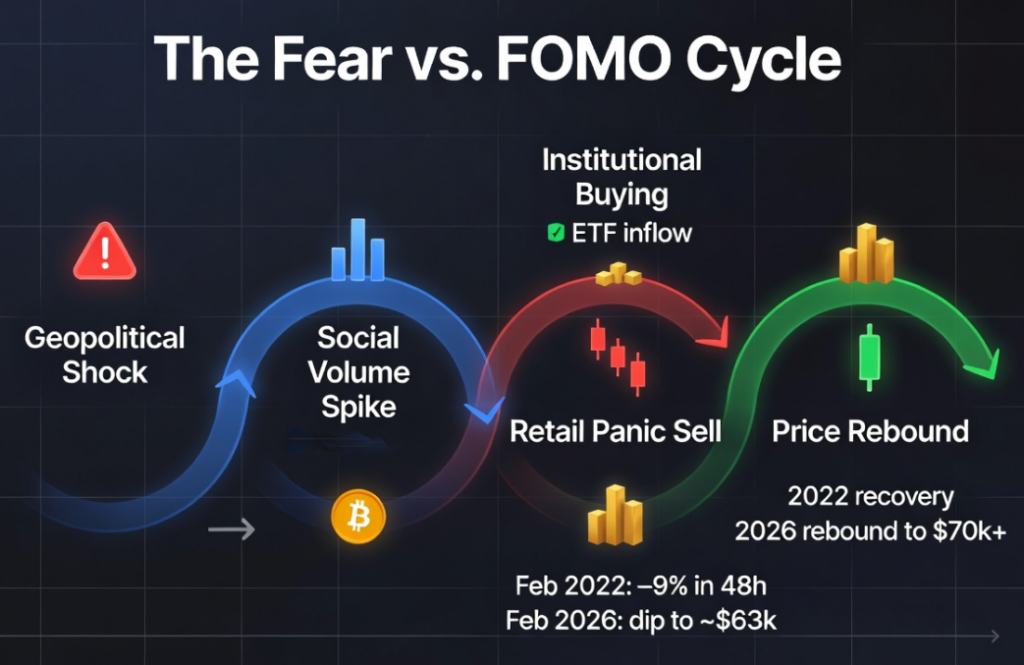
When Russia invaded Ukraine in February 2022, Bitcoin dropped nearly 9 % in the first 48 hours as investors sold everything for cash. Gold rose. Then, within weeks, Bitcoin began its recovery while traditional markets stayed shaky. By year-end it had clawed back significant ground.
Fast-forward to June 2025. Israel and Iran traded direct strikes. “World War 3” mentions on crypto social media hit a prior peak. Bitcoin sold off hard — then stabilized faster than many expected once the ceasefire took hold.
Now, February-March 2026. Fresh U.S.-Israeli strikes trigger the highest “World War 3” chatter since that episode. Bitcoin dips again (reports placed it briefly around the $63,000–$66,000 zone), only to rebound sharply toward $70,000–$73,000 while ETF inflows surged.
The pattern is consistent: peak social negativity often marks the local bottom.
The Fear vs. FOMO Cycle Explained
Crypto markets run on two emotions: Fear and FOMO.
- Fear phase — Geopolitical headlines hit. Retail traders panic-sell. Social mentions of “World War 3” spike. Liquidity dries up. Bitcoin correlates briefly with equities and Nasdaq.
- Capitulation — When even the most optimistic voices go quiet, selling exhausts itself.
- Institutional accumulation — Smart money (ETFs, corporations, long-term holders) steps in quietly during the dip.
- FOMO rebound — The narrative flips. Bitcoin is once again “digital gold in uncertain times.” Prices climb.
Santiment has documented this cycle for years. Extreme crowd bearishness on social platforms has preceded some of the strongest rebounds on record. The March 2026 spike is textbook.
Bitcoin and Gold: Correlation Shifting in Real Time
The old story was simple: Bitcoin = digital gold. The 2026 data tells a more sophisticated tale.
| Event | Bitcoin Initial Move | Gold Initial Move | Key Difference |
|---|---|---|---|
| Russia-Ukraine (Feb 2022) | –9 % in 48 hrs | +4–5 % | Gold immediate safe haven; BTC recovered faster long-term |
| Israel-Iran (June 2025) | Sharp sell-off | Steady rise | 12-day conflict; BTC stabilized post-ceasefire |
| U.S.-Iran strikes (Feb–Mar 2026) | Dip to ~$63k–66k | Surge toward $5,300+ | BTC rebounded with ETF inflows; gold continued classic rally |
Bitcoin’s short-term correlation with risk assets remains higher than gold’s. It still behaves like a high-beta tech stock during the first 72 hours of panic. Yet the speed and strength of its rebounds — driven by spot ETF inflows and global liquidity expectations — are turning it into something new: a conditional safe haven.
Gold wins the pure crisis hour. Bitcoin is winning the “next six months” narrative.
Real-World Impacts: Beyond Charts
For citizens in high-inflation or sanctions-hit countries, this isn’t abstract.
In Argentina — where I’ve written before about stacks of devalued pesos and people rushing to buy goods before prices rise again — geopolitical fear accelerates the same flight to hard assets. Bitcoin wallets in emerging markets ticked up noticeably during the February 2026 spike. Remittance corridors and savings accounts in unstable regions treat BTC as portable, seizure-resistant value.
Institutional players notice too. BlackRock, Fidelity, and other ETF issuers reported accelerated inflows precisely when retail sentiment hit its darkest. The “World War 3” premium created a discount that professional capital happily bought.
Challenges: Why Bitcoin Isn’t (Yet) Pure Digital Gold
Honesty matters. Bitcoin still carries risks gold does not:
- Volatility — A 10 % daily swing is normal; gold rarely moves more than 2 %.
- Equity correlation — In acute liquidity crunches, everything correlated to stocks sells first.
- Regulatory overhang — Government responses to global conflict could include tighter crypto rules.
- Energy perception — Proof-of-work mining still draws criticism during energy-security debates.
These limitations explain why gold remains the undisputed king of immediate crisis protection. They also explain why the narrative is reshaping, not collapsing.
Reshaping the Safe-Haven Narrative
The “World War 3” premium reveals a maturing market. Bitcoin is no longer sold as a perfect replica of gold. It is evolving into a complementary asset:
- Gold for the first 72 hours of panic.
- Bitcoin for the months-long uncertainty that follows.
- Both together for true portfolio resilience.
Institutional adoption (ETFs, corporate treasuries, nation-state interest) is the catalyst. When fear peaks and retail capitulates, the big money treats the dip as a liquidity event — not an existential threat.
Future Outlook
Geopolitical tensions will not disappear. If anything, a multipolar world makes them more frequent. Each new shock will test the same cycle:
Peak fear → social-volume spike → dip → institutional accumulation → rebound.
The data suggests the rebounds grow stronger as Bitcoin’s market cap matures and liquidity deepens. The safe-haven narrative is not dying; it is upgrading from hype to evidence-based strategy.
What This Means for You
If you are a long-term holder, the message is clear: extreme social negativity is rarely the time to sell. It has historically been the time to stay calm — or even add on weakness if your risk tolerance allows.
Diversify intelligently. Hold some physical or digital gold for pure crisis insurance. Hold Bitcoin for its asymmetric upside in prolonged uncertainty. Keep cash for immediate liquidity.
And above all, remember the cycle. Fear sells newspapers and fills timelines. History shows the strongest hands buy when the crowd is loudest about “World War 3.”
Ready to go deeper? Subscribe to Cryptopress.site for more evergreen guides on Bitcoin, safe-haven strategies, and real-world crypto adoption in uncertain times. Explore our related deep dives: “Inflation: This is what US$2,000 looks like in Argentina” and “Bitcoin as a Hedge in Emerging Markets.”
The world feels fragile right now. But the data — and history — suggest that fear, once again, is creating the next opportunity.
Stay informed. Stay patient. Stay sovereign.