


Could there be a blockchain where transactions confirm in the blink of an eye?
No more waiting for confirmations during peak hours or paying exorbitant fees for simple swaps. This is the promise of MegaETH, an emerging Ethereum Layer 2 (L2) solution that’s positioning itself as the “first real-time blockchain.” In a world where Ethereum’s mainnet still grapples with scalability limits, MegaETH aims to deliver over 100,000 transactions per second (TPS) with sub-millisecond latency, making decentralized applications (dApps) feel as responsive as centralized web services.
Launched amid growing demand for faster, cheaper Ethereum alternatives, MegaETH draws inspiration from Ethereum’s core principles while optimizing for performance. As an EVM-compatible L2, it settles transactions on Ethereum for security but handles execution with unprecedented efficiency. This article dives deep into what MegaETH is, its technical foundations, real-world applications, challenges, and future implications. Whether you’re a beginner curious about blockchain scaling or an intermediate user exploring L2 options, we’ll break it down step by step, using relatable analogies like comparing blockchain nodes to specialized factory workers on an assembly line.
By the end, you’ll understand why MegaETH has garnered attention from figures like Ethereum co-founder Vitalik Buterin and how it fits into the broader crypto ecosystem. Let’s explore this innovative project that’s redefining Ethereum’s potential.
Core Explanations
To grasp MegaETH, we must start with its roots in Ethereum’s scaling challenges. Ethereum, the second-largest blockchain by market cap, revolutionized smart contracts but often suffers from congestion, leading to high gas fees and slow confirmations. Layer 2 solutions like MegaETH build on top of Ethereum (Layer 1) to offload processing while inheriting its security.
Historical Origins
MegaETH’s story begins in 2022, when founder Yilong Li conceptualized a high-performance L2 to address Ethereum’s limitations. Li, with a background in technology and blockchain (as per his LinkedIn profile), aimed to create a chain that could match Web2 speeds—think instant Amazon checkouts or real-time gaming updates. Development kicked off in mid-2024 following a successful seed round.
Key milestones include:
- June 2024: Raised $20 million in seed funding from investors like Dragonfly, Figment Capital, and Robot Ventures.
- December 2024: Secured an additional $10 million.
- February 2025: Launched “The Fluffe,” a 10,000-supply soulbound NFT collection to raise up to $27 million more, bringing total funding to around $57 million.
This funding is modest compared to other L2s like Blast or zkSync, which raised hundreds of millions, but it’s seen as efficient amid anti-VC sentiment in crypto communities. The project echoes ideas from Vitalik Buterin’s 2021 “Endgame” blog post, which discussed centralized block production for efficiency while maintaining decentralization elsewhere.
Technical Breakdown
At its core, MegaETH is an EVM-compatible blockchain that uses Ethereum for settlement and data availability (potentially via EigenDA). What sets it apart is its focus on hardware optimization and node specialization, pushing performance to hardware limits.
Here’s how it works step by step:
- Transaction Submission: Users send transactions to the network, similar to other Ethereum L2s.
- Sequencer Role: A single active sequencer (run on high-end servers) orders and executes transactions. This eliminates consensus overhead during execution. The sequencer stores the entire blockchain state in RAM, avoiding slow SSD reads—analogous to keeping all your tools on a workbench instead of fetching them from storage.
- Proof Generation and Verification: Provers generate proofs for transaction validity, while full nodes verify these proofs and update the state. Full nodes require lighter hardware, promoting wider participation.
- State Synchronization: MegaETH optimizes this by grouping Merkle Tree leaves into subtrees, reducing data recomputations and bandwidth needs.
- Settlement: Batched transactions are posted to Ethereum, ensuring security via proof-of-stake.
This heterogeneous execution model addresses the “straggler problem” in parallel computing, where slow nodes drag down the system. By specializing nodes—sequencers for heavy lifting, full nodes for verification—MegaETH achieves current block times of 10 milliseconds, with a target of 1 millisecond.
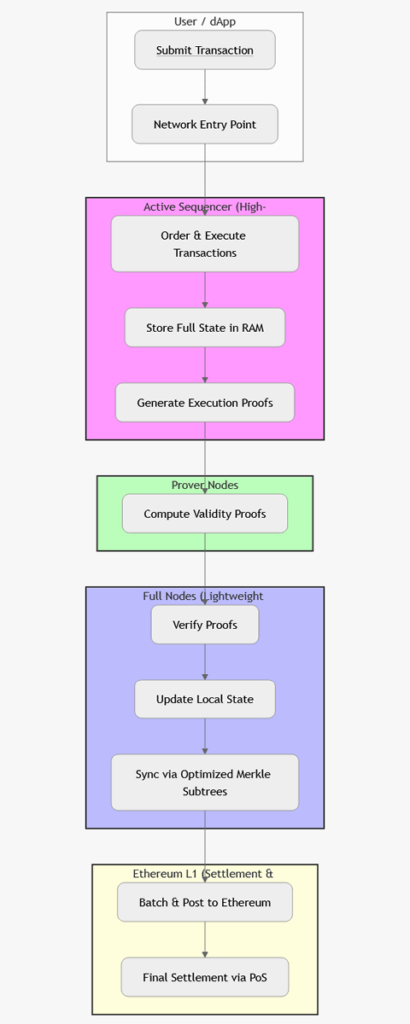
Performance metrics include:
- TPS: Over 100,000
- Latency: Sub-millisecond (target)
- Block Time: 10ms current, 1ms goal
For comparison, here’s a table summarizing MegaETH vs. other L2s (data from MegaETH research and CoinMarketCap):
| Blockchain | TPS (Claimed) | Block Time | Funding Raised |
|---|---|---|---|
| MegaETH | 100,000+ | 10ms (1ms target) | ~$57M |
| zkSync | ~2,000 | ~1s | $458M |
| Blast | ~1,000 | ~2s | $20M (initial) + more |
| Scroll | ~3,000 | ~3s | $80M |
This table highlights MegaETH’s edge in speed, though with lower funding.
Applications and Examples
MegaETH’s real-time capabilities open doors for applications requiring instant feedback, beyond simple transfers.
Real-World Use Cases
- DeFi (Decentralized Finance): High-frequency trading or flash loans could execute in real-time, reducing slippage. For instance, a DEX on MegaETH might handle thousands of swaps per second without delays, similar to centralized exchanges like Binance.
- Gaming: Play-to-earn (P2E) games could feature seamless in-game economies. Imagine trading NFTs mid-game without lag, as seen in projects like Axie Infinity but amplified.
- Social and Metaverse: Real-time interactions in virtual worlds, where avatar movements or chats sync instantly.
Early examples include its NFT fundraiser, “The Fluffe,” which sold out phases quickly, demonstrating community interest. While not yet live on mainnet, testnet demos show dApps running with Web2-like responsiveness.
Case Study: In a hypothetical rollout, a DeFi protocol on MegaETH could outpace competitors on slower L2s, attracting liquidity providers seeking low-latency yields. Historical parallels include Optimism’s success in scaling DeFi, but MegaETH aims higher.
[Insert Graph: Ethereum L2 TPS Comparison – A line graph showing TPS trends for MegaETH (projected), zkSync, and Arbitrum over time. Description: Illustrates MegaETH’s superior projected throughput based on research data.]
Challenges and Risks
No innovation is without hurdles. MegaETH faces technical and market challenges.
Technical Challenges
- Achieving 1ms Latency: Current 10ms is impressive, but hitting 1ms requires flawless hardware optimization. Network congestion could still cause delays.
- Decentralization Trade-offs: Relying on a single sequencer raises centralization concerns, though mitigated by Ethereum settlement. Solutions include rotating sequencers or decentralized proofs.
Market and Community Risks
- Funding and Adoption: With only $57M raised, it lags behind well-funded rivals. The NFT mint drew criticism as a “cash grab” due to its 1 ETH (~$2,800) cost and whitelist requirements.
- Competition: The L2 space is crowded with Optimism, Arbitrum, and Base. Failure to deliver could lead to user exodus.
- Regulatory Risks: As with all crypto, evolving global regulations could impact operations.
Societal impacts include enhanced financial inclusion via faster, cheaper transactions, but risks like centralization could undermine trust. Economic effects: Lower fees might democratize DeFi, but volatility in token launches remains.
Practical Advice: If interested, monitor the testnet via megaeth.xyz (official site from GitHub). Use compatible wallets like Trust Wallet for interactions. Always DYOR (Do Your Own Research) before investing.
Future Outlook
Looking ahead, MegaETH’s roadmap focuses on mainnet launch and token distribution. Post-NFT phases, expect the MEGA token airdrop (at least 5% to holders, increasing with NFT “evolution”). Partnerships with dApp developers could drive adoption.
In the broader ecosystem, MegaETH could accelerate Ethereum’s shift to modular scaling, influencing L2 standards. If successful, it might inspire similar optimizations in other chains, fostering a more efficient crypto economy. However, grounded in facts, its success hinges on delivering promised metrics without compromising security.
Societal implications: Faster blockchains could enable global real-time finance, empowering unbanked populations in emerging markets like Argentina. Economic impacts include reduced barriers for developers, potentially sparking innovation waves.
Conclusion
MegaETH represents a bold step toward making Ethereum as fast and user-friendly as traditional apps, with its specialized architecture and real-time focus setting it apart in the L2 landscape. From its 2022 origins to ongoing funding via innovative NFTs, it embodies the evolution of blockchain scaling. While challenges like execution risks persist, its potential for DeFi, gaming, and beyond is compelling.
For beginners, start by exploring Ethereum basics on Cryptopress.site. Intermediate users: Test MegaETH’s features on its testnet and consider wallet integrations for future involvement.