

NVIDIA is one company. On a public blockchain it is several tokens.
stocksonchain.io’s snapshot on 17 September 2026 counted 1,006 stocks and 3,411 token listings across five issuers and five chains. NVIDIA alone showed on the order of 200,000 “owners” once the copies were added together. SpaceX, which has no New York listing, still had eleven issuers and sixteen chain deployments on Asortino the next day. The book is wide in tickers and narrow in names.
The headline size depends on who is counting. Asortino, refreshed 18 September 2026, printed about $3.1 billion of tokenized stocks and ETFs. RWA.xyz, the same day, printed $2.91 billion of “distributed” value and $25 million of “represented” value — its word for synthetic exposure it is willing to split off. The Block, in mid-August, had the category near $2.8 billion and 15 percent of tracked real-world-asset value, triple the share at the start of the year. A year earlier the same pile was tens of millions.
Those figures are not the New York Stock Exchange. They are a map of wrappers, notes, certificates, broker-dealer claims, and a thin front of issuer-recognized shares. Most of them trade when the cash session is closed. Most of them are blocked to U.S. persons. On 17 September 2026 the Securities and Exchange Commission issued a five-year “Innovation Exemption” that tries to pull a different object — a token with the same rights as the listed share — onto permissioned automated market makers in the United States. The party that already exists and the lane the SEC just opened are not the same room.
This is a map of what is being traded, where it lives, what a holder owns, and which numbers look like use. Readers in the United States, Canada, China, Hong Kong, and Singapore sit on different sides of the same product.
The product is older than this cycle. The size is not.
Tokenized stocks have failed in public before. Mirror died with Terra. FTX listed tokenized shares and took the books with it. Binance offered stock tokens in 2021 and pulled them. Perpetual venues still sell price exposure without calling the contract a share.
What changed in 2025–2026 is not the idea. It is 1:1 backing claims, multi-chain mint-and-redeem, weekend DEX books, and the habit of holding a U.S. name in a self-custody wallet next to a stablecoin. Backed Finance’s xStocks, later tied to Kraken’s parent, put hundreds of U.S. stocks and ETFs on Solana, Ethereum, and BNB Chain as Jersey tracker certificates. Ondo issued a parallel book of total-return notes. Binance launched bStocks in mid-June 2026 onto BNB Chain and was competing for second place by value within weeks. Robinhood opened an Arbitrum-based layer-2 on 1 July 2026 for Stock Tokens in more than 120 countries — not the United States. Dinari opened 724 names, including the S&P 500, to eligible U.S. investors on 4 August 2026.
The plumbing is simple enough to sketch and easy to over-read.
An issuer, or a broker behind the issuer, buys (or already holds) the listed share. It mints a token when someone pays, usually in a dollar stablecoin. It burns the token when someone redeems. Between those two events the token can move on a public chain, sit in a DEX pool, be posted as collateral, or idle in a wallet. Dividends, if they exist, arrive as a rebase, a multiplier, a USDC airdrop, or a cash stablecoin payment. Votes, if they exist at all, are the exception.
That last sentence is the whole argument of 2026. Price exposure is easy to tokenize. The share bundle — vote, notice, dividend as a legal right, a place in the issuer’s books — is not.
Three stacks under the same ticker
Call the ticker NVDA, TSLA, or BABA. The token in the wallet is one of three designs.
As shown in the diagram: stack A is most of today’s volume. Stack B is the U.S. custodial experiment. Stack C is the object the SEC exemption is written around.
Stack A is a tracker, a note, or a certificate. xStocks are Jersey tracker certificates from Backed Assets (JE) Limited, backed 1:1 by shares in custody. Ondo’s tokens are total-return notes; the holder has a security interest in collateral, not a seat at the meeting. Robinhood’s on-chain Stock Tokens are Jersey debt securities. Redemptions settle in cash. The papers allow the backing shares to be lent; when they are, cash or other instruments stand in and the votes travel with the borrower. Binance bStocks are ADGM certificates. Across the stack the token should track the share, dividends are often reinvested after withholding, and there is no vote.
Stack B is a broker-dealer plus a transfer agent. Dinari’s dShares are the live example. U.S. access opened in August 2026 for eligible investors: custodial model, NBBO-linked execution, dividends that can land in USDC. Closer to the share’s cash flows. Still a product. Fensory’s August comparison still recorded no meeting votes on the dShare itself.
Stack C is an issuer-recognized share. Securitize and Superstate’s Opening Bell sit here: the company or its transfer agent treats the chain as part of the cap table. Galaxy’s tokenized GLXY is the research-desk example. Catalogs are small; names can be large. RWA.xyz on 18 September had Securitize at $303 million and Superstate at $37 million — tiny next to Ondo, legally a different animal from a Jersey tracker.
The SEC order published on 17 September 2026 is written for stack C, and only for secondary trading. Tokenized Securities Venues get a five-year, conditional pass from the Exchange Act definition of an “exchange” so they can run permissioned automated market makers in tokenized NMS stock. Liquidity providers in those pools get a parallel pass from the “dealer” definition. The token must carry the same rights as the listed share. Contracts must be public on a permissionless ledger. Access must be gated. The venue must be a U.S. person, post a thirty-day notice, halt when the listing exchange halts, and keep a machine-readable tape. Third-party tokenization needs issuer notice and a window to object. Galaxy and Backpack both read synthetic exposure, linked securities, swaps, and SPV wrappers as outside the lane. Robinhood’s current debt tokens do not qualify on that reading. Neither do xStocks or Ondo’s notes if they remain claims on an issuer rather than the share.
That is not a ban on stack A. It is a statement that the United States just drew a line through the party and labeled one side “innovation” and the other side “something else.”
Who issues what — and who is allowed to buy it
The five products that dominate conversation are not five flavors of one instrument.
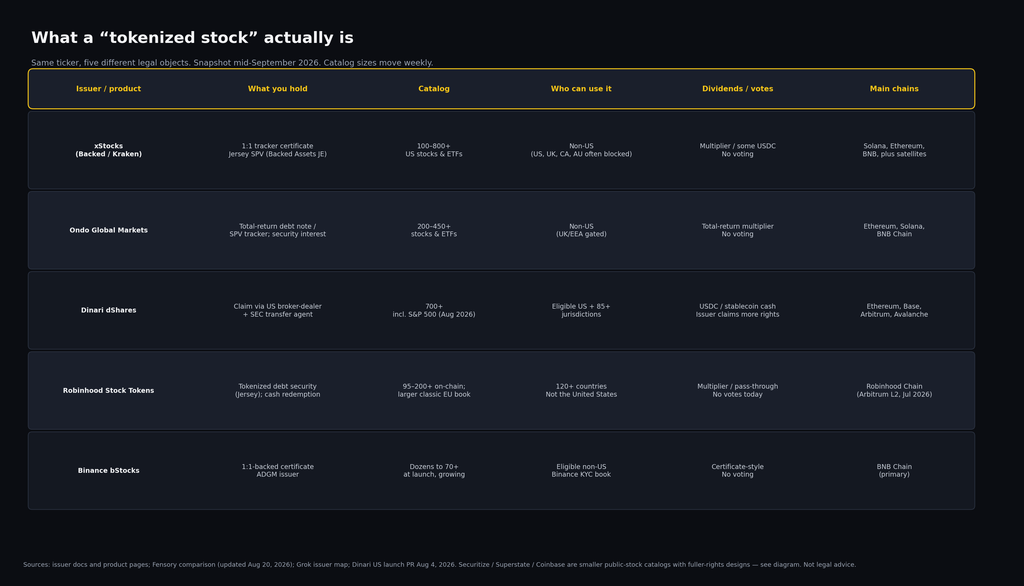
xStocks and Ondo are the non-U.S. default. Both exclude U.S. persons on the large books, and in many venues the United Kingdom, Canada, and Australia as well. Singapore and Hong Kong readers are often inside, subject to the front-end. China-linked names have not been a Backed specialty. Dune work in 2026 put most of that DEX volume on BNB through Ondo, not on Solana through xStocks.
Dinari can say “eligible U.S. investor” without flinching: 724 names in August, S&P 500 included, USDC from a self-custody wallet. Size has not followed. Asortino had $21 million. RWA.xyz had $12 million. A regulated door can be open and still small.
Robinhood wins on distribution and weekends — 120-plus countries, not the United States. CoinDesk’s July read put tokenized-equity flow under a tenth of Robinhood Chain DEX volume. By September the company was citing about $170 million of Stock Token TVL and tens of billions of chain DEX volume. Those are not the same number.
Binance bStocks are the summer’s fastest certificate book, which is why BNB Chain leads some value rankings. Securitize, Superstate, Figure, WisdomTree, Backpack, and Coinbase’s Base deployments are the long tail. Ignore them and you miss stack C. Treat them as the market and you miss Saturday.
Rankings: value, flow, holders — pick the column
A single “tokenized stock market cap” is a marketing sentence. The useful picture is three columns that refuse to agree.
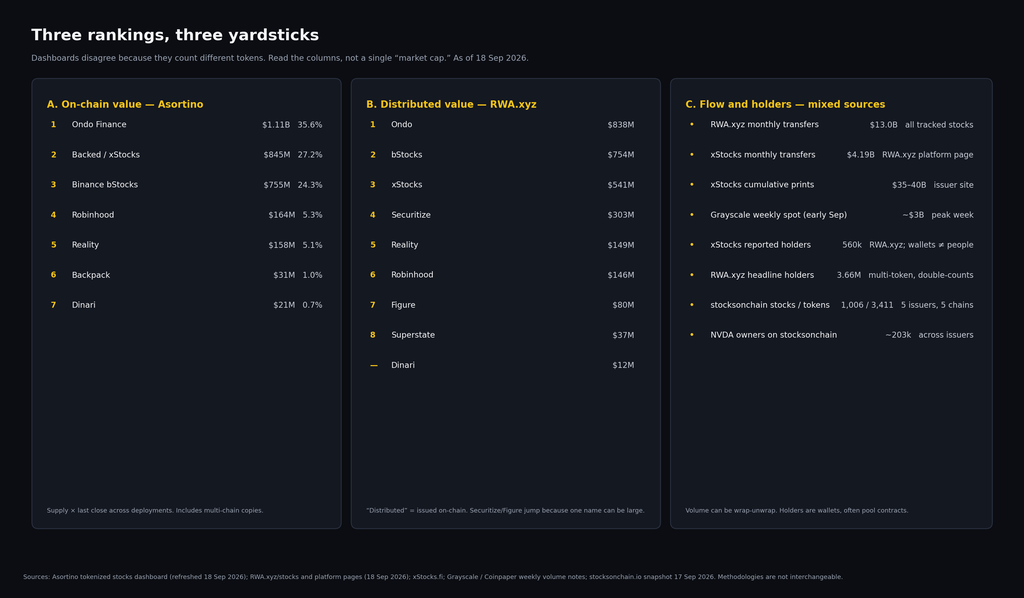
On Asortino’s 18 September cut, Ondo held $1.11 billion (35.6 percent), Backed/xStocks $845 million (27.2 percent), Binance $755 million (24.3 percent). Those three were 87 percent of the dashboard. Concentration, an HHI of 2,660, is the design, not an accident.
RWA.xyz’s distributed-value table the same day told a different second sentence: Ondo $838 million, bStocks $754 million, xStocks $541 million — then Securitize at $303 million and Figure at $80 million. Those last two barely register on a dashboard that treats every xStock deployment as the product. They register here because a registered security and a tracker are being allowed to share a list.
Flow is noisier than stock. RWA.xyz printed $13.0 billion of monthly transfers on 18 September. xStocks alone showed $4.19 billion of monthly transfers, 560,290 holders, and an issuer-site claim of $35–40 billion of cumulative volume. Grayscale put weekly spot near $3 billion at the loud peak. Robinhood Chain has printed weekend equity sessions above $1 billion while U.S. cash markets were shut.
A holder is a wallet, a pool, or a contract. RWA.xyz’s headline 3.66 million holders is not 3.66 million people. The same person with NVDAx on Solana, NVDAon on BNB Chain, and a Dinari dShare on Base is three holders. Protocol-owned liquidity is a holder. A CEX hot wallet is a holder.
The volume-quality caveat belongs next to every ranking. CoinMarketCap’s June study watched SpaceX tokens jump to the top of bStocks within days of listing. That is demand. It is also a reminder that the category mixes S&P 500 float with a private-company wrapper that would not live on Nasdaq. A mint, a DEX hop, and a redeem in the same afternoon is activity. It is not a new shareholder.
Where the tokens live
Chain share is not a beauty contest. It is a record of which issuer picked which rail, and which user base showed up.
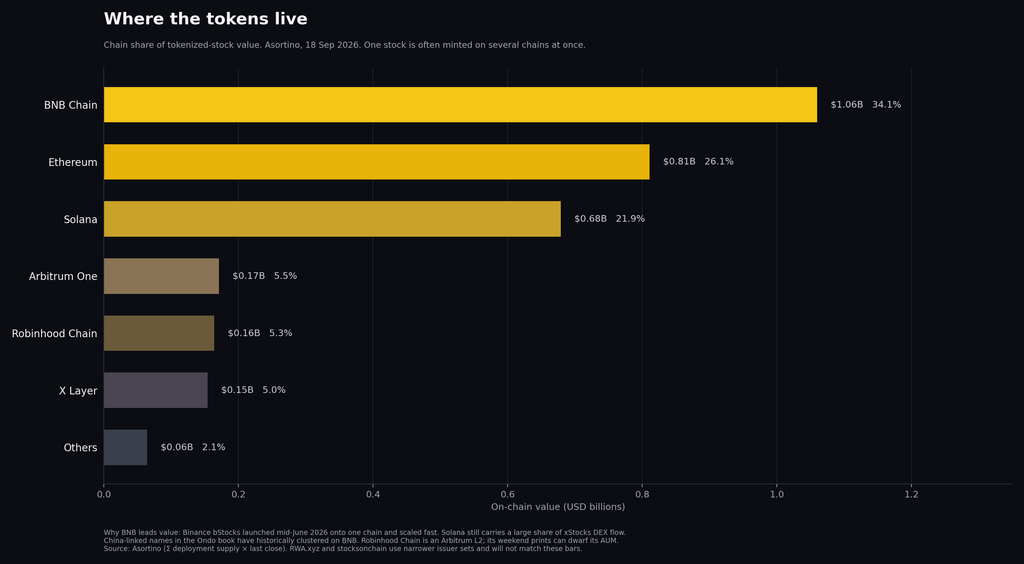
Asortino on 18 September: BNB Chain $1.06 billion (34.1 percent), Ethereum $811 million (26.1 percent), Solana $679 million (21.9 percent), then Arbitrum One, Robinhood Chain, and X Layer around five percent each. Nineteen chains appear in that header. Five appear in stocksonchain’s registry. One dashboard prices every deployment it can see. The other reads a tighter issuer set.
The BNB lead is recent. bStocks went live around 10–11 June 2026. Put a certificate on the chain where the users already are and the value ranking moves before the legal ranking does. Solana’s reputation as “the tokenized stock chain” is an xStocks story about DEX flow and DeFi collateral — Crypto Briefing, on 18 September, put xStocks-related DeFi deposits in the tens of millions against roughly $845 million of on-chain AUM, about ten percent utilization. Most of the certificates are sitting, not working.
Ethereum still hosts several of the more cautious designs. Base is Dinari’s and Coinbase’s neighborhood. Robinhood Chain is Robinhood’s. ICE has spent a year testing Avalanche for a NYSE-linked platform without naming a chain; tZERO is a design partner. DTCC received an SEC no-action letter in December 2025 to tokenize assets it already holds. That is the institutional back office. It is not the weekend book.
For a reader in China, Hong Kong, or Singapore, chain is venue. China-linked ADR volume has sat on BNB through Ondo. NVDA and TSLA exist on Solana, Ethereum, and BNB at once, at three prices, with three dividend rules. That is a fragmented order book wearing a familiar ticker.
What supports this market — and what would weaken it
The market is not “worth” $3 billion because $3 billion of companies moved on-chain. It is worth whatever people will pay for a token that tracks a share they cannot, or would rather not, hold at a broker during hours the broker is closed. Several supports are visible. So are the things that pull them out.
Access and hours. U.S. cash equities still close. A token on Solana or Robinhood Chain does not. Weekend sessions are the product. Force the book back into cash-session hours and you remove the reason many holders showed up.
Catalog breadth. Hundreds of names beat ten. When the book is NVDA, TSLA, MSTR, CRCL, and a private SpaceX wrapper, the category is a theme park. Watch whether new listings are S&P float or celebrity private names.
Redemption that works. A 1:1 claim is a sentence until someone burns the token and receives cash or the share at a published price. Instant mint-and-redeem against a broker book is a different machine from a certificate you can only exit on a thin DEX. Pegs break when the redeem window closes.
The legal object is the fourth, and it just moved. The exemption does not ban stack A. It makes stack C the only design that can walk into a U.S. permissioned AMM and call itself tokenized NMS stock under that order. Issuer objections would narrow stack A’s U.S. future. Issuer-sponsored tokens would give stack C a catalog. Superstate’s Robert Leshner said he expects products to be rebuilt to conform. Dinari’s Gabo Otte called the line around rights the point. Robinhood’s Johann Kerbrat called the exemption a signal that tokenization is ready for the United States — a statement about a future product, not a blessing of the current debt token.
Custody and lending terms are the fifth. If the shares behind a token can be lent, the vote is somewhere else and the backing on a given day may be cash. Robinhood’s own final terms already say that. A market that sells “1:1 backed” without publishing when the 1 is a share and when the 1 is collateral is selling a mood.
What weakens the market is the inverse of those five: geo-fences that tighten rather than loosen, a redeem desk that pauses, a rule that treats the popular wrappers as swaps, a weekend book that is only one private name, and a custody stack that cannot prove the share is there on a Tuesday.
Canada sits in an awkward middle. Many of the large books treat it like the United States and the United Kingdom: out. Hong Kong and Singapore sit in the other middle: often in, with local offering rules still attaching to the front-end, not to the token contract. Mainland China does not get a clean on-chain U.S. cash equity. It gets ADRs and offshore names through whichever issuer will list them, mostly on BNB. Those four sentences will move more of the map than any chain rebrand.
Which signals look like real use — and which look like rotation
Use leaves a residue. Rotation leaves a print.
Residue: holders still there thirty days after a listing week; mint and redeem that match secondary volume; dividends arriving in USDC or as a published multiplier; collateral that is not immediately looped back into the same ticker; a transfer-agent screen that shows the wallet as shareholder of record. xStocks in DeFi, Dinari’s USDC dividends, Superstate’s on-chain transfer agent — those are residue. They can be small. Small and real is not the same as large and circular.
Rotation: a private name taking a majority of a venue’s value in a week; a handful of wallets hopping the same inventory across three issuer tokens; Asortino’s mid-September median product at about $29 with a long right tail; chain DEX volume sold as “stock volume” when the mix is memecoins; holder spikes on three chains the week a CEX lists the wrapper, then a flatline.
The honest near-term indicators are boring, which is why they work.
Watch TSV thirty-day notices, and whether an issuer objects. Watch whether Robinhood, Ondo, or Backed publish a stack-C redesign rather than a quote. Watch whether Dinari’s U.S. door fills. Watch mint/redeem as a share of transfers. Watch whether the top five tickers keep eating the book. Watch Canada, the United Kingdom, and the EU for copycat exemptions or for bans that treat stack A as a derivative. Watch Hong Kong and Singapore for stack-C listings, not only offshore certificates.
None of that is a price target. It is the difference between a rail and a weekend casino with familiar tickers.
The risks that survive the brochure
Legal classification is not a footnote. A tracker, a debt note, a swap, and a registered share are four answers. Most buyers see one ticker. The exemption makes that gap expensive in the United States. Elsewhere it is a terms-of-service problem until a local regulator decides it is not.
Peg and redemption. Twenty-four-hour tokens on a five-day underlying will gap. They already do. If the redeem window is shut, the DEX is the whole market, and the DEX does not owe you the cash session.
Custody and lending. “1:1 backed” can mean backed by the share, or backed by whatever the prime borrower posted. Robinhood’s final terms already allow the second. Read the sentence after the headline.
Issuer objection. The thirty-day window is headline risk for third-party wrappers that want a U.S. future. AMC’s fight with Robinhood over a tokenized listing was the social preview. The order turns it into process.
Concentration and geography. Three issuers, a dozen tickers, one private-company cluster. Tokens sit on public chains; the right to hold them does not. A wallet in Toronto and a wallet in Shenzhen are not the same counterparty.
Operations and the pilot. Multipliers can be late or wrong. The exemption runs five years, with a comment file and promised rulemaking. Building a U.S. business only on stack A and calling it the Innovation Exemption is a category error.
What the next year of this market would actually look like
A serious U.S. on-chain equity market would not look like last Saturday’s DEX print. It would look like a TSV notice, a permissioned pool on a public chain, a token the issuer does not object to, a halt that mirrors Nasdaq, and a holder who can vote. DTCC, Nasdaq, ICE, and the exemption are pieces of that picture. They are not the picture yet.
Offshore, the market already looks like a catalog fight: Ondo, xStocks, and bStocks competing on names, fees, redeem speed, and who they still serve. Singapore and Hong Kong are the cleanest large Asian on-ramps. Canada is mostly outside. Mainland access stays indirect.
Count stack-C value, TSV notices, mint/redeem as a share of volume, whether the top ten tickers lose share, whether Dinari’s door grows, and whether Robinhood’s next token is still debt. If those series move toward rights and a broader book, the party is becoming a market. If only weekend volume moves, you already know that chart. It is a Saturday.
Key takeaways
- “Tokenized stock” is not one product. It is a tracker, a note, a certificate, a broker-dealer claim, or — rarely — an issuer-recognized share.
- Broad dashboards put the category near $3 billion in mid-September 2026. Narrower ones print less. Both can be honest.
- Ondo, Backed/xStocks, and Binance dominate value. Securitize and Superstate dominate the fuller-rights conversation. Dinari is the U.S. custodial door and is still small.
- BNB Chain leads some value rankings because bStocks arrived there. Solana still carries a large share of xStocks flow. Robinhood Chain is loud on weekends and smaller in stock.
- Most large books exclude U.S. persons, and often Canadians. Hong Kong and Singapore are usually inside the offshore catalogs. China-linked volume has clustered on BNB.
- The SEC’s 17 September 2026 Innovation Exemption is a five-year, permissioned, same-rights lane for secondary trading. It is not a blessing of synthetic wrappers.
- Watch TSV notices, issuer objections, mint/redeem ratios, catalog breadth, and whether any major wrapper is rebuilt to carry votes. Those are signals. Saturday volume is not, by itself.
A ticker is a nickname. The rights are the product. The last year made it cheap to put the nickname on a chain. The next year will show how many issuers are willing to put the rights there too.
Subscribe for more research like this: https://cryptopress.substack.com/subscribe