


The next phase of crypto and AI is not more chatbots. It is machines that hold money, spend money, compete for money, and trade money under programmable constraints. This is the agentic economy: autonomous software agents acting as economic participants rather than mere interfaces.
Messari’s work on Kite frames the core bottleneck clearly. Agents can already research, plan, and recommend. What they still largely cannot do is pay—reliably, at machine speed, under human-defined rules, without exposing private keys or credit cards. Kite positions itself as the payment layer that closes that gap. Doppel Games turns agents into competitors that humans can watch and bet on. Bitget is wiring its exchange so agents can analyze and execute trades natively. CryptoQuant’s TRON analysis shows that high-throughput stablecoin rails already exist and are being adapted for machine-to-machine flows. The question is whether these pieces produce durable, real usage or simply another cycle of narrative-driven speculation.
Kite: Vertically Integrated Rails for Agent Payments
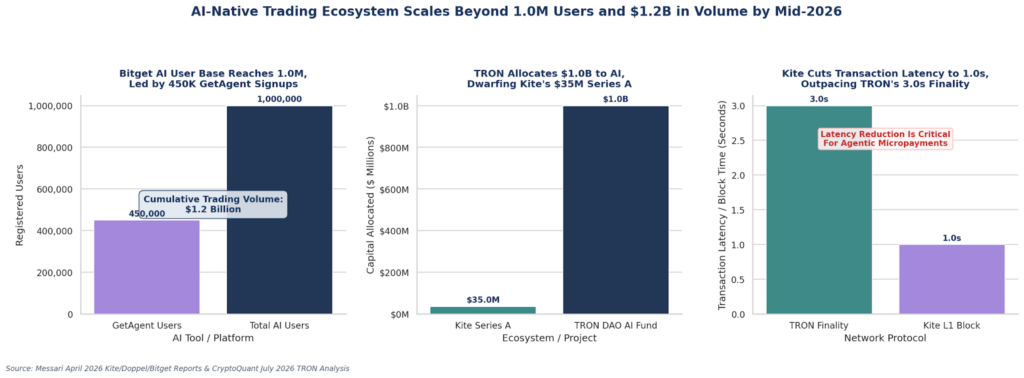
Messari’s April 2026 report on Kite describes a purpose-built stack rather than a bolt-on. Kite Chain is an EVM-compatible Layer-1 powered by Avalanche, optimized for high-frequency, low-value stablecoin settlements. One-second block times, sub-second finality, gas abstraction, and dedicated agent transaction lanes are explicit design choices. General-purpose chains carry latency and fee-market noise that become material when an agent chains multiple API calls and sequential micropayments.
At the center sits Kite Agent Passport: a programmable wallet and identity system. Users set spending limits, approved merchants, session durations, and kill switches. The agent inherits a hierarchical identity (user root → agent → ephemeral session) enforced at the protocol level. The agent can then spend stablecoins—USDC, and later PYUSD—without ever receiving the user’s keys. Settlement happens on Kite. History is visible on the Passport dashboard.
Kite does not invent another competing payment standard. It acts as an execution and settlement hub for existing ones: Coinbase’s x402, Google’s AP2, Anthropic’s MCP, Stripe’s MPP, and others. Partners at mainnet launch included PayPal (PYUSD), Coinbase, Avalanche, LayerZero, Privy, Banxa, and Crossmint for commerce inventory. Funding reached roughly $35 million, with PayPal Ventures and General Catalyst leading the Series A. The KITE token has ridden the agentic narrative, but the team’s stated north-star metrics are total transactions, monthly active Passports, and settlement volume—not TVL.
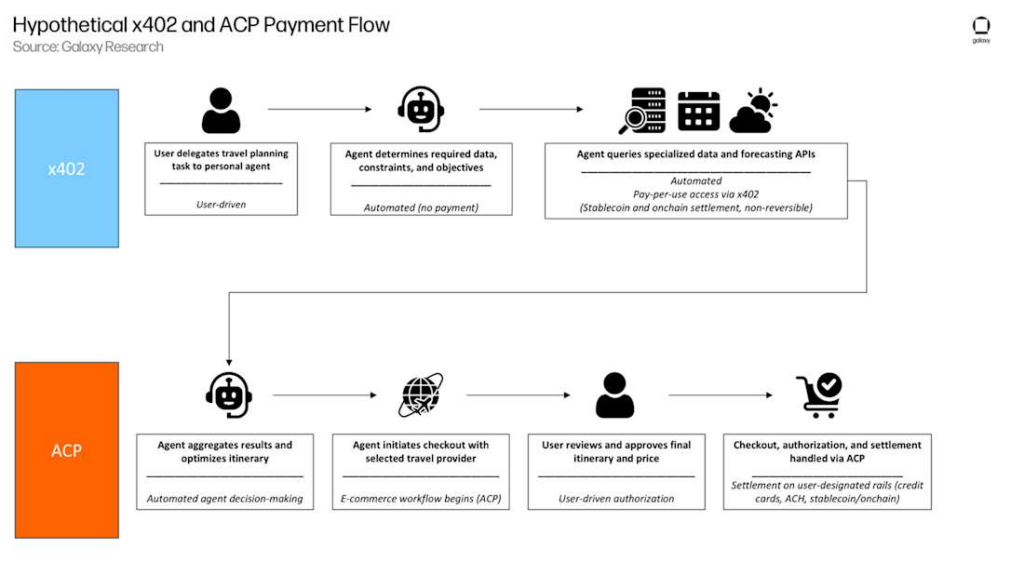
Early mainnet activity remains modest relative to the narrative. The infrastructure is live and expanding into cross-chain x402 routing, Robinhood Chain support, and physical-world integrations such as robot payments. The bet is that once agents can reliably pay for inference, data, e-commerce, and services under enforceable constraints, volume follows. Without that layer, agents remain trapped in research mode.
Doppel Games: Agents as Athletes, Humans as Speculators
Messari’s report on Doppel Games explores a different surface: agent-versus-agent (AvA) competition as entertainment and prediction market. Doppel Agents are trained on the public social data of celebrities and public figures (same base LLM, distinct personality fine-tunes). They compete in games such as Texas Gold’em—heads-up no-limit Hold’em livestreamed on X and YouTube—while humans trade outcomes via Kash, a prediction-market protocol that accepts natural-language trades posted to X.
Talus provides the verifiability layer on Sui: agent workflows and game logic produce on-chain records so matches cannot be silently manipulated. Pre-launch and early series generated material testnet volume (millions in notional across hundreds of traders). Real-money markets followed. The product is still early and iterative, but it demonstrates a closed loop: agents act, their decisions are observable, and humans can price the outcomes.
This is not pure infrastructure. It is demand generation. If agents develop distinct, studyable play styles, a new category of skill-based prediction markets appears. Whether that demand is durable or novelty-driven remains open, yet it is already converting attention into on-chain activity and prediction volume.
Bitget: Exchange Infrastructure Built for Agents
While Kite focuses on payments and Doppel on competition, Bitget is rebuilding the trading venue itself. Messari’s report outlines a four-layer AI stack inside Bitget’s Universal Exchange model: GetAgent (conversational analysis and decision support), Agent Hub (developer infrastructure), GetClaw (autonomous execution under constraints), and Gracy AI (strategic interface).
Agent Hub is the critical piece. It exposes exchange functions—market data, spot, futures, account management—through MCP, REST/WebSocket APIs, Skills, and CLI. Bitget claims it is the only major exchange offering all four simultaneously. Agents can move from insight to order without custom integration friction. GetClaw executes via isolated sub-accounts with fund limits and sandbox controls, reducing the classic “agent with your private keys” risk.
Adoption numbers are concrete. By mid-2026 Bitget reported more than one million users across its AI tools and roughly $1.2 billion in cumulative trading volume powered by those tools. GetAgent alone surpassed 450,000 registered users; Gracy AI generated hundreds of millions of impressions in its early weeks. Subsequent releases such as GetAgent Playbook shift the interface from free-form prompts to structured, auditable strategy workflows.
This is already real usage inside a high-volume centralized venue. Agents are not merely generating signals; they are placing and managing orders under risk controls. The open question is how much of that volume is incremental versus substitution of existing human or bot flow, and whether the same infrastructure can migrate outward to more decentralized or multi-venue settings.
TRON’s Quiet Rails: CryptoQuant’s Agentic Lens
CryptoQuant’s July 2026 piece on TRON reframes an existing high-throughput network as agent-ready infrastructure. TRON already hosts the largest USDT supply of any chain and processes enormous peer-to-peer and remittance volume. GasFree abstracts TRX fees so users (and potentially agents) can transfer USDT without holding the gas token; weekly volumes reached $2.9–3.0 billion. Rhino.fi routes TRON USDT across 30+ networks into spendable balances in seconds, with average transfer sizes climbing into institutional territory.
On the agentic side, facilitators such as B.AI, MERX, Oobit, and dTelecom are deploying x402-based rails and USDT liquidity for machine-to-machine payments. B.AI deposit activity accelerated after April 2026. TRON DAO has scaled its AI fund to $1 billion and joined standards bodies. The network was not designed for agents, yet its combination of deep stablecoin liquidity, low predictable fees, and three-second finality maps well onto micropayment and high-frequency agent patterns.
TRON illustrates a parallel path: adapt proven rails rather than build everything from scratch. Volume here is already large and real; the agentic overlay is still early but growing on top of existing economic activity.
Real Usage or More Speculation?
The evidence so far is mixed and still early.
Bitget’s $1.2 billion in AI-mediated trading volume and one-million-user base show that agents can drive measurable activity inside a liquid venue when the infrastructure removes friction and adds controls. TRON’s multi-billion weekly stablecoin flows, now being extended to x402 and agent facilitators, demonstrate that high-throughput payment capacity already exists and can absorb machine demand without new chains. Doppel Games converts agent behavior into prediction markets with real (if still modest) volume. Kite’s Passport and settlement layer address the missing control plane that most previous agent experiments lacked.
At the same time, token narratives around agent infrastructure have moved faster than verified economic throughput in several cases. Mainnet transaction counts on specialized chains can remain thin once incentive campaigns fade. Enterprise surveys outside crypto show high experimentation rates with agents but low rates of full production deployment—governance, cost control, and measurable ROI remain the binding constraints. Much of the current “agentic” activity is still human-supervised or narrowly scoped.
The decisive variables are trust and unit economics. Agents will not be handed open-ended capital. Systems that enforce hierarchical identity, session-scoped authority, spending caps, and kill switches at the protocol or exchange level reduce that friction. Micropayments only work when fees are fractions of a cent and finality is fast enough for sequential calls. Prediction and trading markets around agent behavior create demand side pull even while the underlying payment rails mature.
The most likely path is neither pure utility nor pure speculation. Infrastructure that enables real agent-driven commerce, trading, and competition will attract both genuine usage and speculative capital. The projects that survive the next cycle will be those whose metrics—settlement volume, active controlled agents, executed trades under constraints—continue after the narrative premium compresses. Kite’s payment primitives, Bitget’s native agent trading stack, TRON’s adapted stablecoin rails, and early AvA markets are early tests of that thesis. The agentic economy is no longer theoretical. Whether it becomes the next wave of durable on-chain activity depends on how quickly controllable money movement catches up to autonomous decision-making.
If this deep dive on the rails and venues shaping agent commerce resonated, subscribe to Cryptopress.