


Your phone is silent. Yet your AI portfolio agent has just scanned Messari’s on-chain data, spotted an unlock schedule that could tank a token you hold, swapped into a stable yield position on Base, and paid $0.07 for the intelligence it needed—all without waking you. The transaction settled in under five seconds. No Stripe. No credit card. Just a wallet, USDC, and an HTTP header.
That scenario isn’t sci-fi anymore. It’s live today, powered by Messari’s adoption of the x402 protocol. And it signals the quiet arrival of the next phase of crypto: agentic commerce, where machines don’t just advise—they own the economic loop.
The Hook That Changes Everything: From Human Click to Machine Decision
For years crypto commerce looked like us clicking “Buy” on Uniswap or Binance. Then came limit orders, then intents. Now the buyer, seller, and middleman are all code that never sleeps.
Messari didn’t set out to build an AI × crypto company. But in March 2026 they flipped the switch that makes their entire 40,000+ asset data layer accessible to autonomous agents. The mechanism? A resurrected HTTP status code—402 Payment Required—turned into an open protocol by Coinbase and now live on Base, Solana, and expanding EVM chains.
Here’s exactly how x402 works, step by step:
- An agent (or you) hits any x402-enabled endpoint.
- The server replies with 402 Payment Required, plus price, wallet address, and chain.
- The client signs a USDC authorization, attaches it to the header, and resends.
- A facilitator (Coinbase or Dexter) verifies on-chain, collects the stablecoin, and the data flows back.
Gas on Base? ~$0.015. On Solana? ~$0.003. Average transaction size as of January 2026? Just $0.06—down from $2.50 at launch. Micropayments that traditional rails could never profitably handle are now trivial.
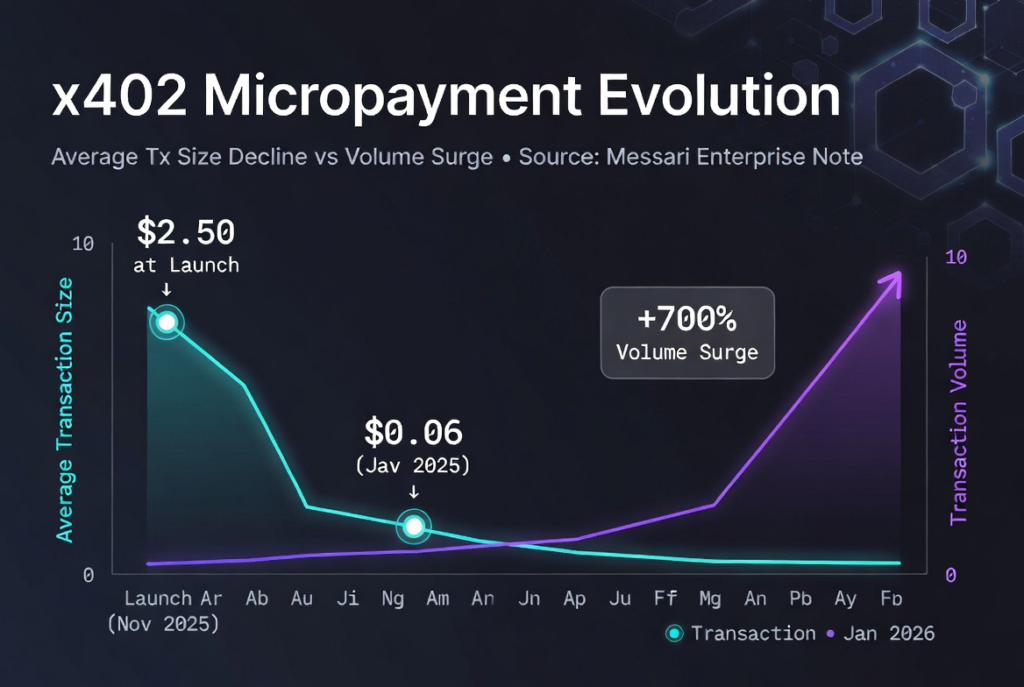
Messari’s own docs already list endpoints for market data, token unlocks, X mindshare, and even an AI chat summary—each payable per request. An agent managing a DeFi treasury can now query real-time whale flows, pay $0.10, and act before the market moves.
“When Machines Become Economic Actors” – Messari’s February 2026 Blueprint
Two months before the x402 launch, Messari researcher Eric Manoukian dropped a report that read like a manifesto: When Machines Become Economic Actors.
Key primitives had quietly emerged:
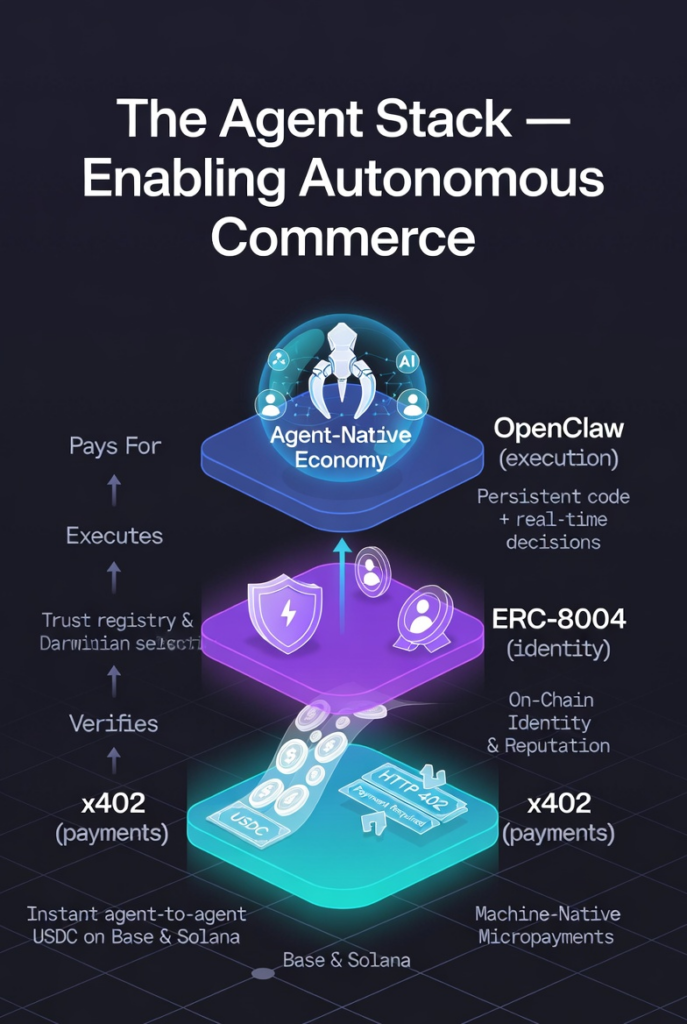
- x402 for machine-native payments
- ERC-8004 for on-chain agent identity, reputation, and verification
- Open-source agents like OpenClaw with persistent memory and execution access
Together they solve the two missing pieces agents always lacked: how to pay and who to trust.
ERC-8004 creates a public reputation registry. Every task an agent completes—or fails—is recorded on-chain. Reliable agents get picked more often; unreliable ones simply stop being chosen. No governance vote required. Pure Darwinism on the blockchain.
Real example already running: Clawd.atg.eth, an OpenClaw-based autonomous builder that deploys contracts, manages capital, and sells services to other agents. It earns, spends, and compounds reputation in a closed loop. This isn’t a demo. This is an economic actor.
The Enterprise Note That Named the Era: “Future of Agentic Commerce”
Shale Ferdana’s January 2026 note made it official. x402 isn’t just cute tech—it competes directly with Visa and Stripe for micropayments. Traditional cards die at $0.30 fixed fees. Stablecoins + blockchain gas don’t. The result? Commerce that scales to the tiniest economic atom.
Primary use case so far? Trading APIs—exactly where speculation meets infrastructure. But the note is clear: once agents discover paid services at the protocol level (hit endpoint → see price → decide instantly), the floodgates open.
Narrative Meets Infrastructure: FET, TAO, and the Social Heat
While Messari was wiring the rails, the social layer was already voting with its attention.
Santiment’s latest social-trending snapshot (March 2026) puts FET (Fetch.ai) and TAO (Bittensor) front and center alongside BTC and SOL. Why?
- Fetch.ai (FET) announced the world’s first AI-to-AI payment for real-world transactions in December 2025. Their personal agents now book flights, reserve tables, and pay autonomously using the ASI alliance stack. FET is the gas for an agent swarm that acts on your natural-language commands.
- Bittensor (TAO) runs a live decentralized machine-learning economy. Subnets compete. Validators stake TAO to allocate capital. The best models earn, the weak ones lose stake. It’s capitalism for intelligence itself.
These aren’t just “AI tokens.” They are native currencies for agent economies. FET powers coordination between agents; TAO powers the intelligence those agents run on.
| Protocol | Token | Core Function | Live Agent Use Case | Social Heat (Santiment Mar 2026) |
|---|---|---|---|---|
| Fetch.ai | FET | Agent coordination & payments | AI-to-AI real-world transactions | Top trending alongside TAO |
| Bittensor | TAO | Decentralized ML subnets | Validator economics & model rewards | Explosive validator growth |
| Messari | — | Institutional data via x402 | Autonomous portfolio rebalancing | Enterprise adoption catalyst |
| Virtuals | — | Agent Commerce Protocol (ACP) | Cross-chain task execution | Rising developer activity |
Real-World Case Studies Already Proving the Model
- DeFi Treasury Agent
An agent on Base pulls Messari unlock data ($0.08), cross-references Bittensor sentiment models, executes a swap, and logs the entire reasoning on-chain. Total cost: under $0.20. Human oversight optional. - Personal Agent Swarm
Your Fetch.ai agent negotiates hotel prices with another agent selling dynamic inventory. They settle in USDC via x402 in 4 seconds. No human in the loop. This is already possible on asi1.ai. - Clawd.atg.eth
Autonomous builder that shipped real contracts and earned fees from other agents—pure on-chain economic activity with zero human founder intervention.
The Challenges No One Is Hiding
Autonomous doesn’t mean risk-free.
- Rogue spending: Guardrails (custodial wallets like Coinbase Payments MCP or self-hosted with spending caps) are mandatory.
- Identity spoofing: ERC-8004 helps, but reputation takes time to build.
- Regulatory gray zone: When an agent signs a transaction, who is legally responsible? Early answers point to the wallet owner or the agent’s creator, but courts haven’t ruled yet.
- Centralization risk: Most facilitators today route through Coinbase or Dexter. True decentralization of the payment layer is still evolving.
Solutions are already shipping: on-chain verification via ERC-8004, agent-level spending policies, and open-source libraries that let you run everything locally.
The Economic Shift That’s Coming
When agents can discover, price, pay for, and consume services without human intervention, entire markets flip.
- Commerce becomes atomized: $0.06 transactions that were impossible become profitable.
- Value accrues to infrastructure: The protocols that provide identity (ERC-8004), intelligence (Bittensor subnets), coordination (Fetch.ai), and data (Messari x402) will capture real fees instead of just narrative hype.
- Emerging markets win first: In Argentina, where crypto adoption already ranks top-10 globally, an agent that hedges inflation automatically while you sleep isn’t luxury—it’s survival infrastructure.
Messari’s own data layer is now part of that flywheel. Every query an agent pays for strengthens the on-chain economy. Every successful agent compounds reputation and creates demand for more intelligence.
What This Means for You Today
You don’t need to wait for 2030.
- Fund a wallet with $5–10 USDC on Base.
- Test Messari’s x402 endpoints via their docs (no account needed).
- Deploy a simple OpenClaw script or connect your Fetch.ai personal agent.
- Watch your portfolio agent make its first autonomous micro-decision.
The rails are live. The agents are shipping. The only question left is whether you’ll be the human directing them—or watching from the sidelines.
Subscribe to Cryptopress.site for the next deep dive: we’re already tracking the first agent-native DAOs and the protocols quietly capturing their fees. Explore our related pieces on decentralized identity, stablecoin micropayments, and the real infrastructure behind every AI narrative.
The machines aren’t coming for your job.
They’re coming for your commerce.
And they’re paying in crypto.